
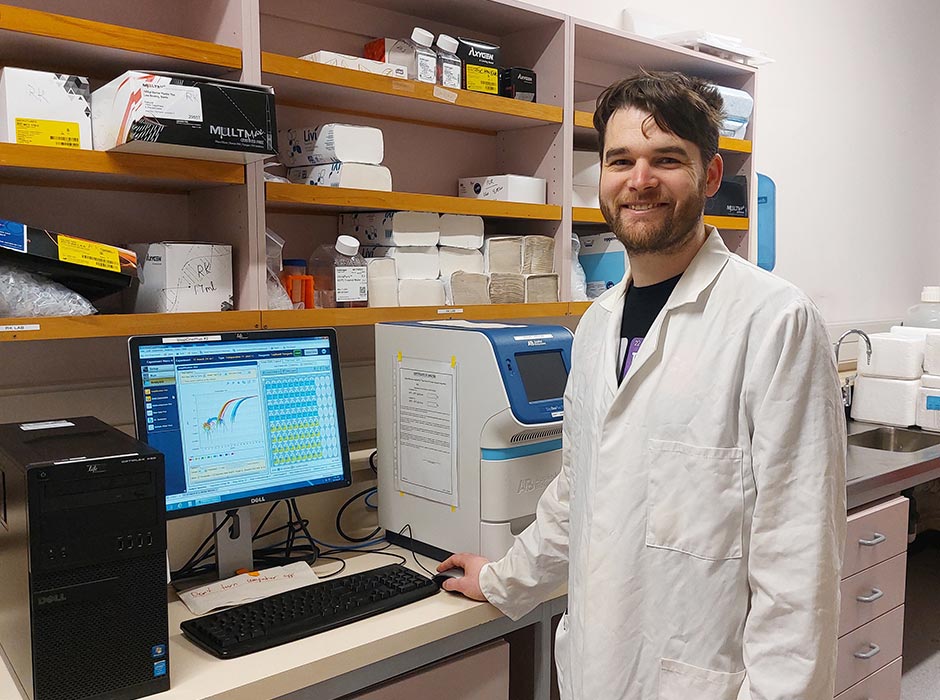
Otago School of Biomedical Sciences PhD graduate Matt Reily-Bell in the Otago Department of Physiology.
An important lesson PhD candidate Matt Reily-Bell learnt from his university studies was that the things that you struggle with the most are also the things you learn the most from.
Matt graduates from the University of Otago on 23 August with a Doctor of Philosophy based in the Department of Physiology; his research investigating novel therapeutic tools for cardiovascular disease.
Matt’s journey through University was full of meeting challenges head-on, not just in his studies and research projects, but also due to dyslexia.
Although Matt was a high achiever in maths, the reading and writing disorder meant English was a struggle – to the point that spelling his own name at age 10 was an achievement.
For his final English school exam, his teacher suggested writing about a topic he liked. Ironically, researching then writing about genetic engineering not only helped him pass the final hurdle but also highlighted a passion for science and provided clarity for his options beyond school.
Opting for university studies was choosing a harder path, but Matt enrolled in the genetics programme at Otago in 2014.
Shifting to Dunedin from Otamatea Christian School in the small Northland town of Maungaturoto was a big deal.
“There were potentially more people in the St David Lecture Theatre than there were in my hometown,” he recalls.
Matt quickly found science subjects did in fact include a lot of writing. But while there is good exam support at Otago for people with reading and writing difficulties, Matt made a choice not to use them; instead, figuring out how to manage each new challenge in his own way.
He says the fact that his disorder was picked up early by his mother, combined with persistence, patience, and practical help, set him up with invaluable coping strategies.
“I broke it down into identifying what was needed and built pictures and diagrams from the ground up followed by practice – lots of practice. I know not accepting exam support was stubborn and created extra work for myself, but I needed approaches to work through problems beyond the education system and into the workplace.”
Matt got the hang of science studies and embraced campus life. He played sports, was active in the Dunedin City Baptist campus community, took up tabletop role-playing, and became a founding member of the hobby enthusiast outlet Hobby Lords.
“I loved that there were so many opportunities not available in small towns, and that I met people with similar interests. You can really find your community here.”
He did two summer studentships at Otago and loved both – one with Emeritus Professor Andrew Mercer looking at how a specific virus evades the immune system, and another with Associate Professor Caroline Beck investigating the use of a South American herb to manage epilepsy.
He taught and tutored in the genetics and neuroscience programmes and the Department of Physiology, passing on his experiences and strategies to students with learning difficulties or who had English as a second language. “Helping others by talking about how I work through a problem was actually one of my highlights at Otago,” he says.
After completing a Bachelor of Science, he started an Honours project modelling developmental syndromes in frogs, with Associate Professor Louise Bicknell and Associate Professor Caroline Beck, which then progressed into a Masters.
All these experiences helped him to see the science he enjoyed the most was one that had practical outcomes like a product or tool, which helped to focus his PhD studies towards helping people.
His PhD project with Professor Rajesh Katare, started in August 2020 after the first Covid-19 lockdown, worked on cardiovascular research. His thesis looked at novel therapeutic tools to modulate dysregulated microRNAs (miRNAs) – small regulatory molecules in the body - in diabetic heart disease.
Novel therapeutic approaches that target miRNAs are emerging as promising global strategies to address several different health conditions. These miRNAs are not well controlled in people with diabetes so the research project investigated if targeting them could also be a strategy for managing diabetic heart disease, a major problem that claims many thousands of lives a year.
The project focused on two aspects: investigating a tool potentially more specific for the regulation of miRNA, and establishing a new protocol to encapsulate microRNA therapeutics into lipid nanoparticles.
Matt is currently writing up the results on the new delivery technique they developed. Both he and Rajesh believe this discovery is a major first step in more accurate delivery, and the genomic tool could be the foundation for other researchers to develop new treatments for diabetic heart disease.
During his studies, Matt also reached other life milestones, including getting married and having a child. He now works for life sciences company AD Instruments in Dunedin and is currently rewriting teaching modules for their physiology curriculum.
Matt says he’s pleased to be working in research. “Given the dyslexia challenges I’ve had, there is obvious irony in rewriting a teaching curriculum. But actually, I like that it’s turned struggle into a strength. I’m hoping that the skills I’ve developed will set me up for an exciting career in research and academia.”
~ Kōrero by Claire Grant, Communications Advisor, School of Biomedical Sciences
Study Physiology at Otago
Understanding human physiology, the study of how our bodies work at the molecular, cellular, and organ systems levels, is a key part of knowing ourselves.
Find out more