
Q&A with Lachie Scarsbrook 2025 20Twenties Young Alumni Award winner
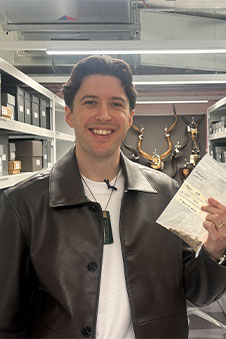 Recently making global headlines for his discovery that dogs existed 5,000 years earlier than previously known, Lachie says he’s always been obsessed by the idea of new discoveries, be it prospecting for gold or searching for elusive animals.
Lachie graduated from Otago with a BSc majoring in Geology and Zoology in 2018, and a MSc with Distinction in Zoology in 2021. He also supported Hands-On at Otago for many years and was an RA in his second year (Cumberland College).
He recently completed his DPhil at Oxford (Merton College) on a Clarendon Scholarship and is now a Junior Research Fellow (Somerville College) undertaking postdoctoral research in palaeogenomics. In 2023, he was named as one of four Merton Prize Scholars.
Lachie uses ancient DNA to investigate the role that humans and the environment have played in shaping global animal populations. During his MSc at Otago, he co-developed a new method of DNA extraction that avoids damaging small and fragile ancient bones. As part of this work, he described a new species of gecko, which was named through collaboration with local Māori iwi (Te Āti Awa).
Lachie’s current research is unravelling the 20,000-year history of humans and their closest evolutionary companion, dogs.
How did you react when you heard you had received the award, and what does it mean to you?
I was genuinely surprised, and incredibly honoured. I don’t consider myself much of a trailblazer, so it was a real privilege to be recognised alongside so many inspiring recipients.
Receiving this award also gave me the chance to reflect on just how much my time at Otago shaped my career. I’d personally like to thank the incredible people who have supported me along my academic journey, from my classmates and friends to the reception staff, technicians, and lecturers. Every one of them played a part in nurturing my curiosity and helping me grow, and I genuinely wouldn’t be where I am today without their encouragement and support.
What path have you followed since graduation?
Ending up in academia was never part of my plan. I went to Otago to study Geology, dreaming of a lucrative career in the Australian gold mines. Instead, I fell in love with research, signed up for a Master's in Zoology studying long-dead lizards, and, well, the rest is (ancient) history.
When I finished my MSc, I was fortunate enough to receive a Clarendon Scholarship to undertake a DPhil at the University of Oxford. It was quite the culture shock. The scarfie lifestyle gave way to Oxford traditions, where wine and cheese tastings replaced flat parties, and my trackies never saw the light of day.
On a more serious note, moving to the UK completely transformed the scope of my research. I shifted from asking local questions about Aotearoa’s biodiversity to tackling global ones, working with collaborators around the world to understand the evolutionary history of our closest companion, the domestic dog.
Today, I’m even more multi-national, working as a postdoctoral researcher in Munich, and a Junior Research Fellow in Oxford. And while I may not have become a geologist, I think I still managed to strike gold.
What inspires and motivates you to work in the areas you are involved with?
I’ve always been obsessed with discovery. As a child, that meant spending countless hours outdoors, whether prospecting for gold or searching for elusive animals. These days, I channel that same curiosity into my research, where a day in the lab or analysing data on my computer could lead to a breakthrough discovery.
Most recently, I published a paper describing the earliest known dog remains anywhere in the world, pushing back the timeline of dog domestication by more than 5,000 years. You truly never know what stories ancient bones are waiting to tell. Better still, these discoveries often capture the public’s imagination, which feels like coming full circle. I can’t help but hope they inspire the next generation of explorers.
What are your plans for the future?
My long-term goal is to lead my own ancient DNA research group in the UK, focused on exploring the interactions between humans, animals, and the environment. I'm particularly interested in how the past can help us tackle some of today's biggest challenges, from restoring lost ecosystems to building resilience to climate change. But these big ideas need funding, so I'm currently spending plenty of time writing grant applications to help turn those ideas into reality.
I'm also working on strengthening connections between universities in Europe and those across the South Pacific (including Otago), as well as with Indigenous communities whose perspectives are often overlooked in global research. With so much left to uncover about humans and their canine companions, the dog days certainly aren’t over.
And in the even longer term, I'd love to bring everything I've learned, as well as the collaborations and networks I've built, back home to Aotearoa.
Tell us about the highlights of your time at Otago, and how it has influenced you in your career and following your interests?
The thing I loved most about my time at Otago was the culture, and its strong sense of community. Whether I was walking through the Department of Zoology or down Castle Street, there was always an open door (or bottle) and someone ready for a chat. I've tried to carry that same ethos with me throughout my career, whether it's mentoring students, or catching up with colleagues at the pub. After all, most of my best ideas and collaborations came outside formal meetings.
I was also a huge fan of a BYO, especially when it involved a butter chicken at the Taj Mahal!