

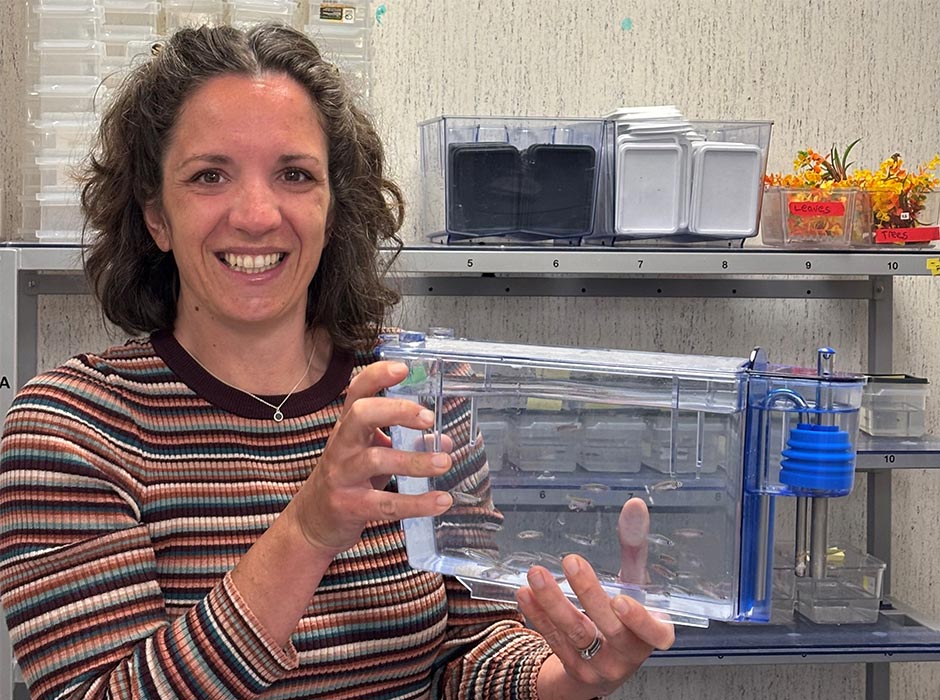
Professor Julia Horsfield, Head of the Faculty of Biomedical Sciences, set up a zebrafish research facility at the University Otago, which is now helping to shed light on genetic links in disease.
A modest grant for a bold idea led to a new frontier in biomedical research and helped launch a brilliant career. Professor Julia Horsfield and Dr Megan Leask (Kāi Tahu, Kāti Māmoe), of Otago’s Faculty of Biomedical Sciences, reflect on the value of exploratory research and the funding to enable it.
It was, Professor Julia Horsfield acknowledges, a “wild idea”.
But it was also a perfect case study to show how a large amount of curiosity – and a small amount of research funding – can lead scientists to exciting new places.
The funding, awarded back in 2015, was $150,000 through a Health Research Council (HRC) Explorer Grant, which enable researchers to test innovative and unconventional hypotheses.
And their hypothesis? That certain genetic variants in our so-called ‘junk DNA’ might have a larger role than we think in influencing genes involved in metabolic diseases such as gout.
“The project was picked randomly out of a pool of ideas that have to meet two criteria,” says Julia, a prominent developmental geneticist and Dean of the University of Otago’s Faculty of Biomedical Sciences.
“That was, was it transformative, or could it change the way we think? And then, was it doable? It turned out that this small programme ticked both boxes.”
The genetic variants in question had earlier been identified among non-coding regions of the genome: the areas of our genetic make-up that don’t build proteins we use to function but often provide ‘switches’ to control gene activity.
Julia recalled lively discussions with her friend and collaborator Professor Tony Merriman about whether those DNA variants were causative, or simply correlated, in disease.
“You're not proving anything by just finding these associations, so we thought, what if we actually tested what this variant is doing in non-coding DNA?”
They hired Dr Megan Leask, who had just finished her PhD, who delved into the genetic data to look for promising non-coding variants.
She then set up cell-line assays to see if the team’s target DNA variant made gene expression go up, switching on a gene more strongly, or down, dampening its activity.
Using a lab tool called a green fluorescent protein (GFP) reporter – a jellyfish-derived protein that glows bright green when a gene is switched on – the researchers were able to directly observe where the variant was active inside living zebrafish.
They knew that, if the variant really did play a role in gout, they’d see tell-tale signals within the fish’s kidney.
“Sure enough, a few of the variants that we picked in non-coding DNA turned out to express GFP in the kidney,” Julia says.
New frontiers in genetics
That study’s novel ‘combinatorial’ approach has proven the basis for further Otago-led research, shedding important new light on why genetic correlation in disease can sometimes appear causal.
As a prominent model in developmental genetics, the zebrafish has often been key to these discoveries, used by Horsfield and others as avatars for testing cancer drugs and advancing therapeutics since the 1990s.
Not only do these tropical fish share most of their genome with humans, their larvae are transparent – meaning researchers can watch cells divide, migrate and interact inside a living animal.
A simple fluorescent tag can light up immune cells as they swarm to a wound, or neurons as they fire in real time.
They’re also far cheaper and faster to raise than mammals. A single spawning produces hundreds of embryos that grow from one cell to a fully patterned organism in a matter of days.
“You can see a zebrafish embryo start as one cell and grow into a fully patterned animal in the space of a day or two, including developing the circulation and all of those structures that you need to be an animal,” Julia says.
“So, for the fundamental questions of biology, it’s a wonderful model animal.”
The gene-editing revolution surrounding CRISPR-Cas9 technology, she adds, has taken the zebrafish platform to a new level. What was once a difficult task – making precise genetic changes – is now a routine part of research.
Her lab can even cross zebrafish carrying mutations with those engineered to have ‘flashing’ neurons, letting them watch in real time how changes in DNA affect brain activity.
For Megan, meanwhile, the 2015 study not only helped launch a career that has since spanned fellowships, international collaborations, and now her own Otago-based lab.
As Julia puts it, it “created a new research area and gave Megan the opportunity to take it in her own direction”.
Dr Megan Leask, from the Department of Physiology, working in the University of Otago zebrafish facility. Megan’s research is looking at genetic variants associated with human health and diseases like gout.
After completing her PhD, Megan joined Tony's laboratory in 2018 with the support of a Lottery Health fellowship, sharpening her skills in complex disease and genetic association studies.
That led to an HRC Māori Career Development Award, and in 2020 an Emerging Researcher First Grant focused on Māori and Pacific genetic variants.
She then spent three years in the United States working alongside Tony at the University of Alabama at Birmingham, extending her expertise with Polynesian gout genetics.
It was a demanding but formative time that she says gave her confidence handling large datasets and forged international collaborations she still draws on.
Back in Aotearoa with her young family in 2023, Megan quickly secured a Rutherford Discovery Fellowship and a Marsden Fast-Start grant to establish her lab in Otago’s Department of Physiology.
Her group now investigates the genetics of complex diseases such as gout, chronic kidney disease and type 2 diabetes, with Māori and Pacific variation at the centre.
Zebrafish remain core to that toolkit, but the work now ranges from wet-lab assays to genome-wide association studies and computational approaches.
The lab has also begun adopting new tools, such as a ‘landing-pad’ transgenic zebrafish line brought in from the US, which allows researchers to test whether single-letter DNA changes alter gene expression without the noise of random insertion.
One PhD student is already using the model to revisit an earlier kidney signal first seen in 2015-16, to check if it holds up under tighter controls.
If successful, it could provide a template for testing not just big genetic hits, but the many subtle variants that together contribute to complex disease.
As Megan notes, this step makes it possible to screen potential variants much faster than before.
Scale on the data side is coming, too. Her group has been exploring collaborations that use machine learning to predict disease risk, including efforts to train polygenic scores for metabolic disease.
But algorithms can only learn from the data they are given: train them on Europeans, and the results will mostly reflect Europeans.
The team is now testing whether datasets from multiple populations produce better models for Māori and Pacific peoples, or whether those tools need to be built from Polynesian data at the outset.
“We don’t actually know the answers,” Megan says.
“So hopefully something comes from that in the next couple of years and that will direct us where we want to go next in terms of investing into more genetic data from Māori and Pacific peoples.”
The potential of ‘precision’ medicine
Megan's research now sits at the forefront of what is often called precision medicine: healthcare tailored to a person’s genetic make-up rather than relying on a one-size-fits-all model.
Overseas, genomic-guided treatment is already improving outcomes and reducing costs, but in New Zealand it cannot succeed without genetic data that reflects the whole population.
That gap is particularly acute for Māori and Pacific peoples, who remain under-represented in global genomic datasets.
Megan's programme is directly addressing this imbalance, working to ensure that future therapies and risk tools are designed with Māori and Pacific genetics in mind.
One recent study, published in HGG Advances, uncovered a genetic variant common among Māori and Pacific people that appears to boost levels of ‘good’ cholesterol: a finding not seen in any other population worldwide.
It underscored the importance of gathering and analysing local genomic data, which can reveal unique variants with direct implications for health.
Last year, Megan secured a $1.2 million HRC grant to build on this work, identifying genetic factors that drive metabolic health and disease in Māori and Pacific peoples.
It is a step toward embedding precision medicine in Aotearoa, where new therapies can be developed to benefit all New Zealanders and not just those whose genomes are already well represented in overseas studies.
She also emphasises the importance of mentorship in building capacity.
Just as Julia and Tony supported her early career, she is now passing on that guidance to a new generation of Māori and Pacific students entering biomedical research.
“I’ve got a really strong Māori cohort of students coming through. And I think that’s really important for the future.”
Their perspectives, she says, will be vital as the volume of data grows and the need for culturally grounded science intensifies.
That culture of support has long been a strength of New Zealand’s biomedical community: or what Julia calls a “science village” that’s sustained as much by organic connections as by formal structures.
“New Zealand is small, but we pull together around common problems. That makes small amounts of funding go further.”
For Julia, the story highlights the broader value of curiosity-driven investment.
A modest Explorer Grant not only seeded new scientific insights but also helped build enduring research capability in New Zealand.
“You’ve just got to trust that the system will have the plasticity and robustness to grow our science system, if we invest in people and their ideas.”
Ultimately, she views Aotearoa’s science capability like an immune system.
“You never know which bit of the science system you’re going to need at any one time,” she says.
“And if you start to cut off bits of your science system in favour of other bits, you’re quickly going to become immunodeficient.”
Study Biomedical Sciences
This interdisciplinary degree provides a deep understanding of how the human body works, how it faces challenges, and how to keep it healthy.
Find out more about Biomedical Sciences