
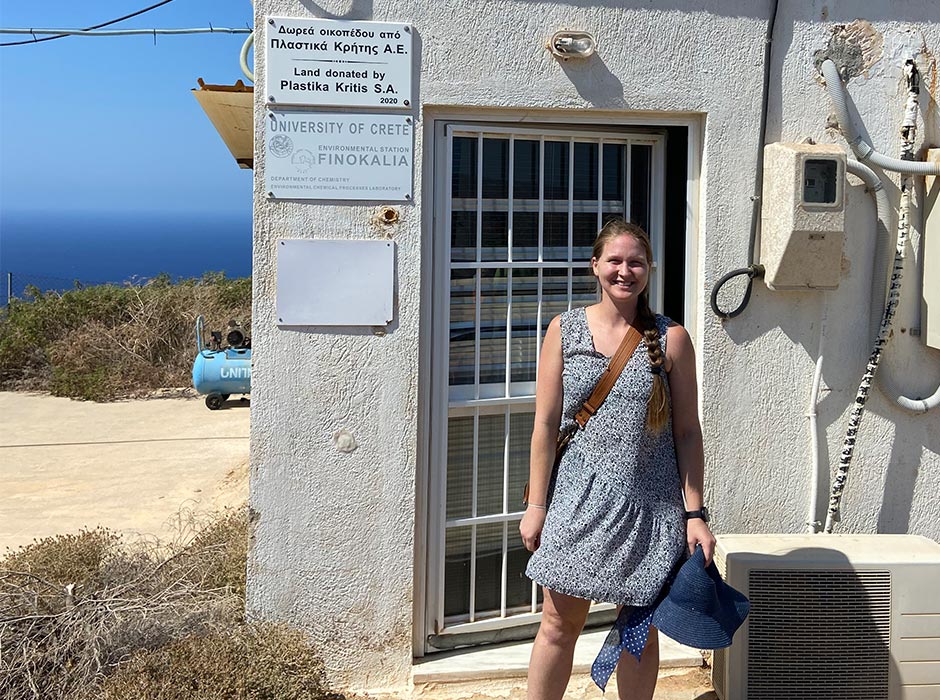
Hannah Kessenich, a Postdoctoral Fellow in the Department of Physics, photographed at a University of Crete observatory while attending an atmospheric chemistry conference in Greece. The trip was a prize for a poster competition she won.
Ozone hole researcher Hannah Kessenich’s degree in Physics landed her a job in tech, but it didn’t bring her fulfilment.
“I felt a lack of passion with what I was doing for work. I was working on printer technology, and if I had the best day, we would make a bit more money selling printers,” she says.
“I saw a lot of issues going on with our planet and the need for us to take better care of it. I thought I would look for a way to combine my interest in the environment with my physics background, and that’s when I found Associate Professor Annika Seppälä and the team at the University of Otago.”
Hannah moved from the United States to Otago to undertake her PhD. Having graduated last year, she is now a Postdoctoral Fellow in the Department of Physics.
“I thought the ozone hole was old news and a solved problem. It became clear that there were elements of the ozone hole season that weren’t looked at and weren’t explained, and that became my PhD,” she says.
“Atmospheric science was completely new to me, so it was a big learning curve, but I now feel that sense of passion about what I do. I’m actually using my work to contribute in some way.”
For World Ozone Day, which is celebrated on 16 September each year to raise awareness of the ozone layer, we asked Hannah to bust some myths about the ozone hole.
“There are many misconceptions about how the ozone hole works. I think most people don’t know that it’s not over New Zealand, that it’s open for only three months a year, and it’s not the reason we’re more likely to get sunburn and skin cancer,” Hannah says, casually demolishing three ozone myths.
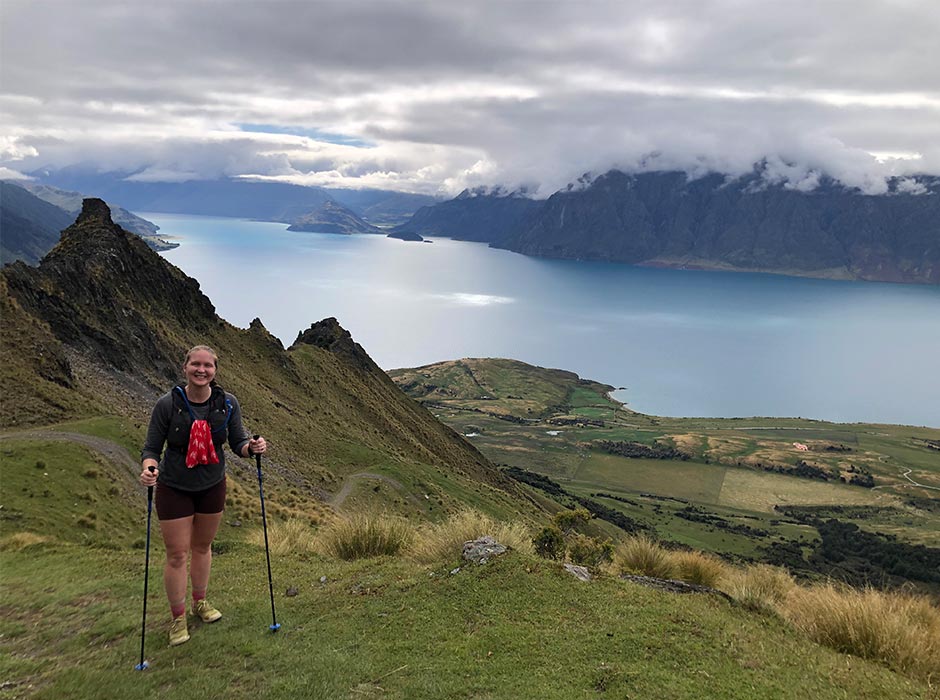
Hannah Kessenich says she enjoys living in New Zealand. “I love the lifestyle, I love the research culture at the University, and I love Dunedin,” she says.
Ozone hole myths get busted
Read on to learn everything you always wanted to know about the ozone hole but were too afraid to ask.
What’s good about having an ozone layer?
“The reason that we like to have an ozone layer above Earth is because it absorbs UV light, which prevents skin cancer. It’s like a down blanket, and when it absorbs UV light, it heats up, so it becomes a warm layer in the atmosphere.”
What is the ozone hole?
“The ozone hole is 20 to 25 million square kilometres of thinner-than-usual ozone. If you think about the ozone layer being a down blanket, and all the molecules of ozone between us and sun being like the feathers, it’s almost like someone’s taken out some of the filling.”
Where is the ozone hole?
“There’s the occasional day or couple of hours where the edge of the hole might be over South America or New Zealand, but it’s pretty much entirely centred over Antarctica and the surrounding ocean.”
Why are we at greater risk of sunburn and skin cancer, then?
“The Earth is slightly closer to the sun in the Southern Hemisphere because the orbit around the sun is not circular, so we get more UV naturally. Our exceptionally clean air is another contributing factor.”
Was the hole created by humans?
“The hole is maybe 80 per cent a natural effect – a result of stratospheric winds and cold temperatures at the pole. But humans added the last 20 per cent, which was the final ingredient to needed to cause the hole. Chemicals released from chlorofluorocarbons (CFCs) and related compounds can deplete thousands of ozone molecules, and they have a long lifetime where they remain in the atmosphere.”
Is the hole open all the time?
“The hole opens for about three months each spring. It forms within what’s called the polar vortex, a band of winds that form in winter.”
When the ozone hole opens, is it always the same size?
“The size and depth of the ozone hole varies each year. So far, this year is looking quite major. Having a major ozone hole is not necessarily a scary thing for us, but we do need to know what it’s doing.”
Could the ozone hole get even bigger?
“The good news is that the ozone hole is really limited by the size of the polar vortex. The area can only get so big, so it’s really more about how long the hole will last.”
Is the ozone hole open for the same amount of time each year?
“A large and deep ozone hole is more likely to remain open longer. We have seen a shift towards these longer-lived ozone holes that could indicate there are global circulation changes. What’s causing those late season ozone holes to become more frequent? It could be due to climate change, but that’s not proven yet.”
Does the ozone hole impact weather?
“While the ozone hole is open, it creates a cold pocket of air which acts almost like a plunger over the South Pole, shifting circulation bands across the entire southern hemisphere. This affects where the winds hit New Zealand, how much precipitation they’re bringing, and whether we’re likely to get drought or fire. It affects our summer weather, circulation and temperature. The wind events in October last year when trees got knocked down on campus were in part due to this cold air being pushed north.”
Wait, wasn’t the ozone hole fixed?
“Not yet, but if we hadn’t brought the Montreal Protocol into play, ozone thinning would have become catastrophic, and we would have eventually lost the entire ozone layer.”
When will the ozone hole be healed?
“Current projections have the ozone hole continuing to open until 2090, but that might be optimistic. I’ve recently looked at some of those projections and they are not completely capturing what’s happening today. Our team is looking closely to see if there’s a missing piece that we’re not accounting for.”
Are there other threats to the ozone layer?
"Potential threats include rocket launches and space debris. The human impact on the atmosphere is an evolving landscape."
What are your research plans?
“Lately, we have had more long-lasting major ozone holes than during any other decade. Our team is actively working to better understand this shift, and I have a paper in review which will hopefully establish the first categorisation system for ozone hole severity. I’m also contributing to a project to replace a NASA satellite with a new instrument. I’m currently at a conference in Greece, and I feel proud to represent New Zealand and give more of a voice to people in the Southern Hemisphere.”
– Kōrero by Kathryn van Beek, Communications Advisor | Kaiarataki Pārokoroko
Study Physics at Otago
Our Physics graduates are problem solvers. Their analytical skills make them versatile and adaptable and desirable in many technical fields. A bachelor's degree in Physics provides a great foundation for many careers.
More about Physics