
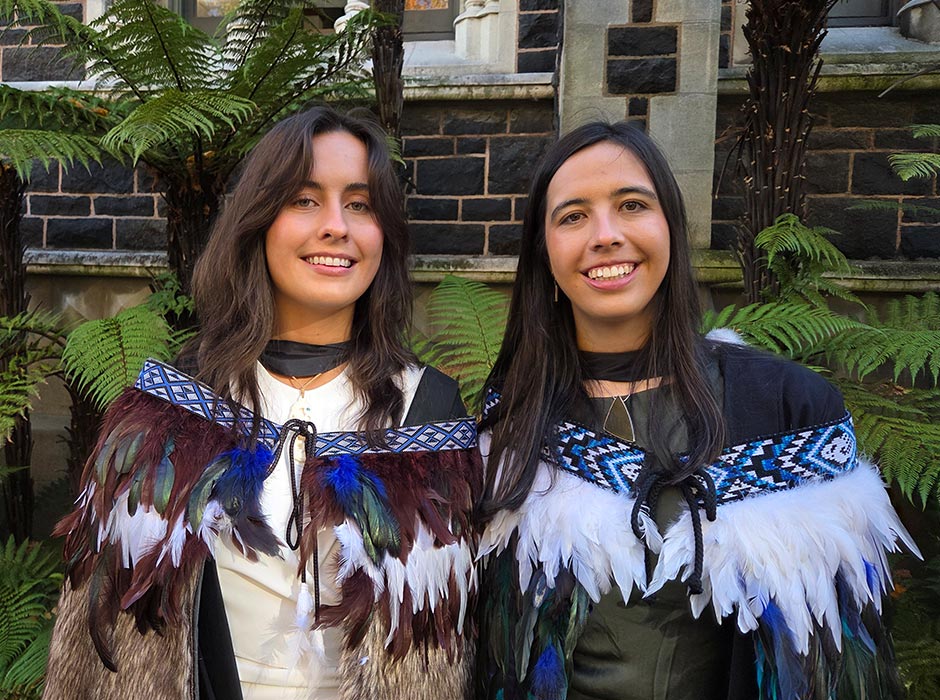
The Ogilvie family has a double celebration planned for tomorrow as twins Catrin, left, and Alex Ogilvie graduate – Catrin with a Bachelor of Sciences (Hons) and Alex with a Bachelor of Arts and Science. The special korowai (cloaks) the sisters are wearing also have family significance. Catrin’s korowai came from their great aunt while Alex’s came from their great uncle’s whānau.
From helping the fight against tuberculosis to representing New Zealand in sport and creating lifelong connections along the way, twins Catrin and Alex Ogilvie (Te Arawa, Ngāti Awa) have a lot to be proud of in their time at the University of Otago – Ōtākou Whakaihu Waka.
Catrin graduates on 16 May with a Bachelor of Sciences (Hons) alongside twin sister Alex, who will receive a Bachelor of Arts and Science on the same day.
The pair credit their parents, Brett and Caroline for their interest in science. Dad studied Zoology and Marine Sciences at Otago in the 1980’s, while Mum is a molecular biologist – the two meeting while studying for their PhD’s in the United Kingdom.
The move to Arana College in 2022 was big for both Catrin and Alex, but starting at Otago’s residential colleges made the transition easier.
“Having my sister made moving to the other end of the country less daunting,” Catrin says.
Catrin first enrolled for a Bachelor of Arts and Science in Biochemistry and Indigenous Development, before switching to Molecular Biotechnology to give her the ‘pick and mix’ choice of papers and tailor them to her medical biotechnology interests.
She took the Māori Studies minor to deepen her understanding of her whakapapa, te ao Māori, and understand how to bring that into her work and research.
She was awarded a University of Otago Scholarship in Applied Science and the Faculty of Biomedical Sciences Māori Postgraduate Scholarship for Honours studies last year.
Working with Associate Professor Htin Lin Aung in the Department of Microbiology and Immunology, her honours project focused on tuberculosis in Māori communities, researching a strain called Rangipo.
“Rangipo is the main tuberculosis strain found in Aotearoa, and one we know little about. One subvariant, has a large deletion across several genes and has been linked to increased progression to active disease.
“Using CRISPR-based genomic tools, I aimed to investigate how this deletion affects the bacteria’s biology and ability to infect cells,” she says.
Catrin’s honours work extended into a summer project, with preliminary results suggesting the target gene was successfully knocked down. Further analysis will be needed to show the knockdown’s full implications.
It was rewarding to see a result in such a short timeframe, she says.
“While there’s still a lot more research to do, these findings could help inform future TB vaccines, treatments, and public health approaches tailored to strains circulating in Aotearoa.
“Ultimately, developing tailored tuberculosis treatments or vaccines that help Māori communities has the potential for meaningful and lasting impact.”
Alongside her studies and summer work, Catrin completed Poupou Huia Te Reo 1, a 20-week course in Māori language and protocol through Te Wānanga o Raukawa. She is currently undertaking Poupou Whakapiki Mauri, a 16-week certificate in hauora/wellbeing.
She was also a tutor for Pūhoro STEMM Academy. A national programme set up to encourage Māori in STEM-related career pathways, it helps to improve rangatahi engagement in science, technology, engineering, mathematics, and mātauranga Māori, and helps tauira navigating university entrance and scholarship applications.
“I found it useful as an undergraduate studying Molecular Biotechnology, but also loved helping support Māōri students later on, particularly advising secondary school students wanting to go to university.”
In 2025, Catrin was awarded the University of Otago Young Alumni Award, the 20Twenties, in recognition of her achievements, which was an honour, she says.
“It was cool to be recognised amongst my peers, especially seeing their achievements and numerous contributions to the community.”
Catrin also represented New Zealand in Ultimate Frisbee tournaments at the 2022 World Under-20 and 2025 World Under-24 Ultimate Championships.
“That was loads of fun – we got fifth in 2022 which was New Zealand’s best placing.”
She sums up her time at Otago as “very fun”.
“There was lots of hard work in the four years, and the research project was intense – developing and optimising procedures in a lab was uncharted territory for me. I made loads of friends and great connections with University staff as well.
“And having Alex on campus was also pretty handy – my go-to support person and also a very convenient person to borrow things (mainly clothes) from,” Catrin says.
Like Catrin, Alex’s introduction to uni life started at Otago’s residential colleges, which she says is “a point of difference from most other universities”.
“I loved my time at Arana College, where I made some lifelong friends.”
She decided to pursue a Bachelor of Arts and Science, combining her interests in the natural environment and the people who shaped it.
“I enjoyed marine science, freshwater ecology and conservation biology papers because they covered the natural environment and ecological systems, an area I want to work in.
“My Indigenous Development papers gave me knowledge of how the natural environment can support Indigenous communities to thrive socially and economically in a rapidly changing world.”
Alex also enjoyed Otago’s supportive learning environment, with “high-quality academic staff dedicated to our success”.
“I particularly enjoyed the last couple of years of teaching, with smaller class sizes giving a much more personalised learning experience.”
Otago has an amazing clubs and societies scene, she says.
“Amongst other pastimes, I enjoyed serving on the executive committee of the Otago University Dive Club, having completed my PADI Level 3 Rescue Diver certification alongside my academic studies.
“I now dive recreationally in my spare time, and maybe one day I will be able to combine my science and dive training in a professional capacity.”
Alex was privileged to go on a Tūrangawaewae Pōkai Whenua Indigenous Exchange to the University of British Columbia, Canada, for the second half of the 2025 academic year, she says.
“This was an amazing opportunity to complete my studies while experiencing a new part of the world, including the Rocky Mountains, complete with great hiking, great skiing and grizzly bears.”
Being able to graduate with her sister is really special, Alex says.
“Even though we had our own separate university experiences, it’s nice to be able to reach this milestone and celebrate it together.”
And now that they’ve crossed the graduation milestone, what’s next for the twins?
Alex is working as a geo-environmental technician for Geotechnics Ltd, doing environmental monitoring and sampling at sites all around Tāmaki Makaurau Auckland.
“My ultimate goal is to have a career in environmental consulting. This role is giving me a great grounding in environmental field techniques, which will be very helpful in the long run.
“I would also like to spend some time working in Europe or Canada in due course, and postgraduate study may feature in that plan.”
Catrin is currently working in Food Risk Assessment within the Ministry of Primary Industries NZ Food Safety, but in late May will start a new role at the Malaghan Institute of Medical Research in Wellington, as a staff scientist within the RNA Technology Development Platform.
“I am looking forward to developing a career in biotechnology. I am also excited to attend the Science New Zealand Awards at the Beehive with the Pūhoro STEMM Academy team later this month.”
- Kōrero by Claire Grant, Communications Advisor, Faculty of Biomedical Sciences