
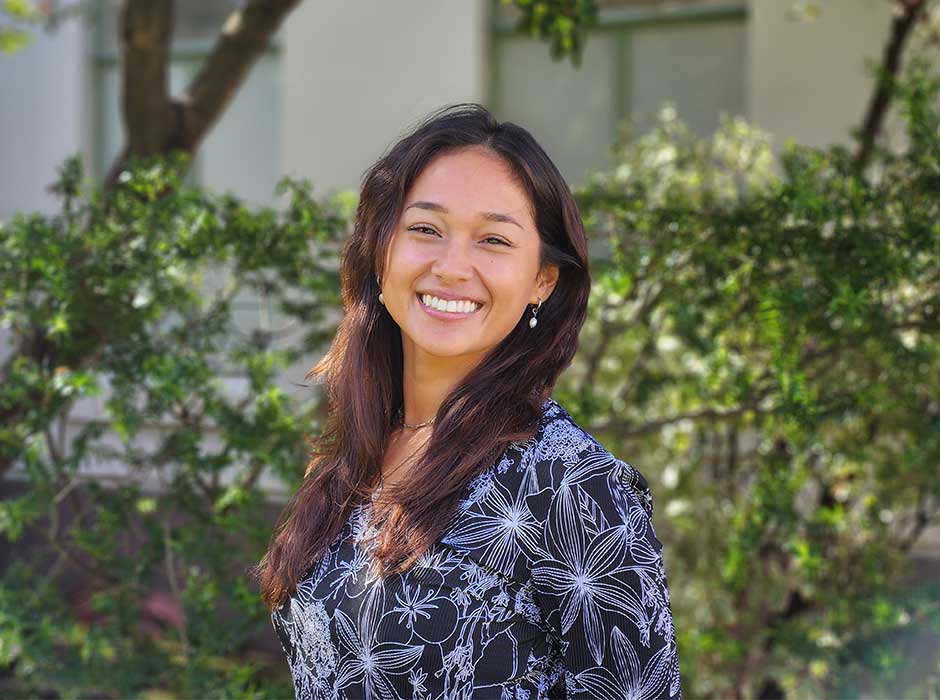
London School of Economics student Isabelle Hidalgo is loving her time in Ōtepoti Dunedin.
A desire to understand the differences between health systems around the world has led a London School of Economics student to Otago.
MSc in Global Health Policy student Isabelle Hidalgo is in Dunedin for six weeks undertaking population-level data research with the Quantitative Social Science Research Group in the Faculty of Medicine – Dunedin’s Department of Paediatrics and Child Health.
“I’m loving it because every day is a question. You can’t get this type of experience in just a classroom,” Isabelle says.
She describes the research team as “phenomenal” and says it’s great to be working with other Master’s and PhD students.
The main drawcard for coming to Aotearoa New Zealand was access to the Integrated Data Infrastructure (IDI), a large national research database that holds de-identified microdata about people and households, including health, education, justice and migration.
“It’s such a robust set of data that just doesn’t exist in that way in places like the United Kingdom or the United States,” Isabelle says.
She is exploring whole population rates of NEET (not in employment, education or training) among youth and looking at variables such as gender, ethnicity, family income and health conditions in relation to this. She is also investigating factors associated with NEET among ADHD youth.
The research project Isabelle is undertaking at Otago is being developed into her first research manuscript.
Born and raised in Delaware in the United States, Isabelle’s education has included arts school, sports and exercise psychology and aspects of social work. She also worked in tech sales and financial education in New York while taking a break between her undergraduate and postgraduate study.
Isabelle decided to do her Master’s at the London School of Economics (LSE) because they host many international students and it was a great opportunity to look at health systems and health policies from around the world.
“I’m interested in what services countries are cutting and what they are keeping, and things like how much funding they are putting into training. Basically, what’s working and what’s not working.”
The opportunity to connect with LSE came through a long-standing international research collaboration which Dr Nick Bowden, of the Department of Paediatrics and Child Health, has with colleagues at Brown University in the United States, which has also involved LSE.
“A colleague at Brown reached out to see whether we would be interested in hosting a Master’s student from LSE, and I jumped at the opportunity. Isabelle’s placement is the first, but we hope it will be the beginning of an ongoing relationship with LSE, with students coming to work with our team each year,” Nick says.
He described this first placement as very successful, saying Isabelle has been “fantastic” and is on track to achieve everything she set out to do at Otago.
“There are benefits on both sides. Isabelle has had the opportunity to gain hands-on experience using New Zealand’s unique linked population data and to take a research project from an initial question through to a manuscript in a very concentrated period.
“For us, it brings a talented international student into the team, creates new ideas and perspectives, and strengthens our relationships with LSE and our wider international research network. I hope the success of Isabelle’s placement paves the way for many more.”
Arriving in New Zealand for the first time on 23 August, Isabelle says she has found Dunedin “absolutely lovely”. After the size and pace of New York and London, she is enjoying the friendliness of the locals, the abundant green spaces – such as the Dunedin Botanic Garden – and having mountains and beaches on the doorstep.
She’s visited other parts of Otago, and Canterbury, and has seen snow, sea lions and penguins, when she’s not in the lab crunching data. She highly recommends other students take up similar opportunities to study overseas, as part of becoming a “well rounded” researcher.
Isabelle leaves Dunedin in early October, and will graduate from LSE in December. She hopes to continue working with population-level data and pursue a PhD in the United States.
- Kōrero by Andrea Jones, Team Leader, Divisional Communications
Faculty of Medicine - Dunedin
The Faculty of Medicine's Dunedin region is based on the Dunedin Campus of the University of Otago. It is home to nine diverse academic departments.
View