
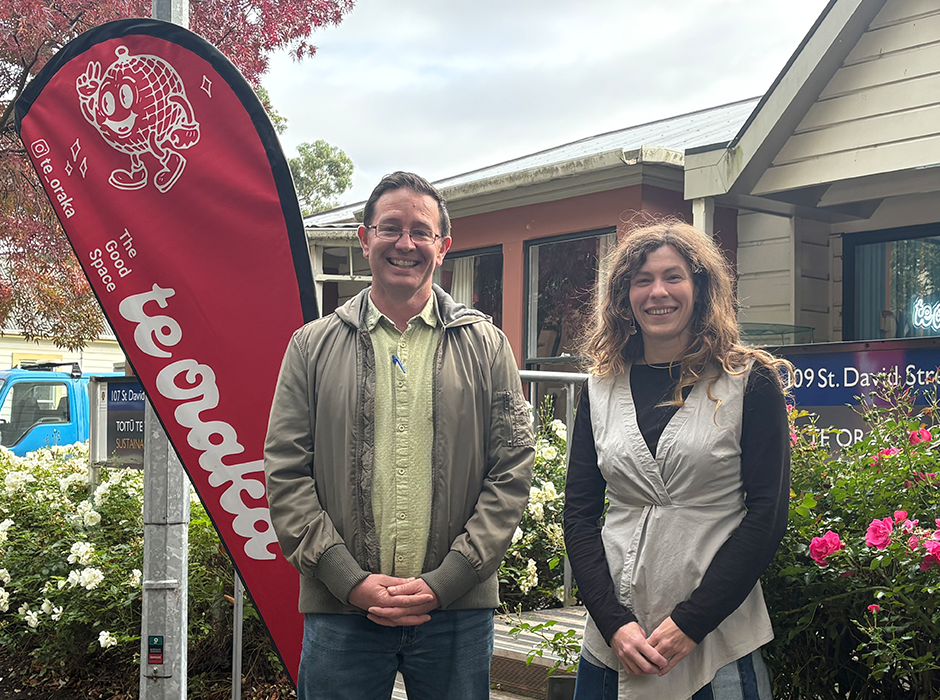
Team Leader Sustainable E-waste Garreth Taylor and Divisional Services Administrator Esther Valmadre at Te Oraka, the site for the staff sale of e-rescued computer equipment.
Otago’s upping the sustainability stakes, adding another ‘r’ to the lineup with rescue.
Thanks to the work of Otago’s Infrastructure and Sustainability teams, e-rescue has evolved into a stream of work turning not-fit-for-university-purpose computer equipment into low-cost tech options for staff and students.
As Team Leader Sustainable E-waste, Garreth Taylor says he was tasked with developing a model that put sustainability at the heart of Otago’s e-waste initiatives.
“With digital infrastructure becoming centralised through the Otago University Digital Workspace project, the Infrastructure team was dealing with a large influx of equipment that was no longer fit for university purposes.
“But not-fit-for-university-purpose is not the same as not-fit-for-purpose and a lot of that equipment still had lots of life left.”
To test a potential model, Garreth worked with Tētēkura Student Leads at the Sustainability Office to explore participation in Shop for Good, the annual Flo Week event organised by Te Oraka, where students purchase pre-loved items to kit out their flats.
“We started out small, offering monitors, cords, and a few desktops that had been processed and wiped of all data.
“The students loved it. We were sold out by the second day.”
The next step was expanding the model by selling equipment to staff, Garreth says.
But selling to staff meant there were “a bunch of implications” to consider.
“We had to consider health and safety, HR, fringe tax, pricing, and more when selling to staff.
“We presented our plan to the Finance team, the Chief Financial Officer and the University Council for sign-off before advertising the sale to staff.”
Plans are in the pipeline for expanding the list of digital items on sale, Garreth says.
“Currently we’re sitting on about 22 per cent of our inventory moving through e-rescue and the rest to recycling through our partner agencies, schools and charities.
“Selling laptops and desktops would require scaling up our processing, testing and tagging capabilities, as these are more labour intensive to process for resale.”
Divisional Services Administrator Esther Valmadre says Te Oraka was the “perfect venue” for the staff sale late last year.
“Te Oraka is a student-run space and with the students gone at the end of the semester, we had the space available to run a sale for staff.
“We also took the opportunity of staff moving to a hot-desking set-up at the Plaza building to organise a pop-up shop there.
“Both sales were a big success.”
The money made from the sales is funnelled back to Te Oraka, Esther says.
“The money is going back to the students, supporting our efforts in keeping this space alive and connecting with a broader group of students each year.
“It’s selling IT equipment at one end and community building at the other.”
In particular, it has supported the hiring of Tētēkura Student Leads, who work as part of the Sustainability Office, Esther says.
“The funds help with paying the Tētēkura wages and for any events organised during the year.
“We’ve just hired two Tētēkura, one of whom is a gardens coordinator managing the community gardens and our sustainability neighbourhoods. It’s pretty cool that we’re able to have a role like that this year.”
Head of Infrastructure Wallace Chase says collaborating with the Sustainability Office in supporting the Sustainability Strategic Framework Tī Kōuka goes beyond working on innovative ways to keep Otago’s technology devices in the product lifecycle for as long as possible.
“We are also looking at ways we can help bridge the digital divide in our communities with equitable access to technology.
“Devices that may no longer be fit for the cutting-edge nature of university use may still have use in other settings such as primary education, community organisations or personal use.”
Head of Sustainability Tumuaki Ray O’Brien says e-rescue is a great example of a common-sense solution to sustainability challenges that staff and students love.
“Everyone involved has worked to make it happen, make it simple, and make it accessible.
“Perhaps most importantly, everyone involved feels good about the amount of waste that has been avoided, and the benefits that so many staff and students are enjoying.”
~ Kōrero by Sandra French, Adviser, Internal Communications
Boldly sustainable, together
Sustainability initiatives at Otago contribute to targeted global efforts and are underpinned by a strategic framework that shows how our commitment will be brought to life.
Explore sustainability at Otago