
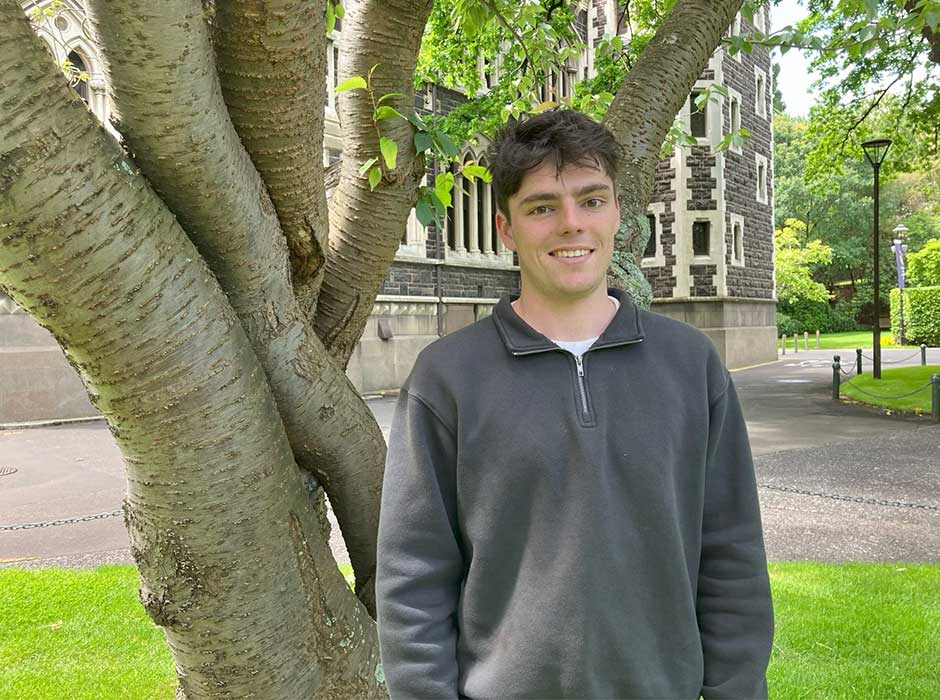
Max Stiven relishing a few moments of exhale after the final exam of his BCom degree.
When Max Stiven heard he’d been awarded the 2026 Sir Frank Holmes Prize for being the top economics undergraduate student in Aotearoa, he was more than a little pleased.
“I was ecstatic. The prize has the potential to open a lot of doors and it’s a great motivation to keep working hard,” Max says.
Named after one of New Zealand's most distinguished economists, Sir Frank Holmes, the prize is offered by the Motu Research and Education Foundation – an independent, public-good-focused economics and public policy research institute.
Motu Research gives the winning student a cash prize of $5,000 to support studies in economics at honours or master’s level – in the hope that awards like this will help build New Zealand’s research capacity in economics and public policy.
Professor Ronald Peeters, Head of Otago’s Department of Economics, was thrilled at the news – not least because Max is the second Otago student to win this accolade in the past three years. Ronald describes the Sir Frank Holmes Prize as the most significant nationwide award for undergraduate students within the field of economic analysis.
Formerly a student at Mount Albert Grammar School in Auckland, Max chose the other end of the country for his tertiary studies.
“I think for myself and a lot of students, going to university is as much about independence as study, and moving away from home was part of that. Otago also has an excellent Department of Economics, with lecturers who go well beyond their duties and are driven by seeing their students succeed.
“Dr Murat Üngör in particular has given me incredible support, whether it’s advice on plans for my future, or writing reference letters for internships, or simply passing on his enthusiasm and interest for economics through his teaching.”
Murat has high praise for Max too – particularly his intellectual maturity, mathematical sophistication, and research-oriented mindset.
“Max’s academic interests extend beyond achieving high grades; he is deeply motivated to understand economic mechanisms, formalise them rigorously, and apply them to real-world economic problems. We are very proud of him at Otago,” Murat says.
During the course of his Bachelor of Commerce in Economics and Finance, Max maintained the sort of sterling grade average that would be the envy of many. But as nice as those top marks were, they were never the main propulsive force behind his academic success.
“More than anything, I think I’m driven by an urge to understand things at a deeper level. I’ve never really aimed for a particular grade. I just enjoy fully understanding what I’m learning, and the grades tend to follow. It’s also never really felt like a chore as I enjoy what I’m studying, which makes it much easier to work hard towards my goals.”
Now that he’s finished his undergraduate degree, Max is returning north to take up a summer internship at NERA Economic Consulting in Tāmaki Makaurau Auckland before returning to Otago to begin his Master’s degree in Economics and Econometrics.
Asked what initially drew him to the field of economics, Max mentions its compelling scope.
“People often think economics is about markets and prices, but I see it as a way of understanding the world – a science of how people make decisions, respond to incentives and weigh trade-offs. Its reach is surprisingly broad.
“Game theory helped shape how we think about nuclear deterrence, and development research has shown how closely falling birth rates are tied to educating women in developing countries. What drew me in was the method – a disciplined, evidence-based way of working through complex problems rather than relying on gut feeling.”
He likes that economics offers a way to think clearly about difficult decisions that emotion tends to cloud.
“Ask people what a life is worth and many will say it’s invaluable, yet those same people drive every day, accepting a small risk to life for convenience. If we truly placed infinite value on life, we’d never get in a car. So, in a world where every decision has trade-offs, we need economics to navigate those hard decisions.
“Economics is to public policy what chemistry and biology are to medicine.”
-Kōrero by Claire Finlayson, Communications Adviser (Otago Business School)
Department of Economics
It is about choice and is at the heart of decision making – providing a logical way of looking at a variety of issues.
View