
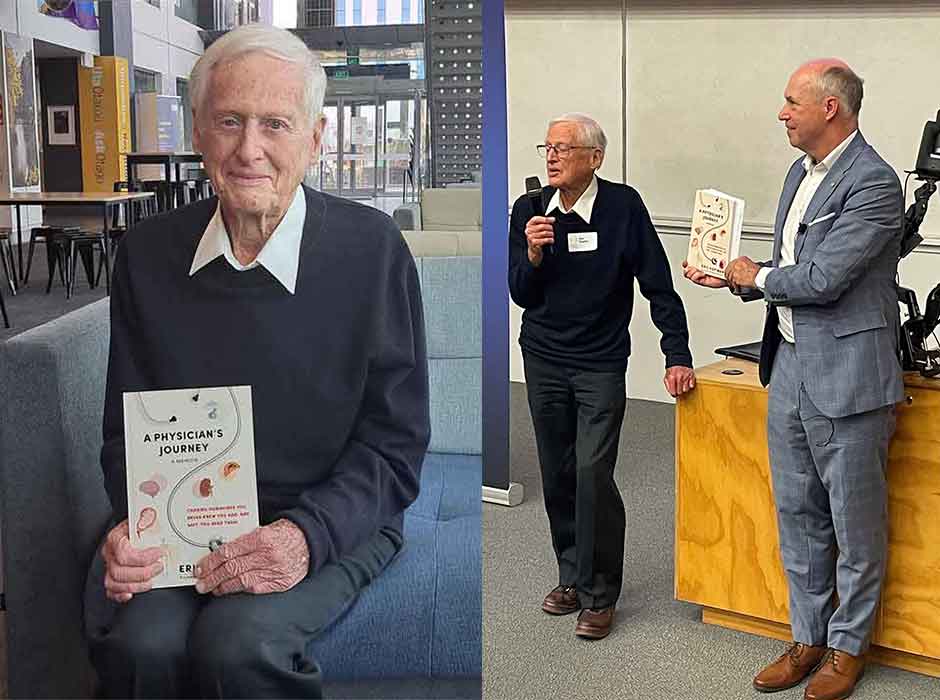
Left, Emeritus Professor Eric Espiner holding his book 'A Physicians Journey'. Right, Emeritus Professor Eric Espiner, left, alongside Faculty of Medicine - Christchurch Ōtautahi Dean, Professor Lutz Beckert. The pair was speaking to colleagues in the Rolleston Theatre last year.
“I was blessed by chance and good fortune. So often those sliding doors opened at just the right moment.”
Emeritus Professor Eric Espiner, a physician, scientist, and one of New Zealand’s most distinguished clinical researchers, died on 25 March 2026, aged 91. A hugely admired and respected taonga at the University of Otago’s Faculty of Medicine – Christchurch Ōtautahi, his death followed a sudden neurological event while on a cycling trip in South Canterbury—an activity emblematic of the vigour and determination that characterised Eric’s life to its very end. The day before he died, he had been engaged in online meetings with international colleagues, continuing a career in medicine and research that spanned an extraordinary 68 years.
Eric was born in May 1934 in Palmerston North to a schoolteacher father and a nurse mother. The family later moved to Christchurch, where he attended Elmwood Primary School then Christ’s College. His early academic record was unremarkable—indeed, one school report described his work as “fair” and even “inferior”—but this belied a steady upward trajectory. Later reports noted that he was “making good progress”, and he ultimately secured an academic scholarship to Christ’s College.
A love of biology, combined with the example of his older brother (and later surgeon) Harry, motivated him to study hard in order to follow in the footsteps of his sibling at the University of Otago medical school.
Graduating with an MBChB in 1958, Eric began what he would later describe as a daunting transition from student life to the realities of clinical practice. “After all the years in Dunedin,” he recalled, “becoming an established and paid member of the medical workforce, with all its responsibilities and unpredictable challenges was a daunting experience.” His early years as a house surgeon at Christchurch Hospital, followed by appointment as a medical registrar, grounded him in clinical medicine.
A pivotal moment came with his assignment to the Medical Unit at Princess Margaret Hospital (PMH) in Cashmere, an outpost of the University of Otago’s Department of Medicine. Under the leadership of the “debonair and brilliant” physician Professor Don Beaven, the unit fostered a culture of research and inquiry that would shape Eric’s career. Don’s interest in diabetes and endocrine disorders required new methods to measure hormones, and Eric found himself drawn into a research programme investigating pituitary and adrenal function.
This work, which included collaborations with scientists at Lincoln University, led to Eric’s doctoral research on the regulation of adrenal hormones. Although far removed from his initial clinical ambitions, Eric embraced the challenge, demonstrating the intellectual curiosity and persistence that would define his career.
Following his doctoral work and admission to the Royal Australasian College of Physicians, Eric undertook a travelling scholarship that took him to leading centres in London and Boston. At the Royal Postgraduate Medical School in Hammersmith and later at the Peter Bent Brigham Hospital, he worked at the forefront of endocrinology, focusing on aldosterone and its role in blood pressure regulation. These were, in his words, “exciting times”, as he and his colleagues developed new diagnostic approaches to conditions such as Conn’s syndrome.
It was in Boston that Eric met his wife, Mary, at a gathering of the city’s “Down Under Club”. Mary, originally from County Durham, was working as a dental hygienist. They married within months, and in 1967 returned to Christchurch, where Eric resumed his work in the Medical Unit at PMH—now an increasingly dynamic centre of clinical research.
Eric played a central role in establishing clinical protocols for studying hormone regulation in patients. His work on aldosterone and salt balance proved crucial in understanding cardiovascular disease, particularly heart failure. The team also began investigating early ACE inhibitors, demonstrating their effectiveness in reducing blood pressure and alleviating cardiac symptoms. These findings were published in leading journals, including The Lancet, marking the emergence of the then-Christchurch School of Medicine at PMH as a centre of international significance in clinical research.
The late 1980s and 1990s saw the most transformative phase of Eric’s career. Working alongside colleagues such as Professor Vicky Cameron, Professor Mark Richards, and Research Associate Professor Tim Yandle, their work fundamentally altered understanding of the heart, demonstrating that it is not merely a mechanical pump but so much more.
“By the mid to late 80s,” Eric wrote, “it was clear that the heart was an endocrine organ—an organ secreting a new class of unique hormones into the circulatory system every second.” This insight led to the identification and characterisation of cardiac hormones such as ANP and BNP, and to the development of diagnostic tests that remain central to modern cardiology to this day.
One of the group’s most significant contributions was demonstrating that measurement of these hormones could rapidly distinguish between cardiac and non-cardiac causes of breathlessness. “The capacity of a simple blood test to distinguish cardiac impairment within hours of a patient arriving at a hospital ED was, and still is, a major breakthrough,” Eric noted. This work not only advanced scientific understanding but also had immediate and lasting clinical impact.
Reflecting on his career, Eric identified three major advances that had transformed endocrinology: the development of immunoassays for precise hormone measurement, advances in imaging technologies, and the rise of genetic engineering. Yet he was always careful to emphasise the collective nature of scientific progress. “My journey could not have commenced, let alone been ‘completed’, without a like-minded group of colleagues working across diverse disciplines and national borders,” he wrote. “To travel with them along the highways and byways through twists and turns has been an extraordinary experience.”
In later years, Eric turned to writing, producing A Physician’s Journey, published in 2024, not so much a memoir as a record of the extraordinary successes of medical research at PMH and the CHI in the halcyon decades of the 1960-1990’s.
Despite his professional achievements, Eric remained a private and modest individual. He lived until his death in the same house in Cashmere, where he and Mary raised their family. His twin passions, as noted at his funeral, were his work and his family. He continued to work almost until his death, maintaining an office in the University’s Department of Medicine within Christchurch Hospital and engaging with colleagues around the world.
His sons, Colin, Stephen and Guyon, recall a father who was intellectually engaged, understated in manner and an undemonstrative yet loving father, teaching them all how to ride a bike, ski, and play tennis. He was not drawn to social clubs or DIY, preferring opera, silent films, and thoughtful conversation. Dinner table discussions were lively and wide-ranging, often focusing on current affairs. It is perhaps no surprise that two of his sons entered the field of journalism.
“He set the scene, helped where he could, then left you to it,” his son Stephen said, describing a parenting style that encouraged independence and critical thinking.
Eric’s humility was a defining trait. His son Guyon described him as “a deeply humble man, genuinely strong in values and morals, and deeply proud of his family.” He taught his children that excellence could coexist with kindness and empathy, and he modelled this in his professional and personal life.
He was physically active well into old age, maintaining a love of the outdoors which he instilled in his whānau, even if it sometimes involved being “marched up hills” in their youth.
A femur fracture just months before he died did little to deter him; he worked diligently on his rehabilitation to be fit for his last biking trip with friends.
To his nine grandchildren, he was simply “Pop”—a figure of enduring energy and intellectual vitality. His granddaughter Ciara described him as “our ‘time-travelling Pop’ who defied his age and was unchanged in energy, looks and intellectual rigour over our lives.”
Close colleagues remember Eric as a pivotal figure in New Zealand medicine. Mark Richards observed, “with Eric’s passing an era has concluded. He lived well and long as a master clinician and scientist. He was pivotal in the unique partnership established between endocrinology and cardiology in Christchurch which has proven so fruitful.” He added that Eric’s long professional career “traversed the equivalent of change in endocrinology as horse traffic to supersonic travel in the world of transport”.
Others at the funeral spoke of his tenacity and integrity. Close friend and colleague Dr Tim Prickett described him as “very tenacious” and “a gentleman”, while generations of patients expressed gratitude for his care, his sons unearthing many letters from patients thanking him for improving or saving their lives.
University of Otago, Faculty of Medicine – Christchurch Ōtautahi Dean, Professor Lutz Beckert, says Eric will be hugely missed on campus.
“With Eric’s passing, we lose a man of great wisdom, kindness, and quiet distinction. Eric was an outstanding clinician, scientist, teacher, and mentor whose work shaped endocrinology and cardiovascular research in Christchurch, New Zealand, and far beyond,” Lutz says.
Eric was not merely witness to a period of extraordinary change in medical endeavour, but one of its architects. His work helped redefine the understanding of the heart, advanced the diagnosis and treatment of cardiovascular disease, and contributed to the global development of endocrinology. Yet he remained, above all, a clinician and teacher, committed to the care of patients and the advancement of knowledge. His legacy endures in the discoveries he helped make and the many thousands of lives he touched.
Korēro by Lorelei Mason