
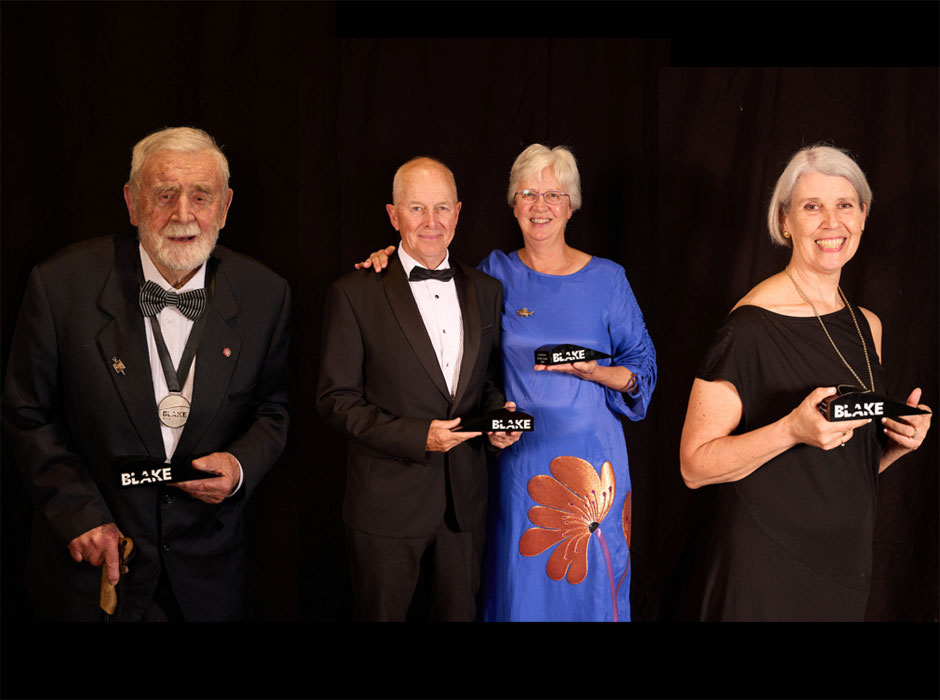
2025 BLAKE award recipients, from left, Emeritus Professor Sir Alan Mark, Emeriti Professors Steve Dawson and Liz Slooten, and Dr Sally Carson, Director of the New Zealand Marine Studies Centre. Photo credits for composite image: Brendon O’Hagan
Emeritus Professor Sir Alan Mark has been awarded the 2025 BLAKE Medal, alongside three other Otago researchers who received BLAKE Leader awards for their outstanding contributions to environmental leadership.
Emeriti Professors Liz Slooten and Steve Dawson received the Earth Sciences New Zealand Pūtaiao/Science Award, and Dr Sally Carson, Director of the New Zealand Marine Studies Centre, received the Mātauranga/Education Award.
Sir Alan, an Otago alumnus, received the 2025 BLAKE Medal for his outstanding contribution to New Zealand as a leading plant ecologist, lifelong environmentalist, and champion of science-based conservation that’s helped protect and conserve some of Aotearoa’s most significant landscapes.
On behalf of the University, Pro-Vice-Chancellor of the Division of Sciences Professor Richard Barker extends congratulations to these talented scientists.
"These awards recognise not only exceptional individual achievement, but the collective decades of dedicated research and community engagement that have resulted in outstanding environmental outcomes," Richard says.
“They have all shown a deep commitment to advancing scientific knowledge and environmental health for future generations, and should all be proud of their achievements.”
Each of the four awardees as follows, have devoted their life to science, education and conservation.
Emeritus Professor Sir Alan Mark
Based in the Department of Botany while at Otago, Sir Alan is well known for leading New Zealand’s first major conservation campaign ‘Save Lake Manapouri’. The movement challenged the proposal to raise Lake Manapouri by at least 24 metres and merge with Te Anau.
Between 1969 and 1972, Sir Alan played a key role in providing scientific research which demonstrated the effects this would have on the natural ecosystems. Following marches and discussions with government, and a petition which garnered 260,000 signatures, agreement was reached on minimum and maximum lake levels to preserve the ecology and surrounding ecosystems of the lakes.
Since this landmark achievement, Sir Alan has continued a strong interest and advocacy of conservation and the crucial importance of wise, sustainable management. He has also conducted ground-breaking studies on the impact of farming practices such as burning and grazing on the tussock grasslands of the South Island high country. He says tussock grasses are an important heritage factor for New Zealand, and his research has increased recognition of these grasslands into conservation systems.
Sir Alan says it is an absolute honour to receive the BLAKE Medal as it recognises a lifetime of involvement in conservation and environmental issues, some of which have been quite controversial. Sir Alan acknowledges Labour Prime Minister Norman Kirk, who had a landslide victory in 1972 with a policy of saving the Fiordland lakes, and who also established the Guardians of Lakes Manapouri and Te Anau to advise on lake management to avoid any detrimental environmental effects.
“When we exploit the environment beyond its ability to recover, we’re looking at serious problems, and politicians have shown they’re willing to do this,” Sir Alan says.
“When making these environmental and conservation efforts you are subject to abuse from those who would rather see the development, and we all pay the price.”
Sir Alan graduated from Otago with a BSc in Zoology and Botany, and an MSc in Botany, in the 1950s.
Emeriti Professors Liz Slooten and Steve Dawson
Liz and Steve’s careers have focused on studying the impacts of damaging fishing methods on marine mammals, gillnets and trawling in particular. Their research has resulted in the first marine mammal protected area in New Zealand. Together with their current and past students, they continue to work towards improving protection for Hector’s and Maui dolphin as well as other marine mammals.
Their most recent work shows that these dolphins are doing better than they were in the 1980s and 90s, but that much more protection is needed to ensure their long-term survival and recovery, as well as for other marine mammals.
Steve and Liz started New Zealand’s longest running marine research programme on Hector’s dolphins at Banks Peninsula in 1985, and two more in 1990, on Kaikoura’s sperm whales and Fiordland’s bottlenose dolphins. These projects have supported more than 90 graduate students and are now co-ordinated by one of their previous PhD students, Marine Science Associate Professor Will Rayment. They have mentored a large team of graduates who continue to study human impacts on marine ecosystems.
Liz and Steve say that in the face of ongoing industry criticism, the BLAKE Awards celebrate environmental activism based on sound science.
“That has been our life’s work. Doing the best possible science and making sure that environmental protection is based on solid, robust science.”
Dr Sally Carson
Over more than three decades, Sally has developed the New Zealand Marine Studies Centre (NZMSC) into an integrated programme that reaches over 16,000 students, teachers and families annually, providing education and inspiration, and igniting a lifelong interest in science and the marine environment.
Her work has spanned numerous marine education projects including the establishment of Seaweek, the writing of The New Zealand Seashore Guide and the travelling Aquavan that takes marine education to communities.
In 2013 she launched Marine Metre Squared (Mm2), a national citizen science project focused on the long-term monitoring of New Zealand’s seashore. Mm2 is collaborative, and feeds information collected by educators, schools, community groups, iwi and individuals into a database that is a valuable resource for marine scientists globally to research and track changes over time.
She is currently leading outreach for the Centre for Research Excellence Coastal People: Southern Skies, and is working alongside waka voyaging trusts and yacht clubs, connecting more rangatahi with the moana and providing tools to monitor its health. Sally’s influence and impact has created a legion of marine conservation ambassadors who are inspiring the next generation to connect with their coastlines. Last year, Sally graduated with a PhD in Education from Otago.
On receiving the BLAKE award, Sally says she’s privileged to work alongside experienced educators and passionate scientists, and the award is a testament to the great work of the entire NZMSC team.
Your future in Science starts at Otago
Explore human health and behaviour, mental and physical well-being, alternative food-based solutions, environmental impacts, sustainable solutions, climate change mitigation and so much more with a Science degree from Otago.
View