
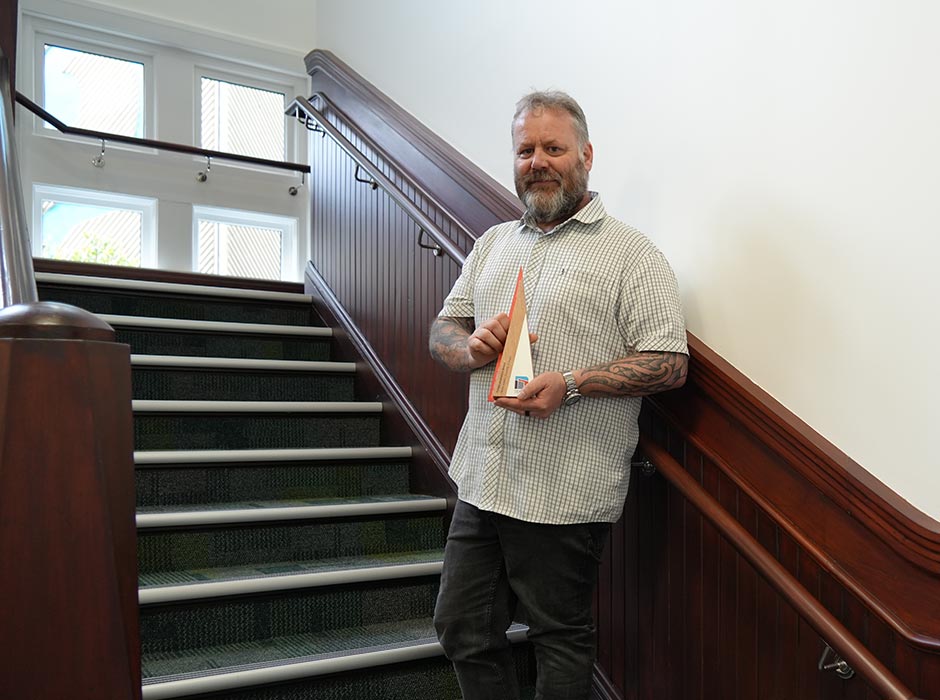
Head of Energy and Building Controls Shane Jenkins pictured with his TEFMA Innovation Award trophy, in the recently reopened CApSc Building – one of the locations on the Dunedin Campus operating on a building management system.
An Otago kaimahi has been recognised on the international stage for his mahi in spearheading a sector-leading initiative that transforms how energy and building performance is managed across the University’s campuses.
Head of Energy and Building Controls Shane Jenkins won the Tertiary Education Facilities Management Association (TEFMA) AECOM Innovation Award for leading the design and delivery of Otago’s Building Analytics Platform initiative.
The TEFMA AECOM Innovation Award recognises and rewards an individual member or institution that has developed and fully implemented a practice, process, or physical development, which is innovative and has improved the delivery, efficiency and/or effectiveness of facilities, their management and services.
Shane says the Building Analytics Platform initiative is part of the Smart Buildings Project, which is aimed at creating smarter, more responsive buildings that align with the University’s sustainability goals.
“The purpose of the initiative was to help drive continuous energy optimisation across five campuses through embedding advanced building analytics into Otago’s facilities management strategy .
“That meant bringing together building management systems (BMS), our ecosystem of connected devices, Application Programming Interfaces (API), and institutional data onto one unified analytics platform.”
The analytics platform provides a rich layer of performance visibility across core infrastructure, Shane says.
“It enables early identification of system inefficiencies, tracks energy use trends, and supports maintenance prioritisation.
“From 2019 to 2024, buildings included in the analytics platform, which now number 11, saw an 18.63 per cent reduction in energy consumption and cumulative savings exceeding 5.6 GWh, despite increased occupancy and technical upgrades in several facilities.”
A key innovation was the development of a bespoke API linking the BMS to the University’s room-booking system.
“This enabled real-time scheduling of climate-control systems based on actual space use, optimising performance, reducing unnecessary energy use, and improving comfort for staff and students .
“In parallel, an interface was developed to bring sensor data from connected devices directly into the BMS environment, eliminating manual workflows and enabling faster, data-driven decisions.”
What makes this project truly innovative is its holistic, scalable and replicable design, Shane says.
An example of this was its use at Te Rangihīroa College, where it not only supported a five-star Green Star certification in 2024 (now six-star), but also provided ongoing performance validation during commissioning and post-occupancy tuning.
“Replicability is central to the project’s value. It seamlessly integrates multiple systems into a unified framework that is now becoming the standard for future University projects.”
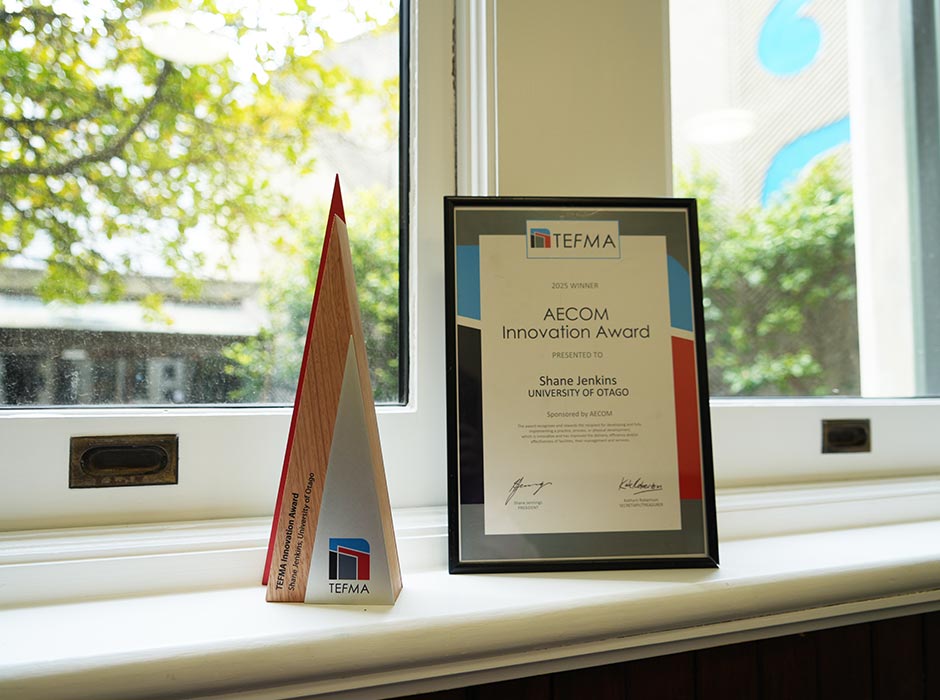
The TEFMA Innovation Award and certificate is presented to individual member or institution that has developed and fully implemented a practice, process, or physical development, which is innovative and has improved the delivery, efficiency and/or effectiveness of facilities, their management and services.
And because the system has been designed using commercially available platforms and open standards, it is easily transferable to other institutions.
“Lessons from the initiative are being actively shared through national forums such as Facilities Management Association of New Zealand and the BMS Community of Practice.
“The work has also helped shape Energy Efficiency & Conservation Authority funding pathways for analytics-based energy initiatives.”
At its core, this innovation represents a systemic shift from reactive facilities management to a proactive, data-driven model that prioritises performance, sustainability and replicability, Shane says.
“This project delivers a compelling combination of technical innovation, operational improvement, and strategic foresight.
“It sets a benchmark for what’s possible in higher education facilities management and offers a model that is already influencing peers across the sector.”
The success of the initiative is “very much a team effort”, Shane says.
“While I developed the original business case, and led the project from concept through to implementation, Otago provided the platform for this mahi, supported by Trade Services — particularly the Electrical and Controls team, ITS and ITS Project Manager Ria van den Berg, as well as our BMS provider Setpoint Solutions, and analytics partner CopperTree Analytics.”
The Building Analytics Platform is now embedded in Otago’s business-as-usual operations, supporting efficient building performance and great spaces for staff and students.
“The next exciting step is automated commissioning, which builds on our analytics for fault detection and diagnostics, which in turn enables proactive fine-tuning of building systems.
“It’s a hot topic in the industry now, and I see it as the next big thing.”
Receiving the TEFMA award is an affirmation for Shane, both personally and professionally.
“On a personal level, this award validates my approach to energy management, where I strive to make our operations as sustainable as possible in every sense – environmentally, economically, and socially.
“For the University, it underscores the value that property operations – particularly in energy management – bring to the institution, delivering benefits like sustainable operations, enhanced student engagement, and international recognition – all while keeping our campuses comfortable and energy efficient.”
~ Kōrero by Sandra French, Adviser, Internal Communications