
Wednesday 27 July 2022 2:56pm
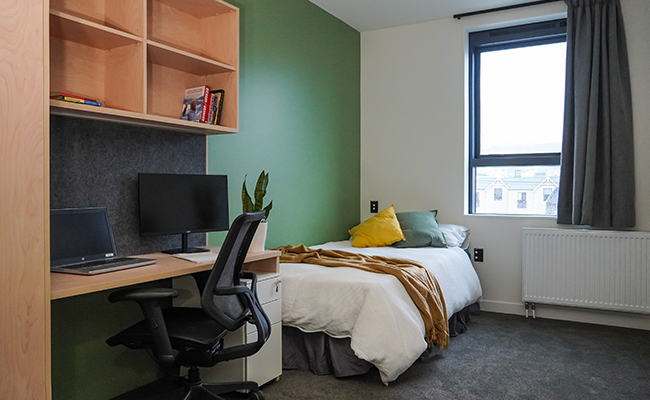 A sample of the living on offer at the new Te Rangihīroa College, opening in 2023. Photo: Eugene Yeo
The first room of the Te Rangihīroa project to be completed is setting the benchmark standard for the rooms to follow, Project Manager Kim Sneddon says.
A visit to the multi-storey K-shaped building under construction quickly confirms this home planned for 450 first-year students and due to open in May 2023 will be like no other the University offers, delivering an enriching bicultural living experience in a five-star Green Star sustainable setting.
Descendants of Te Rangihīroa (Sir Peter Buck), the University’s first Māori medical graduate, gifted the use of his name for the existing college on Castle Street which opened in 2014.
The design of the new facility on the corner of Albany and Forth streets involves input from Te Rangihīroa’s Ngāti Mutunga and local iwi Kāi Tahu and pivots on the concept of He Manawa Ora: He Pou Tāiki.
Put simply, He Manawa Ora: He Pou Tāiki is the tensioning post that binds Taranaki and Ōtākou with the journey of the tauira/students within their care, guiding and nurturing their wellbeing.
The building displays an impressive use of Māori artwork inside and out. Te Rangihīroa is reverently remembered as a great son of Taranaki, and a leader and doctor among his people; a man who used his medical training to stem the tide of profound and serious health problems that almost wiped out the Māori population in the first part of the twentieth century.
As we climb the stairs on a guided tour of the build to the wide corridors of the first floor in the first phase of the building where fire, electrical, and other services are being installed, Southbase contractor Chad Robinson says the hallways of this college are wide enough to allow residents room for that integral part of student life: socialising.
With this build there’s more attention to such detail. The design and planning teams of the building have made the corridors of each floor wider to allow for socialising, as students in the rest of the University’s 14 colleges enjoy mingling there, Campus and Collegiate Life Services Project Manager (Organisational Delivery) Kirsten Eichstaedt says.
“As the University’s first purpose-built college in 50 years we have been able to design the hallways and corridors taking into account the way residents will use the building,” she says. “I have enjoyed seeing the elements come to life from the drawings prepared.
“We can now see the fruits of the work that the whole team have dedicated themselves to getting to this point.”
 Southbase Brand and Communications Manager Kate Harland and Project Manager Chad Robinson onsite at Te Rangihīroa on Forth St. The University’s existing Te Rangi Hiroa College in the background is earmarked for the Dunedin Hospital development. Photo: Rebecca Anderson
The building overall has a total floor area nearly as big as the University’s largest college, University College, but will have fewer rooms overall than Unicol.
That leaves lots of space at Te Rangihīroa for the ten whanau rooms and study areas. There are 90 rooms on each floor.
The sample room is painted green to represent the whenua/land as seen when viewing Mount Taranaki from the ground. The cultural design concept, He Manawa Ora: He Pou Tāiki, can be seen at work in the building’s overall colour scheme.
The colours on each floor graduate from the dark blue of sea-level water to the green of the whenua/land on the first floor, moving to a lighter green on the second floor to represent the Taranaki raorao/lowlands then to the blue of a mountain stream on the third level, progressing to level 4’s pale waipuna/springwater-coloured blue and finally, up high on level 5, becoming the blue of Ranginui/the sky.
The pattern and colour design reflect the bubbling and energetic spring of water “drawn deep from within Paptūānuku, rising up through the building to show resilience, determination, courage and strength”, according to the cultural design document.
Standard rooms are almost 12m2 with special doors fitted which reduce the need for chocking the doors.
The University’s Strategic Architect, Gordon Roy, says the door of the prototype room is configured in such a way as to allow it to remain open when needed but close in the event of a fire.
“It’s linked to the fire alarm to activate the door closer in the event of a fire but allowing the door to remain free at all other times, “ he says.
Each room is built with the aid of the cloud-based building information modelling (BIM) software used for the entire project. Standard USB charging units are already fitted in the prototype room, and fire and acoustic ratings are calculated using state-of-the-art digital engineering tools.
Each room has its own individual STC (Sound Transmission Class) acoustic rating. Rooms with ensuites are a little larger with a floor space of 17m2.
- Kōrero by Rebecca Anderson