

Otago tauira Ella Borrie, left, and Melanie Bishop have recently returned from a six-week cultural excursion to India. India is the “definition of expect the unexpected”, Ella says.
Six bustling weeks in India was just the thing to jettison Otago tauira Melanie Bishop and Ella Borrie out of their comfort zones this year.
As Ella puts it, India is the “definition of expect the unexpected”.
“It’s the most diverse place on earth,” she says.
“There are so many religions, rituals, beliefs, and ways of living, layered on top of each other or folding out in front of you on the street.
“My favourite part is the passion you see in the dance and music where the volume is often at least three times too loud and somehow in all this chaos you still find key moments of peace between people living and loving bold.”
Melanie says that while she knew what to expect, there were still plenty of surprises.
“Coming from a largely secular society in New Zealand, this was one of the biggest differences I noticed. In India, spirituality and symbolism sit openly in politics, in education, in public ceremonies, and in daily routines. You see rituals performed before events and offerings placed in small shrines on street corners.
“Also, I don’t think you can ever truly expect Indian traffic!”
Melanie graduated with a Bachelor of Laws degree with Honours last year and will complete a Bachelor of Arts in Politics, Philosophy and Economics in Semester 2. Ella is in her fourth year of a Bachelor of Commerce majoring in Marketing and Management with a minor in Sustainable Business.
The two spent six weeks in India at the start of the year as part of the 2026 India Sustainable Development, Social Entrepreneurship & Innovation programme, which was supported with funding from the Prime Minister’s Scholarship.
The cultural excursion – which included two tauira from each university in Aotearoa – had a heaving itinerary, with stops including Delhi, Jaipur, Mumbai, Carola, Chennai, Puducherry, Auroville and Rishikesh.
“My favourite part is the passion you see in the dance and music where the volume is often at least three times too loud and somehow in all this chaos you still find key moments of peace between people living and loving bold.” – Ella Borrie
“It was an incredibly well-planned journey, with every experience feeling like a once-in-a-lifetime opportunity,” Ella says.
“Some of the most memorable visits were to places like Salaam Baalak, an orphanage supporting street children; Jaipur Foot, which makes prosthetics for amputees; and Sheroes Hangout Café, run by acid attack survivors, which was an incredibly powerful and humbling experience.
“On top of that, we dunked in the Ganges, went to a yoga retreat, travelled across multiple states, and ate more curries than I could ever count. Every day felt completely different, and that’s what made the experience so special.”
The diversity of activities was also a highlight for Melanie.
“In the span of a few kilometres, or even just a few hours, you could move between very different versions of what it means to live in the world’s fastest-growing major economy. You could see extraordinary ambition, wealth, and creativity.
“You could also see structural inequality, informal labour, and the reality of urban density at a scale most New Zealanders have never experienced.”
Having the opportunity to meet university leadership and policy thinkers, listen to social entrepreneurs and visit cultural institutions was a real privilege, Melanie says.
“We were essentially educational visitors – guests – moving through spaces that represent people’s lives. It made me reflect on how uneven opportunity can be, but also how much energy, resilience, and creativity exist across all parts of Indian society.
Both tauira had reasons close to home for wanting to go to India. Ella’s grandmother had been to India when she was younger and had always told her how impactful and beautiful an experience it was, while Melanie’s parents first met in India.
“I was brought up with a lot of love and admiration for the country and always knew I wanted to visit,” Melanie says.
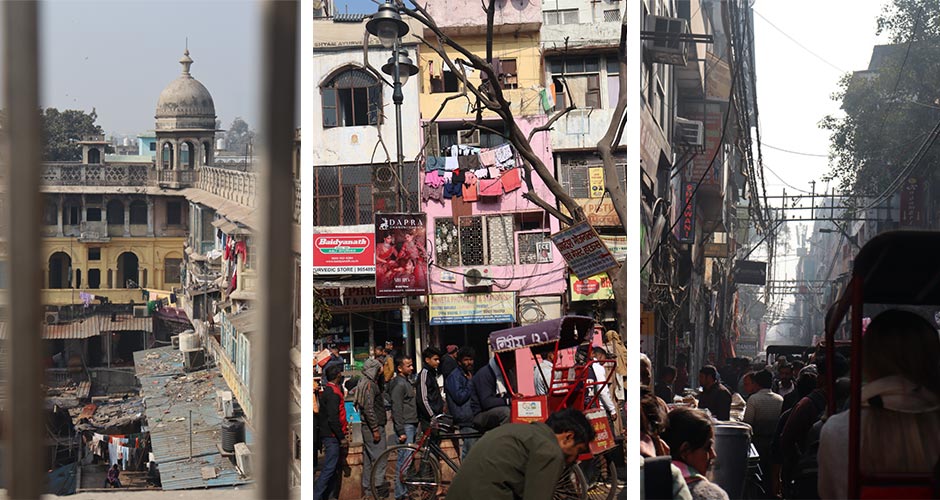
Pictured are street scenes captured by Melanie Bishop, whose parents first met in India. “I was brought up with a lot of love and admiration for the country and always knew I wanted to visit.”
The trip inspired both tauira in different ways. Ella, who has long been interested in starting an initiative focused on reducing textile waste and teaching people the art of repairing clothes, was inspired by the people they met who were creating meaningful change with very limited resources, she says.
“After visiting India and seeing firsthand the scale of waste, inequality, and the different realities people live in, the idea felt much more real and urgent to me. It showed me that you don’t need perfect conditions to start something. Sometimes, the most important thing is simply having the courage to begin.
“Since coming back, I’ve already started writing a business plan to try and make my initiative happen.”
For Melanie, the common-place use of AI made a huge impression.
“I had been able to keep AI at arm’s length before I left,” she says.
“It felt like something happening in tech circles, or something that would gradually filter into everyday life, that I could stay away from. But in India, it was everywhere.
“Students we met spoke about AI almost as if it were a companion. One of the largest use cases globally since 2024 has been forms of personal therapy and emotional support through AI. This reminded me of the early days of social media, when we were excited about connection but slower to grapple with the psychological and social consequences.”
Since coming home, Melanie has been thinking about the quality of the conversation people in New Zealand are having.
“AI is already changing how research is done, how content is created, how coding happens, and how people learn new skills. I think that should prompt thoughtful discussion about what we teach, how we assess students, and what human skills we prioritise.”
Melanie and Ella are now looking to their next adventures, as they’re both heading away in Semester 2 for an Otago Global Student Exchange – Melanie to the University of British Columbia in Canada, and Ella to the Rotterdam School of Management in The Netherlands.
“Experiences like these push you outside your comfort zone, introduce you to new ways of thinking, and make you realise how big and, at the same time, how connected the world really is,” Ella says.
“For me, an exchange is the kind of experience that stays with you long after you come home, and the memories and lessons you take from it are something you carry with you forever.”
*Otago tauira wanting to head to India on an Otago Global Exchange now have the option of studying at Ashoka University, located in Sonipat near Delhi. Ashoka University is India’s premier Liberal Arts and Sciences University.
Find out more about an exchange to Ashoka
– Kōrero by Internal Communications Adviser Laura Hewson
Otago Global Student Exchange
With the Otago Global Student Exchange Programme, you can study across 30+ countries – or even go to two countries, one semester each. You’ll receive a $1,000 Otago Global Student Exchange Scholarship, continue to receive StudyLink, and may be eligible for additional scholarships.
Lean more about a global exchange