
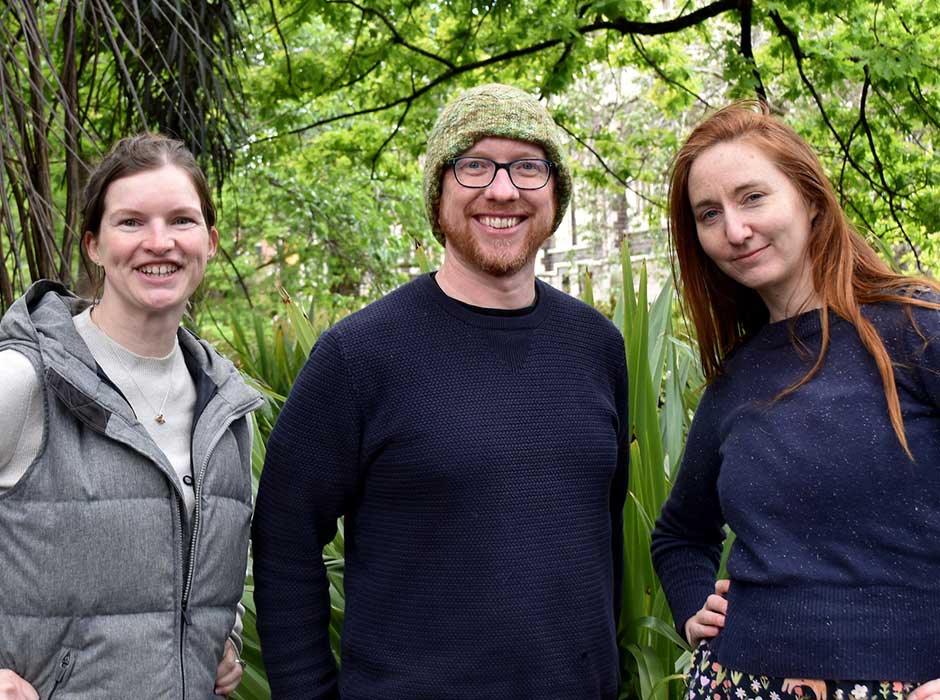
Dr Ruth Warren (Department of Anatomy), left, with Brendan Christie (Pākiki kids) and Dr Charlotte King (Department of Anatomy). The trio have been recognised for an outreach project that shares the stories of Aotearoa New Zealand’s goldrush era.
What was everyday life really like in the Otago goldrush?
Dr Ruth Warren and Dr Charlotte King from Otago’s Department of Anatomy have been taking school students on a gold rush journey; their work on sharing the everyday life stories of people living through the goldrush era gaining international recognition.
The team was recently awarded the Martin Davies Award at the Australasian Society for Historical Archaeology conference in Tasmania. The award is presented annually for the best project that engages the public with historical archaeology.
Charlotte and Ruth, alongside collaborator Brendan Christie, created a school’s outreach programme designed to share the life stories of people living in colonial Otago during the goldrush period.
Charlotte and Ruth are bioarchaeologists (archaeologists who study human remains), who have been involved with excavations of unmarked graves in historic cemeteries across Otago, aiming to identify those lying within them and share their stories.
Brendan leads Pākiki kids, a gifted and talented education programme run out of Dunedin North Intermediate that involves kids from schools across Dunedin and wider Otago.
Together, the trio designed and implemented a ten-week teaching programme to bring colonial Otago to life.
Students excavated mock sites, worked in the University’s bioarchaeology lab, and analysed artefacts from local colonial sites – experiencing the science of discovery firsthand.
The team have since been interviewing the students involved to find out what worked well and what could be improved, with plans to roll out the resources more generally sometime next year for all educators in the region to use.
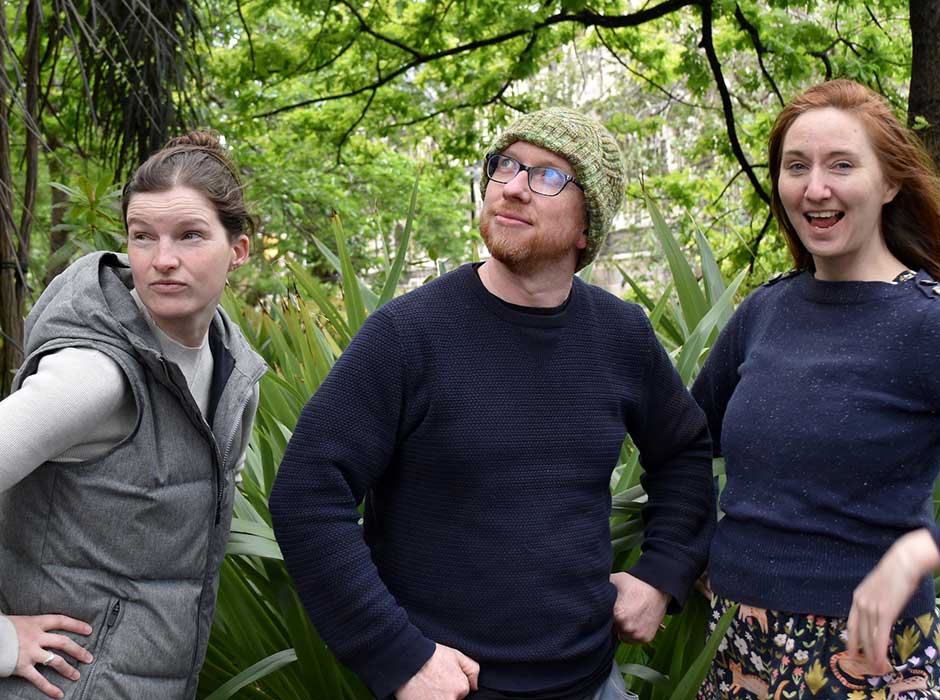
Dr Ruth Warren (Department of Anatomy), left, with Brendan Christie (Pākiki kids) and Dr Charlotte King (Department of Anatomy) . Ruth says the trio are "really passionate about telling the stories from our region and helping people of the present connect with their past".
Charlotte says the judge’s remarks were lovely.
“They liked that the students were active collaborators, investigating their local and family histories and that the format, structure and content of the project promoted connections with the people whose stories were being uncovered. And most importantly, we were able to show them how much fun the students had during field work!”
She says the award means a lot to the trio. “We’re really passionate about telling the stories from our region and helping people of the present connect with their past. It’s great to see that work being valued on the international stage.”
Ruth says the recognition also reflects the project’s close connections with the wider community.
“It’s awesome to see these outcomes from the students. Before and after the excavations, we consulted with descendants and community members who gave us permission to undertake this work, and they shared how important it was that the findings be used to engage young people — to spark excitement about science, archaeology, and their own family histories.
“It’s really rewarding to see that vision come full circle through this programme, and also very special to have the Society recognise the value of that work,” she says.
From the teacher’s perspective, Brendan says the opportunity to connect students with working professionals such as Charlotte and Ruth has been like discovering their own kind of educational gold.
“It has made learning incredibly real, contextual and purposeful. We are so grateful for the mahi from the whole team and look forward to future hair-brained schemes,” he says.
Ruth is a postdoctoral research fellow whose research at Otago focuses on how science communication can help people connect with stories reconstructed using skeletal evidence. Charlotte’s research focuses on the use of bone and tooth chemistry to solve forensic and archaeological problems, and in particular to reconstruct the lives of unknown individuals. She is also involved in repatriation research, exploring the use of these techniques to identify and return peoples to their places of origin.
-Kōrero by Claire Grant, Communications Advisor, Faculty of Biomedical Sciences
Biological Anthropology Research Group
Think studying Biological Anthropology sounds interesting?
Find out more