
Thursday 23 February 2023 12:22pm
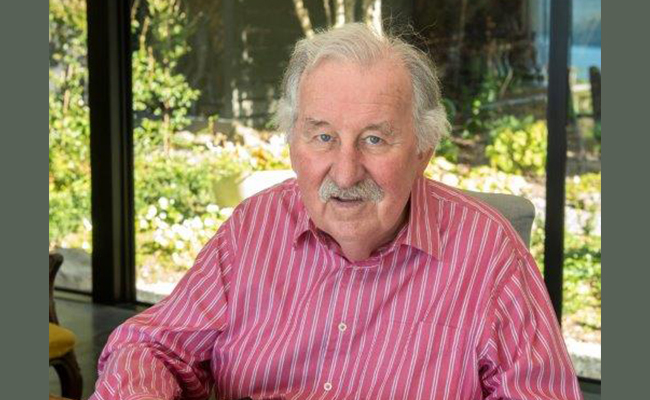
Otago law alumnus Wallace Bain was named an Officer of New Zealand Order of Merit (MNZM) for services to health and the community in the 2023 New Year Honours list.
When he decides to do something, Member of the New Zealand Order of Merit (MNZM) recipient Wallace Bain, doesn’t do it by halves. As a young pharmacist in Auckland, he developed a strong interest in the law, after viewing a retrial of alleged murderer Arthur Allan Thomas in the early seventies.
Before this major career shift Wallace grew up in Hamilton and after studying pharmacy in Wellington, he returned to his hometown to work at the family-owned pharmacy. Shortly after this he was managing an Auckland urgent pharmacy, with work hours which allowed him to sit in on the Thomas retrial.
“After sitting down and watching the case for several days I decided that this (law) is what I want to do,” Wallace says.
He contacted the Pharmacy School Dean, who had since moved from Wellington to the University of Otago, about his new career choice and says the candid response was, “we always thought you should have been a lawyer”.
Wallace was accepted into the University of Otago Law School with three unspecified units and had to take the paper “Legal System” in his first year. In only three years he had completed a first-class honours degree in Law.
“I had never been much of one for study, but when I got to Otago I quickly adopted a daily regime of getting up at 4am for two hours to review my notes. During the day I attended lectures and revised my notes and studied again in the evening. I worked much harder than I ever had academically, but I just loved Otago, I really did.”
On his graduation, fellow Otago alumnus, former Chief District Court Judge Sir Ron Young (LLB, Otago, 1974), interviewed Wallace in Dunedin and offered him a job at a Hamilton law firm.
Wallace says the training at McCaw Lewis and Chapman was outstanding. Next, he moved to his wife Juliet’s hometown of Te Kūiti as he received a job offer that he “couldn’t refuse”.
“As so often happens you grow to love the community and I came to specialise in medical and pharmaceutical law there and went on to become Mayor of Waitomo District,” he says.
While working as a lawyer, Wallace had seven years as the Vice President of the Pharmaceutical Society of New Zealand. Then he was appointed the Coroner for the King Country, which went from Ōtorohanga in the north, to Mōkau in the south and east to a large chunk of the central North Island, which eventually included Taupō and had around 60 part-time coroners.
He says the Coroners Act, which came into force in 2007, reduced the team to 16 full-time Judges of the Coroners’ Court and One Chief Coroner. He was offered a coroner’s role at Rotorua, which included all the Bay of Plenty and he remained there until his retirement.
Highlights of his 28-year coroner’s career include moves to reduce child abuse, including recommendations from the Nia Glassie and Moko Rangitoheriri inquests.
He developed systems working closely with Māori where the body of the deceased could stay with the family to meet the tikanga requirements, while also meeting autopsy rules.
He worked closely with fellow Otago alumnus and honour award recipient Rotorua’s Dr John Armstrong, who worked tirelessly in the area of allowing Māori cultural beliefs to be listened to.
Co-sleeping (parents and newborn babies sharing the bed) has been a major problem often known as Sudden Infant Death Syndrome or SIDS, that he worked actively to improve. He says through education and implementation, efforts are made to make sure that the babies were not in bed with the parents.
He says recent research has indicated that the country’s rate of SIDS has been dramatically reduced from around 60 babies a year, down towards five to 10 deaths a year.
“So that’s about 50-55 young children walking around New Zealand each year who wouldn’t be with us.”
He has done a lot of work on youth suicide prevention with Mike King, which they called the ‘Coroner and the King’. “He’s brilliant as he talks to the young at secondary schools, he has them all eating out of his hands. I’d follow up with case details and that was very rewarding. He does a wonderful job.”
Wallace says historically there have been many fatalities in the forestry industry and some of his recommendations have helped limit that. He’s also worked extensively in the hunting and boating areas. He feels one of his greatest achievements was the swift adoption of some of his recommendations in the Firearms Act.
Having assisted in major advances to the way coroners operate, he currently has some ideas for improving the way the courts operate in general, being in favour of the inquisitorial way the Coroners’ Court operates to get to the truth versus the adversarial system in most courts.
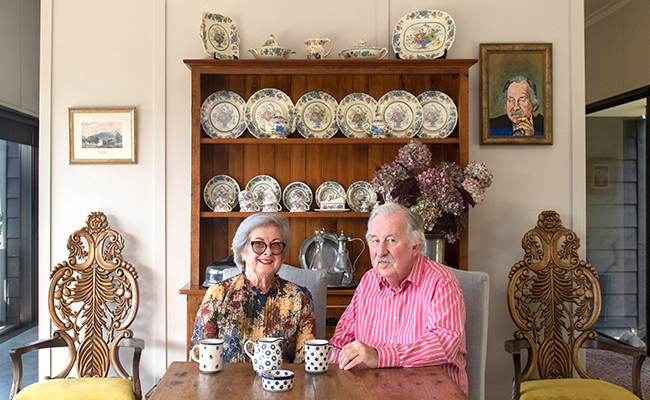
Wallace and Juliet Bain at their Lake Tarawera home
In New Zealand, judge’s warrants expire when they turn 70 and they face compulsory retirement, so time came to hang up his legal gown. He and Juliet (a former pharmacist) have retired to Lake Tarawera, near Rotorua. “It’s an absolutely beautiful part of the country to live in.”
During his legal career and beyond Wallace has maintained ties with his old law school and says from his time there and beyond he has immense respect for former Law Dean John Smillie, current Professor Geoff Hall, and recently deceased Emeritus Professor Kevin Dawkins. He adds that former Law Dean Mark Henaghan made a huge difference to legal studies at the University.
“I have steadfastly steered students towards studying Law at Otago over the more than 40 years of my career and they have all loved their time there.”
With a passion for New Zealand’s national game, he was President of the Piopio rugby club in Waitomo and he later supervised disciplinary hearings at two Rugby World Cups.
Many years later he travelled to Dunedin to combine his two passions by catching up with some of his former law professors at an All Blacks test at Carisbrook stadium.
In terms of being awarded the MNZM he says, “It was quite overwhelming it was totally unexpected. There’s quite a procedure involved, they’re really strict about not to tell anybody, which is quite hard.”
He had to keep the award from his two children; Lyndon who is currently Head of Financial Governance and Management Assurance at BNZ in Auckland and his daughter Catherine, who was a business analyst and special projects manager in the pharmaceutical industry, but is currently busy bringing up three young children.
At the end of his incredible career Wallace recently published his book on his time in court, “A Coroner for the Dead to protect the Living”
Wallace was offered a role in Dunedin at the start of his law career, but chose instead to move to Hamilton. “How different things could have been if I had stayed in the south, I guess we’ll never know.”
Kōrero by Kerry Dohig, Communications Adviser Development and Alumni Relations Office