
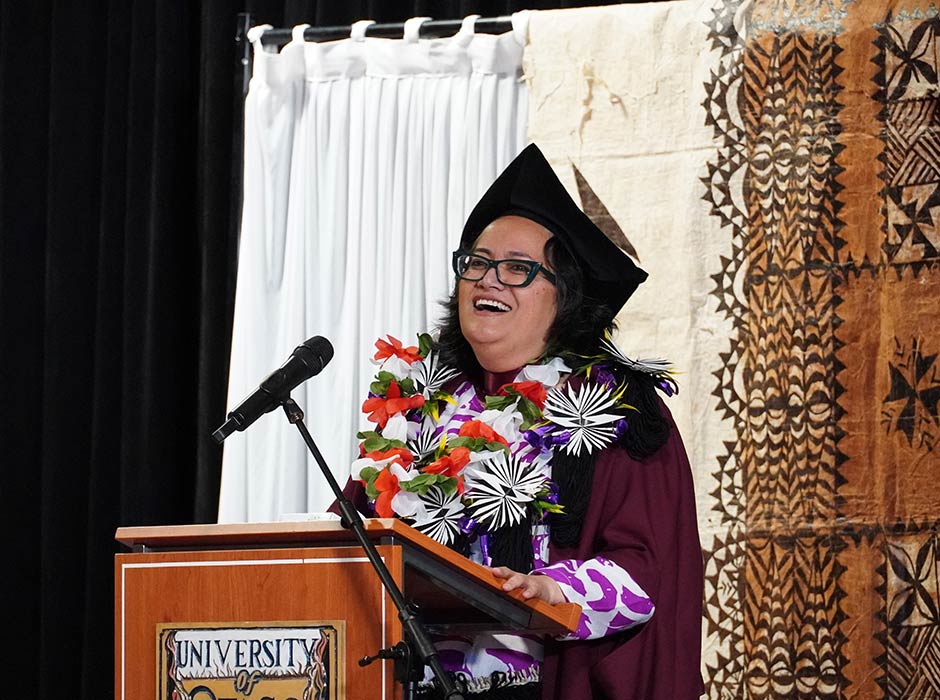
Dr Mere Taito addresses the Pacific Graduation breakfast.
From Rotuma to Fiji, and now to the University of Otago, Mere Taito’s graduation with a PhD in English marks what is believed to be the world’s first doctoral thesis focused on Rotuman literature.
Her work is a scholarly and creative gift to her community, one she describes with pride, humility and gratitude.
“I am extremely humbled, overwhelmed, very grateful, and at the same time, mind blown. I did not set out to be the first of anything,” Mere says.
“I was drawn to the work of examining early Rotuman literature because there were so much joy and rich intellectual engagement to be had here.”
Mere traces her heritage to the districts of Malha’a and Noa’tau on the island of Rotuma, a political dependency of Fiji. She was born in Fiji, then moved to New Zealand in 2007, a decision encouraged by her father who will proudly watch her cross the stage on graduation day.
“I had no inkling that this move to New Zealand would open so many doors for me,” she says.
“It has been 18 remarkable years of personal, creative and scholarly growth.”
Mere’s thesis has been recognised as an ‘Exceptional Thesis’ by the University. For her, the real achievement is how it has re-centred Rotuman voices.
“I am most proud that this research has sharpened and re-focused our attention on earlier writers such as Emosi Rima, who was a key contributor to the Rotuman-language newsletter Rogorogo (1913–1914), Mesulame Titifanua, author of the original Rotuman-language text of Tales of a Lonely Island (1937), and Fuata Taito, author of The Aborigines of the North (1949) and My Own Story (1949). I am also proud of how my work suggests creative ways to engage with these and other historical texts.
“To be able to offer my people a scholarly and creative gift that is of an exceptional standard makes me teary just thinking of this.”
The poet in Mere shaped much of her doctoral process. She brought creativity, play and experimentation into her research, producing a collection of 54 digitally born poems alongside her academic writing.
“Play is joyous, and yet play is also vigorous,” she says.
“Any substantial work like a doctoral thesis rests on vigorous revisions, re-thinking and re-editing, which is a process I quite enjoy.”
As creative as Mere was, her academic journey was not without hardship.
She initially began her doctorate at another university, but a lack of support forced her and six other Indigenous PhD candidates to leave.
Throughout this time and the rest of her PhD studies, Mere was supported by Professor Alice Te Punga Somerville of the University of British Columbia.
“But I was without a second supervisor for six months. This was tough. I was fortunate to have within my circle, fabulous PhD scholars and writers who kept me going.
“Finding your intellectual tribe is essential to your PhD survival kit.”
After moving over to Otago, Mere felt the shift in support, especially from Professor Jacob Edmond, who joined Professor Te Punga Somerville to form the second half of her supervisory team and whom she credits for creating a space for Pacific-centred research within the English and Linguistics Programme.
She is also quick to acknowledge her fellow Māori and Pacific scholars Essa Ranapiri and Stacey Kokaua-Balfour, saying “More Pacific literary scholars are coming to English at Otago, so clear the way.” When Mere crosses the stage on Saturday, she will become the first Indigenous Pacific scholar to graduate with a PhD in English from Otago, a huge milestone for the English and Linguistics Programme and an inspiration to those who will follow in her footsteps.
Come graduation day, Mere’s celebration will be a family affair.
“I have a 13-member graduation party travelling with me from Fiji, Auckland and Hamilton. This is how we celebrate – in packs!
“You can easily spot us because we will all be wearing kalavata and the Rotuman tefui. We will come with our tears of joy as well as wild raucous laughter,” she shares.
For Mere, this is only the beginning. After graduation she has already secured the Northwestern University Center for Native American and Indigenous Research’s postdoctoral fellowship in Chicago.
There, she will continue exploring archival texts and building on her doctoral work.
“I feel excited and very fortunate that I can jump into this next chapter so soon as it maintains a certain momentum of my research. There is no wait time for ideas to grow rusty.”
Looking back, Mere offers encouragement to the next generation of Pacific scholars.
“Set high standards. Do not settle for mediocrity. Bring your A game to your research. Find joy in your work because joy will sustain you throughout your journey and most importantly, find your intellectual tribe.”
Mere says her PhD is not just an academic milestone but a reminder of the strength of her heritage, her family and her community.