
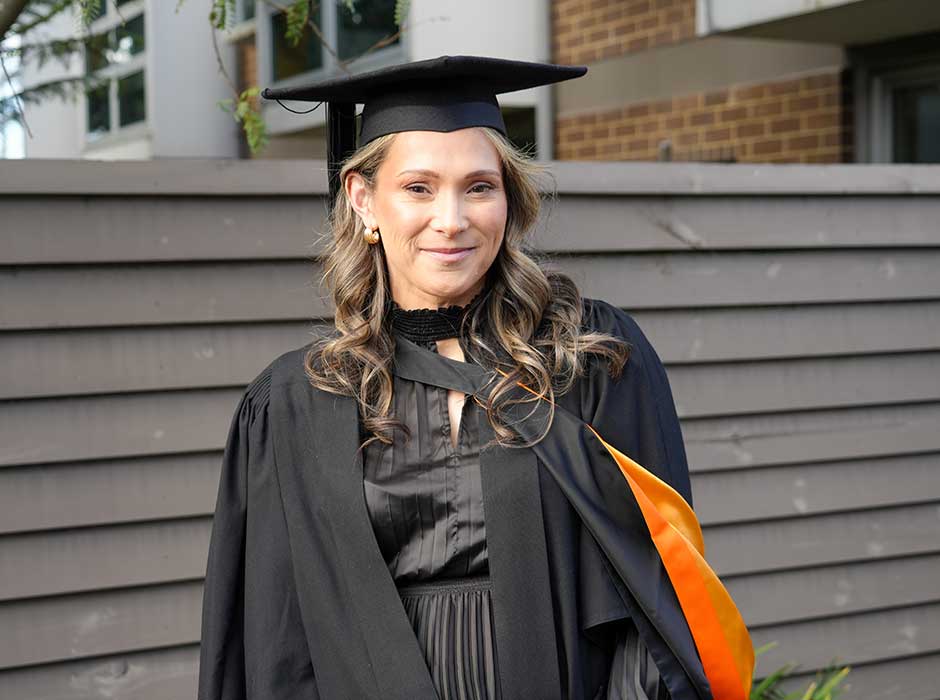
CEO, elected Councillor, mum of four, Heniti Buick graduated with a Master of Business Administration with plans to help her rural hometown flourish.
When Heniti Buick began at the University of Otago – Ōtākou Whakaihu Waka at 17, she did not have a “grand career plan”.
“I just wanted to go to the best Uni and be sent far from home.”
She completed both her undergraduate and postgraduate studies in health sciences and spent a decade working as a dietitian before deciding to return to Otago.
“I just felt like there was a different scale I could work towards.”
Today, Heniti (Ngāti Raukawa) is CEO of Te Puna Oranga, a kaupapa Māori organisation providing services in her community, an elected Ōtaki Ward Councillor, a mum of four, and, as of this weekend, a Master of Business Administration (MBA) graduate.
The MBA wasn't just about the qualification, she says. It was about understanding the systems that shape her community so she could change them from within.
“It's hard work trying to change a system not built for you, designed for you or by you.
“But we only need to understand the Pākehā world to move as Māori within it. The MBA provides the tools to understand that world.”
For Heniti, the value of that learning was immediate.
“As soon as I learn something, I straight away put it into practice.”
She applied concepts from each paper directly to her work at Te Puna Oranga, testing new knowledge in real time.
“I loved every paper – economics, finance, strategy, even artificial intelligence – it's an eye opener.”
Her final consulting project examined community facilities in Ōtaki – what was available, who was using them and whether there were opportunities to bring resources together. The council is now using that work to inform its next project.
For graduate Heniti Buick, returning home to Ōtaki has always been inevitable.
“I love Ōtaki. Every time I try to leave, I end up coming back. It’s the place I’m supposed to be,” she says.
Balancing the MBA with running an organisation, serving on council and raising four children was no small feat.
“Luckily the programme was often late nights and my husband’s super supportive of whatever learning I’ve got myself into. He’s used to it. He’s the opposite, so he’s like, ‘You do you, I’ll do the kids’.”
That support made all the difference.
“I couldn't have done it without that. I would have run myself into the ground, which I surprisingly didn't do.”
For Heniti, the rewards of her achievement won’t be found walking across the graduation stage. In fact, she contemplated skipping graduation altogether.
“I just want to celebrate with my kids. I know that one day what I've learned and what I’m doing in my community is going to benefit my kids, their friends, their moko, and that's all I need.”
Most of her wider whānau didn’t even know she had returned to study.
“For the sake of this story, I put it in the family group chat.”
Her mother told her she was “super proud”, while her older brother – who “never speaks” – called it “an awesome achievement”. Her youngest sister had another take: “I had no idea and I'm not surprised. You're such an overachiever.”
That reaction captures something fundamental about Heniti's approach. She doesn't do things for recognition.
“I just do my thing, and I do it to satisfy myself. I don't do it to show people what I'm capable of.”
She ran for council about a year ago, toward the end of her study.
“Of all the things I can do, I can't be stagnant and not learn. With my MBA finishing, I needed to find a new place of learning, somewhere that I’m out of my comfort zone.
“That’s where council came in. That's my learning zone now.”
Her next ambition for Te Puna Oranga is significant – a purpose-built facility for integrated health services. Her hope is to create something that outlives her. Something she can design, build and walk away from, while it flourishes and enriches her community in Ōtaki.
“When I first stepped into Otago, I was running away.”
In her second year, her brother and his friends joined her.
“I took five from Ōtaki, a small rural community. All five of them followed me to Otago.”
Even her husband, who she was dating at the time, followed her down. Heniti recalls telling him, “You can’t just be my boyfriend, you have to study too".
“All of them now are in really good positions because they thought it was a good idea.”
And after a journey from Ōtaki to Otago and back again, Heniti knows exactly what all that learning is for.
“If you love what you do, there is no kaupapa that will stop you.
“I'm super lucky and I love what I do. I have a supportive husband, four healthy kids, a dream job in my hometown, and that all came from moving down and getting the mahi done.”
-Ani Ngawhika, Kaitohutohu Pāpāho Māori
Tohu Paerua Whakaritenga Pakihi
Established in 1976, the Otago MBA emphasises practical application of business theories through case studies, live cases and professional consulting engagements. Preparing students for careers anywhere in the world, we offer diversity in class and a rigorous practice-oriented curriculum with strong elements of international business.
View