
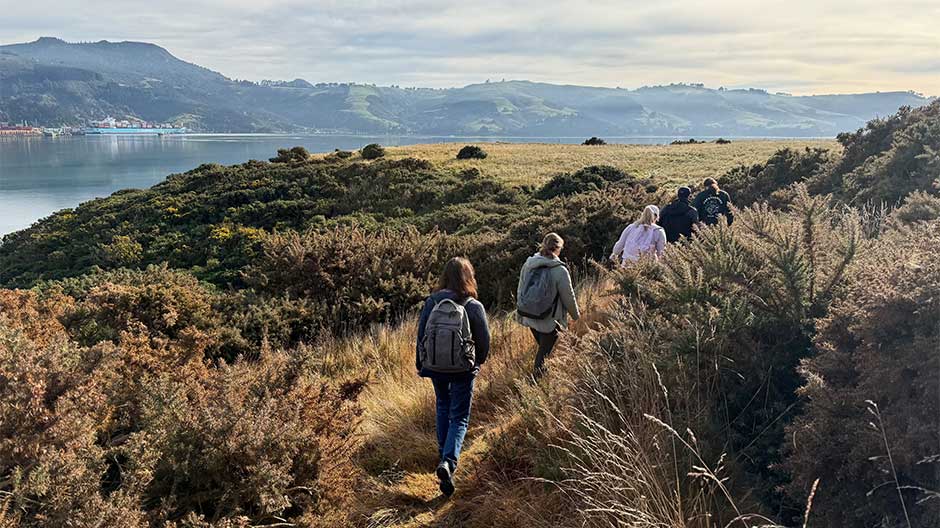
Centre for Educational Design and Innovation spent a day on the Otago Peninsula, connecting as a team while using their social impact leave to help with regeneration work at the Portobello Marine Centre.
University of Otago staff and students are invited to step away from their desks and experience sustainability in action through volunteer field trips to the Portobello Marine Centre on the Otago Peninsula.
Centre for Educational Design and Innovation Operations Manager Suzanna Turner recently took up the invitation with her team and spent a day at the Marine Centre with Head of Sustainability, Tumaki Ray O'Brien, and Kaiwhakahaere Kaupapa Ben Sommerville.
“The location was definitely a highlight. It is a breathtaking spot, and walking out to the headland through the areas where regeneration has already taken place really helped put the work in context,” Suzanna says.
The field trip appealed to Suzanna as a chance for her team to step away from the desks and do something practical together that connected with the University’s sustainability work.
“A lot of our work is about supporting teaching, learning design and innovation, so it was useful to take some time to think about how sustainability fits into that,” Suzanna says.
She says the best part of the day was the conversations.
“Ray gave us some thought-provoking questions linked to the Tī Kōuka Sustainability Framework while we were working, and that sparked some lively and interesting discussion.
“It also helped open up a conversation about sustainability and how it relates to our work.”
The regeneration project was initiated by the Ecology programme in 2021 and is now focused on maintaining existing plantings by protecting them from rabbits and removing invasive grasses.
“We broke into groups and worked together to clear and protect the plants. It was simple, practical work, but it felt worthwhile.” Suzanna says.
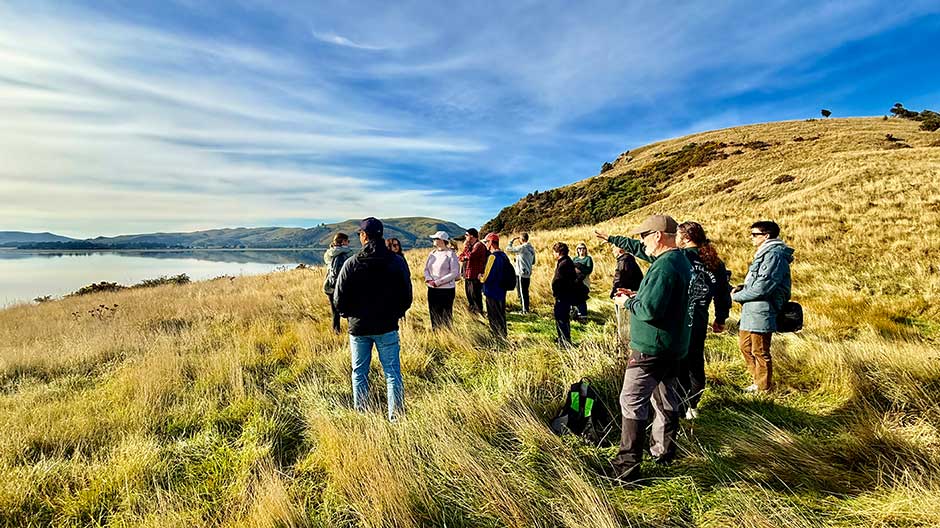
The University of Otago Sustainability Office’s volunteering field trips on the Otago Peninsula are a great opportunity for staff and students to get outdoors, engage in regenerative work and connect with the whenua.
The field trips include transport to and from the peninsula from campus, as well as shared kai, and an opportunity to contribute to environmental restoration while learning more about the University's sustainability work.
“Whether you’re joining as a group or an individual, the field trips are a great way to connect take some time out of the office and connect with the whenua,” Ray says.
He says the day is also an opportunity to learn more about the work of Marine Studies Centre and gain insight into the environment from the bottom of the ocean to the top of the hill. It is a chance to see sustainability in action and explore how Tī Kōuka, Otago’s sustainability strategic framework, is helping shape practical outcomes across the University.
Ray says the Otago Peninsula is an area of great significance for the University. It is where the harbour tides inspired our new tohu.
“It’s also a place steeped in history, from Kāi Tahu pā and fishing sites, through to Scottish settlers on Quarantine Island.”
Beyond the environmental benefits, working with the earth is great for promoting physical and mental wellbeing, reducing stress and improving cognitive function and creativity, he says.
Otago Manager Staff Wellbeing Suzie Bartlett says the field trips are a great example of how our new staff wellbeing framework, He Oraka Tōnui, and and Te Kōuka come together to support staff wellbeing, by contributing to connection, belonging, psychological restoration, cultural wellbeing, physical activity and regeneration.
“Through volunteer field trips we are creating restorative environments that support both environmental sustainability and staff wellbeing,”, Suzie says.
Ray says that no prior experience is required, and there are a wide range of tasks available to suit different abilities and interests.
Participation qualifies for social impact leave for full time staff and will be recognised with a Tī Kōuka Ora e-badge, acknowledging your contribution to sustainability, wellbeing and environmental stewardship.
Ben says he’s looking forward to connecting with different groups and individuals across the University and sharing his knowledge and passion.
“Bringing people together through contribution to such a beautiful place is a privilege and I’m so excited to share in it with you all,” he says.
Check upcoming dates and register your interest here. To enquire about bespoke dates for groups or if you have any other questions, please reach out to ben.sommerville@otago.ac.nz
Portobello Social Impact Leave
CEDI tell the story of their recent trip to Portobello to look after some plants, learn more about Tī Kōuka, and enjoy each other's company.
Read transcript
Back in May, the CEDI team hopped in the bus for a field trip.
Ray O'Brien and Ben Sommerville from the Sustainability team had invited us out to the Marine Studies Centre to spend our Social Impact leave together.
We quickly discovered that a trip to Portobello is a pretty fine way to spend a workday.
We spent the morning getting stuck into some restoration work, helping protect and realease native plantings, and generally doing our small part for the landscape around the Marine Studies campus.
But the day wasn't just about rolling up our sleeves.
We enjoyed a guided tour of the Marine Studies Centre, learning about its history and current research.
Standing looking out across the harbour, on a perfectly calm autumn morning, it became easier to see the bigger picture.
It’s a great reminder that what we do at the University really matters.
A change of work place definitely changes the conversations too. Away from the office, people slowed down, asked different questions, and generally enjoyed having a bit more space to think.
By the time we headed home, we'd contributed to the regeneration of a special place, learnt something new, and spent a day that was just as good for our own wellbeing as it was for the environment.
That's a pretty good way to spend a day.