
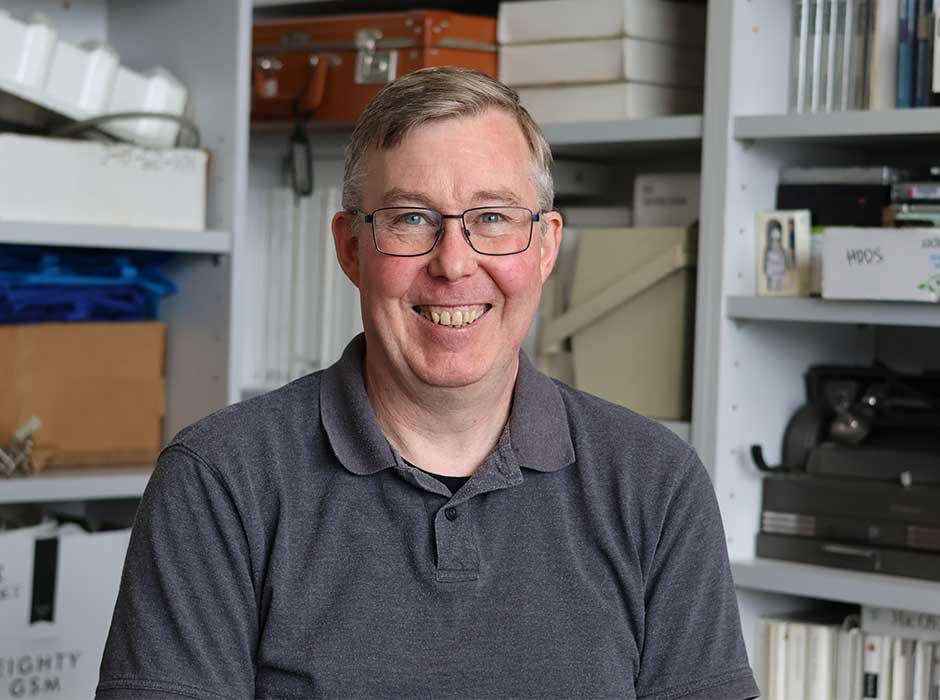
Nigel Stanger, recently promoted to Senior Lecturer in the School of Computing, says even he can get frustrated with computers. “Turning it off and on again does sometimes work,” he admits.
Nigel Stanger, who’s recently been promoted to Senior Lecturer at the School of Computing, uses technology to avoid boring tasks.
“There’s a quote that the best programmers are the laziest programmers because they’ll spot what’s tedious and automate it,” he says.
“I’ve written automations to click on things for me in the University’s reporting systems. It’s sped up some processes quite dramatically.”
Nigel also harnesses the power of technology to make life easier at home.
“I have half a smart house. I’ve got a few things wired up – I like tinkering around with this kind of thing. You can buy drop-in smart control modules that go behind your light switches.”
Technology and computing have come a long way since Nigel’s introduction to the field at Waitaki Boys’ High School in the 1980s.
“We had a bunch of Apple IIs and miscellaneous 1980s-vintage computers, and I got into programming at that stage,” Nigel says.
“I was mostly messing around writing games or typing code listings out of Bits and Bytes magazines. You’d buy a magazine, type the code out of it, and then you’d have a game. It felt like quite an advanced thing that you could do at that time.”
Nigel came to Otago to study Computer Science in 1985 – before he’d even had a computer of his own.
“The Computer Science department had early Macintoshes, those beige ones with floppy disks. I’ve seen the entire progression since then.”
Nigel says computing went in “leaps and bounds” during the 80s and 90s due to an exponential growth phenomenon called ‘Moore’s Law’.
“The number of transistors on a chip was doubling every 18 months or so, but the chips weren’t getting bigger, so for the same size of chip you were getting twice as much. That hit a wall in the early 2000s, when we couldn’t run the chips any faster because they’d melt.”
Nigel has seen all these changes unfold from the University of Otago.
“At the time I was finishing up my Master’s, the new head of Information Science was starting up a database paper. They were looking for tutors, and I joined the department as basically a teaching fellow.”
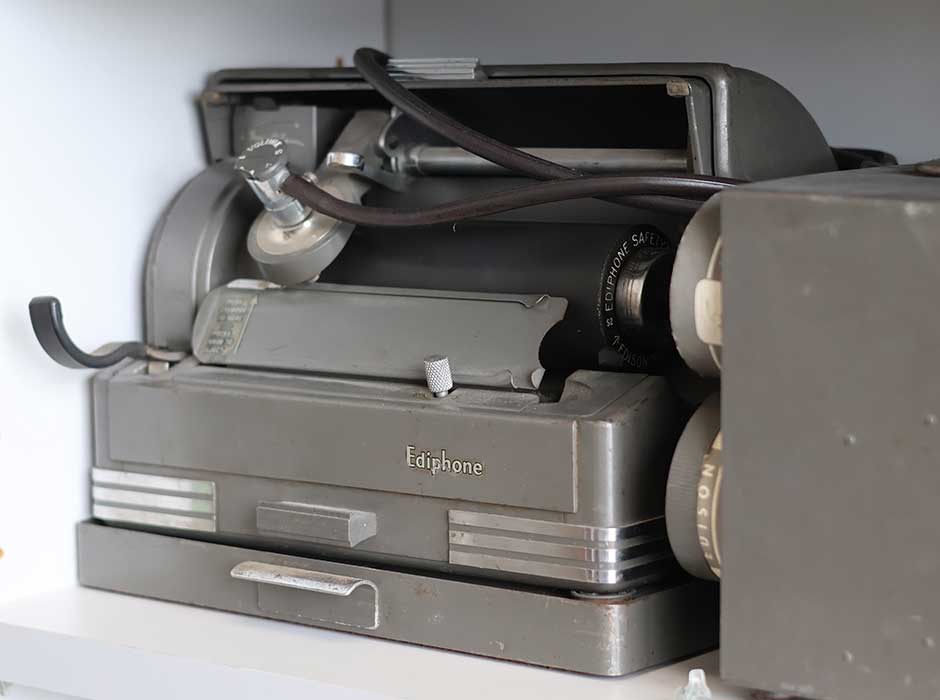
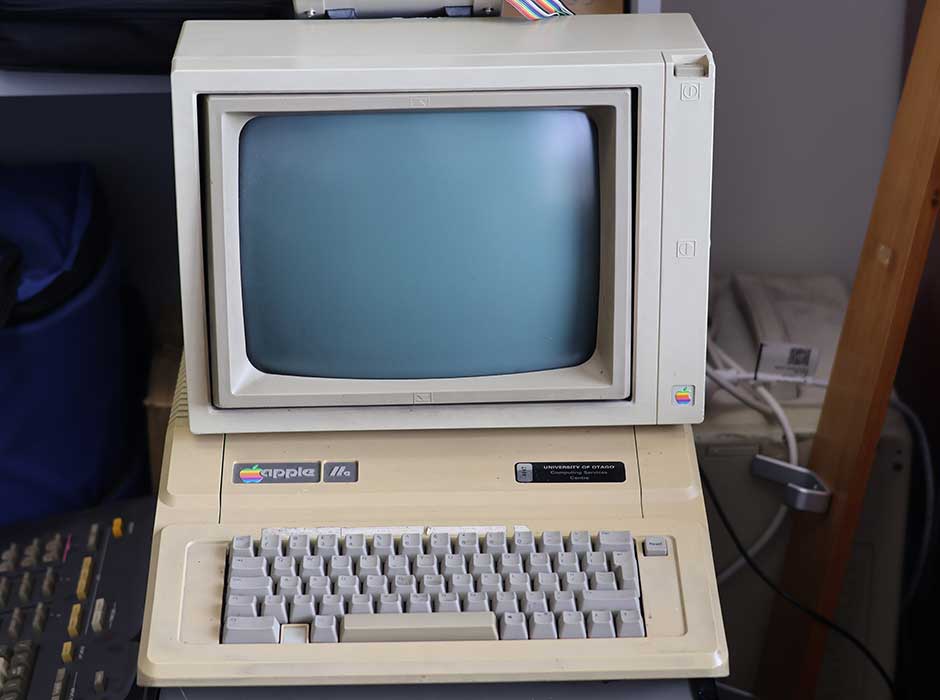
Having an academic job meant Nigel could finally afford his own computer. It also propelled him into a PhD in data modelling.
“I’ve been teaching and working in the data space ever since, although these days it’s more about what can you do with the data than the database side of it. If you’d told me when I was an undergrad that I was going to be a teacher, I would have laughed at you, because I was terrified of public speaking. But as long as you know what you’re talking about, it’s fine.”
Nigel’s brought his passion for tech-tinkering into the classroom.
“Before lecture recording was a common thing, I started doing it myself. I recorded the video on my laptop and the sound on an iPod and wrote myself a bit of software to automate stitching them together.”
Although technology’s always transforming – with computer ‘assistants’ evolving from Clippy the animated paperclip to Claude the large language model – Nigel doesn’t think students have changed that much.
“Calculators started turning up in classrooms at the end of my time at high school, and people said, ‘oh no, it’s going to make everyone stupid’. But it’s just different. These days students have different tools.”
Nigel says it’s an exciting time at the School of Computing.
“We’re halfway through rolling out our new curriculum. Next year I’m doing a new database paper, which is focused more on data science and business analytics.”
And what about that behemoth built on data – artificial intelligence?
“Is AI going to kill us all? I wonder about that myself. But I doubt it. For all that it has a lot of annoying and terrible aspects, it has great ones as well, if used properly.”
And if he does find himself worrying about dystopian futures, Nigel has plenty of ways to decompress.
“I’ve been doing tai chi for a very long time, and I’ve been learning bass guitar. A couple of us get together on Mondays and play Genesis songs.”
-Kōrero by Kathryn van Beek, Communications Advisor| Kaiarataki Pārokoroko
School of Computing
We teach, research, and innovate across all core areas of computing, solving real-world challenges and shaping the next generation of tech leaders.
View