
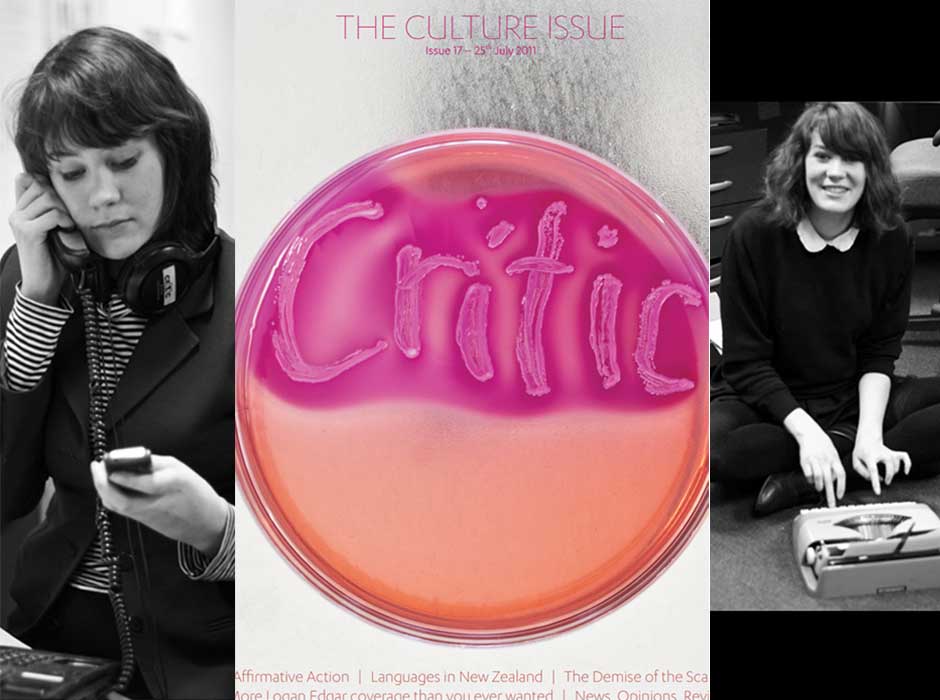
Pictured left and right: Julia Hollingsworth during her time as editor of Critic Te Ārohi in 2011; and middle: a cover of the magazine she was proud of; for its annual ‘culture’ issue, she asked a member of Otago’s Division of Sciences team if they could write the word ‘Critic’ in a petri dish
Picking up a CD from the office of Critic Te Ārohi was the start of a successful, adventurous career in journalism for Julia Hollingsworth.
Now working in Sydney as a Live News Editor for Guardian Australia, Julia still remembers that first small step into the media.
“It would have been in the first few weeks that I was at Otago. I found out you could go to the office and get a CD and review it, and I was like ‘this is amazing! Not only do I get a free CD, I also get to write about it’.”
She did have a little insight into student media, having grown up in Wellington reading Salient, the Victoria University of Wellington magazine, which she found lying around in cafés.
“And my friend who had gone down to Otago the year before me would send up copies of Critic that she would annotate, like ‘this is a great article’. This is so nerdy to talk about.”
While at that stage she hadn’t thought about a career in journalism, she says she had always been interested in writing.
“When I was a kid I would make little newspapers, which tells you something. And I would always be writing stories or making books.”
After planning to study English Literature for her BA at Otago, Julia took a Philosophy 101 paper and never looked back.
“All I wanted to do was talk with my friends about all of these big questions about existence and stuff, so my major ended up being Politics and Philosophy, mostly political philosophy.”
“When I was a kid I would make little newspapers, which tells you something."
During her student days, she says she especially loved the Dunedin music scene and made a lot of good friends while she was at Otago.
“Dunedin was a really fun place to live. Because it’s so small you felt like you were part of a community. You’d be walking down the road and bump into friends, and then that would turn into having coffee with them.”
And then, there was Critic Te Ārohi. Moving on from the CD reviews, Julia became a reporter for the magazine in February 2010, covering the Otago University Students’ Association (OUSA) news, which she describes as “sort of like being the political reporter on campus”.
Despite weekly, sometimes boring and often long, student executive meetings, she loved it.
“It was so fun to be witnessing the mechanics of decision-making and seeing the different personalities.
“I also just really liked coming to the office and being involved in creating this thing. And because we were students, it would often kind of come together at the last moment, so it would be really long hours on one or two of the days. But it was so fun, working with people who I might not have met otherwise, just feeling part of this project.”
She was named Best News Reporter in the Aotearoa Student Press Awards for 2010, and at the end of that year, she took on the role of Critic Te Ārohi editor.
While she enjoyed the freedom and creativity of producing the magazine, she says she also felt the weight of responsibility, making sure people met their deadlines and figuring out which stories to cover.
“I definitely remember being quite stressed, but I also remember feeling very inspired. There was just this huge range of things that we could do.”
Passionate about the visuals of the magazine, one of the things they did was display the word Critic on the cover in a different way for each issue of 2011, relating it to the magazine’s theme.
“We had a culture issue and went to the Science department and got them to grow [the word] ‘Critic’ in a petri dish.”
With two print deadlines a week, it meant a lot of late nights, working into the early hours with the designer to get everything sorted.
“We were happy to work these really, really long hours because we just wanted it to be as good as it could be. Which is a nice feeling, because I think when you go into the workforce you don’t always get jobs where you feel like that.”
The main issue she remembers from her time at Critic Te Ārohi was the Voluntary Student Membership Bill, which passed in 2011.
“We were really worried about the impacts of the Bill . . .it sort of felt like there was an existential threat that whole year.”

Julia on a hike with a friend in China.
After leaving Otago, Julia decided to follow the media path rather than philosophy, and went to Massey University to do a Postgraduate Diploma in Journalism. While she was there, she was awarded an Asia New Zealand Foundation scholarship, which was aimed at getting journalism students into newsrooms in Asia. It was the beginning of a long association and fascination with China.
“It was clear that China was a very important country to know more about and to be thinking about.”
After finishing her diploma, she spent six weeks at the state-owned newspaper Shanghai Daily.
“Shanghai was fascinating to me. I guess coming from Wellington, Shanghai was this amazing city where it felt like everything was happening. It felt very exciting to be there and Shanghai Daily was a really interesting newspaper, there were so many differences from what New Zealand media felt like. I just came away from that trip feeling like I really want to get back to China.”
Back home, she worked for Australian Associated Press and then in 2015 won a Prime Minister’s Scholarship and headed to Tsinghua University in Beijing to study Mandarin.
After her studies, Julia worked as a reporter at the South China Morning Post in Hong Kong, and then as a Features Editor for Sixth Tone, an online magazine in Shanghai.
She says the main difference between media in New Zealand and China was the level of freedom journalists had to choose and report on issues.
“Also, the newsroom vibe felt quite different. It was probably more rigid in terms of what people could do.”
Julia went on to work as CNN Digital News Producer and CNN Features Lead in Hong Kong, and during this time covered the 2019 protests sparked by the government’s proposed extradition laws.
“I was out covering the protests on the ground, but also it was a story that we were kind of living, because it was all anyone was talking about.”
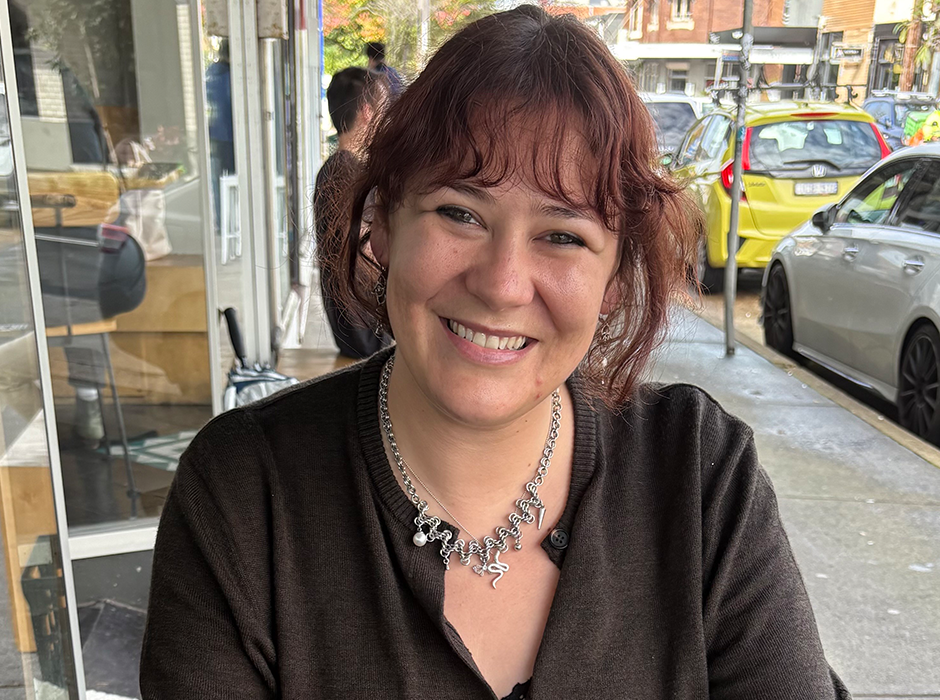
Former Critic Te Ārohi editor Julia Hollingsworth is now a Live News Editor for Guardian Australia in Sydney.
In 2022, she decided it was time to move closer to home. She relocated Sydney, first working as Managing Editor for Seven Network, before moving into the role of Assistant News Editor, then Live News Editor at the Guardian Australia.
“Sydney felt like a really good place to move to because it still felt like an interesting big city, but I could be closer to family.”
In her current role, Julia assigns reporters to breaking news stories, decides what goes up on their blog and which other stories need to be covered.
“At the same time, I’m thinking about the next day. Do we have a splash? How are we going to organise our stories?
“It's commissioning, working out how to play the stories, alerting to stories, overseeing the flow of news.”
It’s a long way from writing a review from a freebie CD at Otago, but Julia says she still believes student media has an important role to play today.
“I think it was the most amazing opportunity to be able to grow and learn and have so much responsibility and so much freedom early on.
“When you leave journalism school and you do your first journalism jobs, that is just not something that happens. So it was this incredible opportunity and I really hope that that does continue, in whatever format.”
In terms of the current media landscape, she says that while it “feels like there is a lot of misinformation and disinformation, which is really scary, I think that – I don't know if I'm just going to sound really naive and idealistic – but I think we just have to keep on creating good quality media that offers value to readers and educates them and interests them.
“I think the reality is that the media does something that we need. Even if the form of media changes, there's going to need to be something that educates people and holds power to account and teaches people about the world.”
And her advice to students thinking of doing a music review for Critic Te Ārohi?
“When I did my journalism course, I remember there being a really negative view of journalism. I remember being told we're probably all going to end up in PR. And there was a lot of negativity about the media environment.
“Some people have left journalism, but there are people in my journalism class who are still in journalism 15 years on. I think if you're really passionate about it and you're really interested in it, then it's worth pursuing and it is a really interesting career. I would still encourage people to go into it if that’s what they’re passionate about – the opportunity to talk to people about all these different topics is amazing.”
-Kōrero by Margie Clark, Communications Adviser, Alumni
Alumni & Friends
If you are a former student, staff member, friend or supporter of the University of Otago, we warmly welcome you as a member of our alumni community.
View