
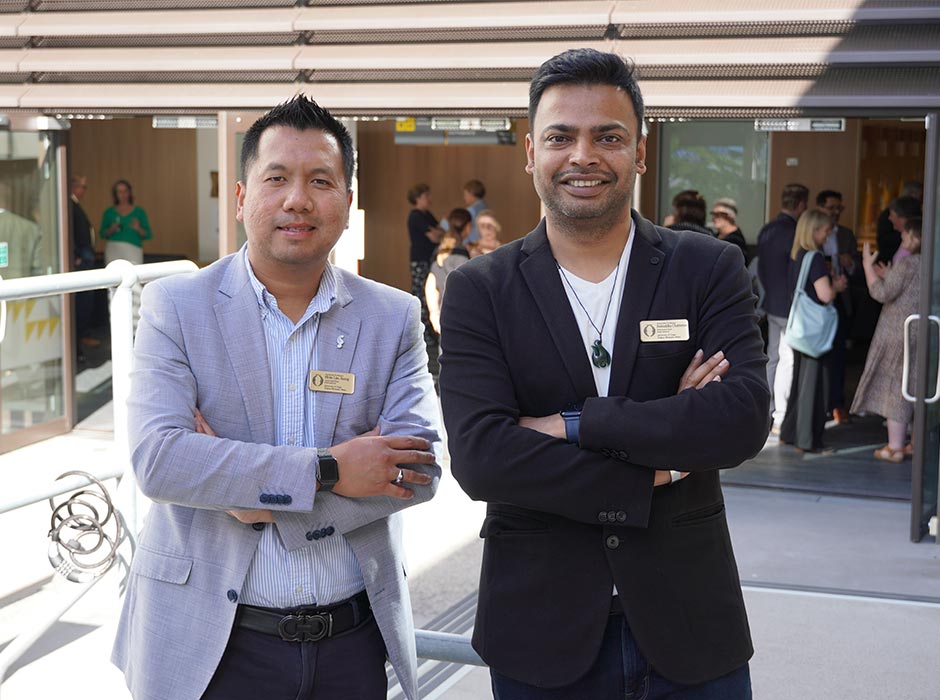
Having known each other for more than 15 years, Associate Professor Htin Lin Aung (left) and Associate Professor Aniruddha Chatterjee were elated to be the first academics ever appointed to the role of Associate Dean International in a dual capacity for the Division of Health Sciences, especially having been Otago international students themselves.
Once international students themselves, Associate Professors Aniruddha Chatterjee and Htin Lin Aung are the first Otago academics jointly appointed to the role of Associate Dean International for the Division of Health Sciences.
They have spent their first few months in the position using what they have learnt from their own personal experience to empower and equip University of Otago international tauira to thrive.
Pro-Vice-Chancellor of the Division of Health Sciences Associate Professor Megan Gibbons says both academics were appointed as they each had first-hand experience as an international student, staff member, academic, teacher and researcher.
“Htin and Aniruddha have taken up the role with the type of enthusiasm only known to those who have a personal understanding of the international space,” Megan says.
“They have a vested interest in the success of international students and are already working hard to support and improve on our global events, opportunities, study pathways, programmes and policies.”
Both Htin and Aniruddha are among the rare few to have been awarded both of New Zealand’s most prestigious fellowships: the Royal Society Te Apārangi Rutherford Discovery Fellowship and the Health Research Council of New Zealand’s Sir Charles Hercus Health Research Fellowship.
Having lived, studied and worked at the University’s Dunedin campus for decades, the pair were elated to be appointed to the role in July. They say it’s an opportunity for them to give back to the communities that have given so much to them.
Aniruddha and Htin have known each other for more than 15 years and were delighted to hear they’d been appointed to the role in a dual capacity, having spent many years supporting each other both professionally as academics, and personally as immigrants who now call Dunedin home.
Aniruddha Chatterjee
No stranger to adapting quickly, Aniruddha says being appointed Associate Dean International has meant learning a great deal fast.
To best serve the large cohort of international students they currently have, recruit future students, network with overseas academics and institutions, establish new international connections for Otago and grow and improve internal policies, Aniruddha says they have been putting innovation first.
“It has been both energising and intense taking on this role and so, to manage its demands, Htin and I are always considering how we might improve things,” Aniruddha says.
“The world is changing, and internationalisation is a big part of that. It’s something I’m personally familiar with and so I hope to develop a fit-for-purpose strategy that can help guide the Division and hopefully the broader University during these unique and ever-changing times.”
“Having come to Otago 16 years ago from Berhampore (in West Bengal State) in India, being given this role is a sort of full-circle moment where I can now help the next generation of international students.”
Aniruddha grew up in a regional area in India with a deep sense of community similar to what he’s found in Dunedin. With a high school headmaster for a father, he was raised to value education, health and wellness.
Knowing this, it’s unsurprising he enjoyed studying the sciences in school and spent many days captaining his cricket and soccer teams.
It was this upbringing that motivated Aniruddha to combine his passion for science and health and go to university to pursue this as a career. He studied Biotechnology and completed his Bachelors and Masters from Southern part of India (Hyderabad and Vellore). When planning to study overseas for his PhD in the emerging area of epigenetics, he came across the University of Otago.
“Though I was offered the opportunity to complete my PhD in various parts of Europe, I was drawn to Otago to do this because here they required computational analysis and working with people in their clinical research, which was novel at the time. I also felt highly supported by my PhD supervisor and the Department.
“Knowing that, I applied for and received the New Zealand Centre of Excellence (NRCGD) Scholarship and started in Professor Ian Morison’s lab in what is now the Faculty of Medicine’s Department of Pathology and Molecular Medicine in Dunedin School of Medicine.
“Funnily enough, my passion for health and sports meant I actually knew a great deal about New Zealand before moving here because of the Black Caps cricket players. I pretty much knew all NZ cricket grounds and their details.”
After completing his PhD, Aniruddha considered taking up offers to complete further research overseas, but decided to stay at Otago.
Now, 16 years later, he remains in the same Department and lab space and is personally moved to be appointed an Associate Dean International.
“Acknowledging this milestone is what provides me with enthusiastic motivation and a deep desire to keep going and to innovate in whatever small or big ways might be possible – even on my busiest days,” Aniruddha says.
As Head of Otago’s Epigenetics, Disease and Phenotype Laboratory, Aniruddha has a very active research lab and already has a global network and hopes to leverage this in his journey to serve others.
“The world is changing, and internationalisation is a big part of that. It’s something I’m personally familiar with and so I hope to develop a fit-for-purpose strategy that can help guide the Division and hopefully the broader University during these unique and ever-changing times.”
Aniruddha encourages current and future international students to not be overwhelmed by culture shock, but to try to take differences in their stride and invest time into building a support network.
He says Otago is very welcoming and so students can feel comfortable to balance hard work with a sense of humour and spend time enjoying Dunedin city and its beautiful landscapes. In his words and for him, “Otago is a lifestyle”.
Htin Lin Aung
Based in the Department of Microbiology and Immunology, Htin’s journey as an international student was not unlike Aniruddha’s, but began with him working from the ground up.
Originally from Myanmar, Htin began at Otago nearly 25 years ago as a young international student looking to complete the University’s Foundation Studies programme (now the Pathway and English Language Centre).
The entry-level programme inspired his curiosity for what would end up being a lifelong passion for academics and, more specifically, contributing to antimicrobial resistance research as a molecular microbiologist.
“After completing the foundation programme, I went on to complete a Bachelor of Science (Honours) in Genetics and then a PhD in Microbiology,” Htin says.
“Today, I am an academic scientist and Associate Professor, serving as Co-Deputy Director of the Otago Global Health Institute (OGHI) and lead an internationally recognised, transdisciplinary research programme that brings together biomedical sciences, social sciences, and public health to address complex global health challenges.”
Htin’s passion for academia is clear and perhaps rivalled only by his desire to support and enhance the experience of international students.
Htin says his first few months in the role have been incredibly enjoyable and energising, as the demands of the position keep him busy, but in a rewarding way.
When he first arrived at Otago as an international student, he was filled with both excitement and nervousness as the idea of navigating a new country, culture, and academic system was hugely daunting.
However, the experience ended up being incredibly enriching and genuinely transformative as Htin would go on to thrive at Otago and make Dunedin his home.
“Studying abroad can be challenging, but it is also an incredible opportunity to grow, and Otago offers an unparalleled student experience. Build connections with both local and international students, because your community will become your anchor."
Just as Otago was a supportive and welcoming environment for him, Htin hopes he too can play his part in his new role as Associate Dean International to support not only the academic success of students, but their personal growth, professional development, and overall wellbeing.
“Having walked that path myself, I am deeply committed to championing initiatives that help international students feel truly welcomed, valued, and connected to the Otago community from day one.”
In addition to strategising and improving programmes and policies alongside Aniruddha, Htin says they will take a relationship-based approach to their work, where mutual trust, respect and care are at the centre of the work they do.
The two will focus on building local and overseas relationships with professional and academic stakeholders, and students and staff.
He says their function is to play a vital role in advancing Otago’s international strategy and harness these relationships so international students might benefit from the world-class research and teaching being offered here.
As a former international student himself, Htin encourages students to be open and curious because, by trying new things and meeting new people, they will likely come across exciting opportunities for growth.
With a culture focused on pastoral care, overseas students coming here will find the people around them are happy to help and are championing them to succeed.
“Studying abroad can be challenging, but it is also an incredible opportunity to grow, and Otago offers an unparalleled student experience. Build connections with both local and international students, because your community will become your anchor.
“Above all, enjoy the experience, knowing that there are people like Aniruddha and I working hard to ensure this is an environment where you can thrive, contribute, and find a real sense of belonging.”
– Kōrero by the Division of Health Sciences Communications Adviser, Kelsey Swart.
Te Wāhanga Matua Mātau Hauora
The Division of Health Sciences delivers undergraduate programmes in Biomedical Sciences, Dental Technology, Dentistry, Health Sciences, Medical Laboratory Science, Medicine, Oral Health, Pharmacy, Physiotherapy, and Radiation Therapy. For those looking to build on their degree the Division offers 100+ postgraduate programmes in health.
Find out more