

Japanese language graduate Blake Turnbull is now a lecturer in the Department of Intercultural Studies at Ōtani University in Kyoto.
Blake Turnbull’s interest in Japan and the Japanese language began with karate class in Dunedin at the age of four.
Karate took Blake to Japan on a club trip when he was 16, and he pursued his interest in the Japanese language at university, graduating from Otago in 2013 with a BA (Hons First Class) in Japanese and Linguistics and an MA with Distinction in Linguistics in 2015.
A PhD in Foreign Language Acquisition and Education from Kyoto University followed, and Blake, who has Pākehā, Ngāi Tahu and Kāi Tahu heritage, is now a lecturer in the Department of Intercultural Studies at Ōtani University in Kyoto.
He’s also just published a book, The Complete Guide to English Chunks: Commonly Used Phrases by Native Speakers in Everyday Conversation, consisting of 1000 everyday English phrases and “chunks of language” to help students acquire practical, natural English communication skills.
Although Blake didn’t study Japanese at school, he learned some phrases before his karate trip to Japan at 16, which set him on the path he took at Otago and beyond.
“I was really excited to be able to use Japanese when I was there,” he says. “So Otago had what I wanted, the chance for me to learn Japanese, and I was looking at what would pair well with Japanese, and Linguistics was the natural pairing.”
He says he made the most of everything offered through the Japanese Programme at Otago, and especially praises the teaching he received from Senior Teaching Fellow Haruko Stuart.
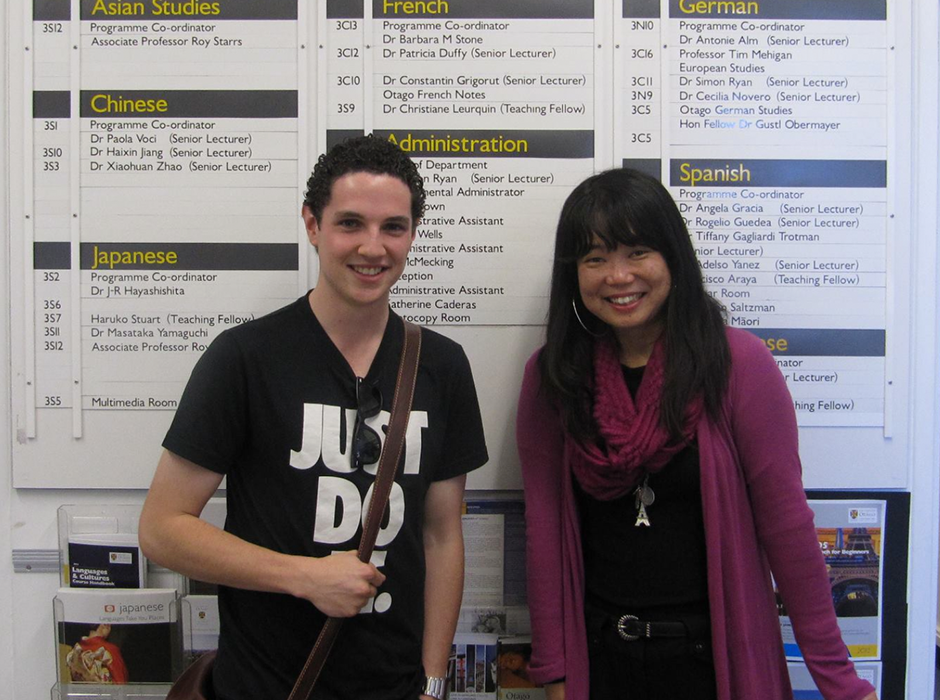
Blake Turnbull in his first year at Otago with Japanese language Senior Teaching Fellow Haruko Stuart.
“It was amazing. Haruko is a very energetic teacher and the energy and motivation she gives her students just really helps you to study and to learn. I went to her office almost every day with questions. It was a really great class and encouraged me to keep going with study.”
Blake says he likes not only the structure of the Japanese language, but the writing system of Chinese characters, Kanji.
“They have a really long history, how they’ve come to be the way they are now, which was fascinating for me at the time. Learning to write those characters, I just found it really fun. I used to practice over and over again.”
He also really enjoyed using Japanese to communicate with his karate masters in Okinawa, Japan, and says it gave him a completely new perspective from which he could understand karate more deeply. Blake holds a black belt in karate.
After Otago, Blake spent a year studying and gaining the highest-level qualification in the Japanese Language Proficiency Test, then moved to Japan for his PhD.
His thesis topic was about translanguaging in language education in Japan – taking bilingual learning strategies and using those in the English classroom in Japan.
From there, he gained a teaching position at Doshisha University, and two years ago secured a tenured position as a lecturer at Ōtani University. He teaches English language, Linguistics and Cultural Studies, and his research focusses on combining language education and bilingualism.
As a teacher, Blake says he began to feel there weren’t many English language resources for his students that were very practical.
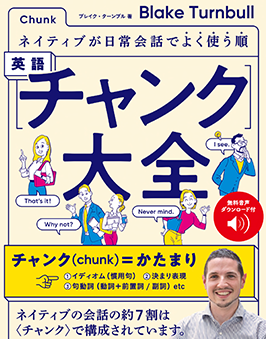
The cover of Blake's recently published book, (translated from Japanese to English), The Complete Guide to English Chunks: Commonly Used Phrases by Native Speakers in Everyday Conversation
“A lot of the textbooks or guides available in Japanese are not very natural, the way that English is really used,” he says.
“I like looking for these things to try and help my students, and I wasn’t really coming up with many useful resources to help them acquire natural English communication skills. So I thought well maybe I would just write something myself.”
After approaching a publisher, he worked with an editor who asked him ‘what would be a quick way for students to improve their English communication skills?’. Blake came up with the idea of memorising useful and practical “chunks of language” that would be readily available to use in different contexts.
The Complete Guide to English Chunks: Commonly Used Phrases by Native Speakers in Everyday Conversation was published in November 2024. Now onto its third printing, it has become a number-one best-seller on Amazon Japan and has sold more than 6,000 copies.
“If students can memorise these phrases, they can just use them, without having to process the grammar and think about the structure,” says Blake.
“There are some really small things [described in the book], like ‘it depends’ or ‘same here’ or ‘fair enough’. Someone says something to a Japanese person and they want to just say “oh yeah same here” – that phrase is very natural to us but there are very few books that would teach that in Japanese.
“Others are like ‘the odd one out’ or ‘up one’s alley’ or on ‘it's on the house’. These are kinds of very useful phrases that we take for granted but are not taught in Japan at all. Phrases that you could use in a range of different situations.”
Haruko says Blake was a wonderfully enthusiastic student who took every opportunity offered through the Programme, and created new ones, including a Chat Time group on Fridays at the Otago University Students’ Association (OUSA) for language and exchange students, and organising events for the Japanese Culture Club.
“He was just full of curiosity and interest, and he wanted to know everything about Japan, not just grammar or vocab questions. So I was like, wow. I mean, all my students are very enthusiastic, but he was extra enthusiastic!”
She says Blake knew he wanted to be a teacher, and she felt that for him studying wasn’t difficult, because he was passionate about what he was doing and had a purpose.
“He was just thinking it's not a study thing. It's just what I love to do. So I want to keep doing that.”
She was proud but not surprised when he was accepted for his PhD at Kyoto University. “It’s a big achievement, not many people can do so. It's a big thing, but at the same time, I thought, well, it's natural. I mean, he's been going for it and he deserves it.”
Haruko says his book reflects his experiences as a language learner, and is an effective way to help English learners in Japan.
“Young people have good memories, so they can remember a word quickly. But if you don't know how to use the word, in what context, no matter how young you are or how great your memory is, it won't really stay in your head.
“He’s using his theory as a learner and sharing that with other people, because he wants other people to be like himself ... to learn the language with fun and joy.”