
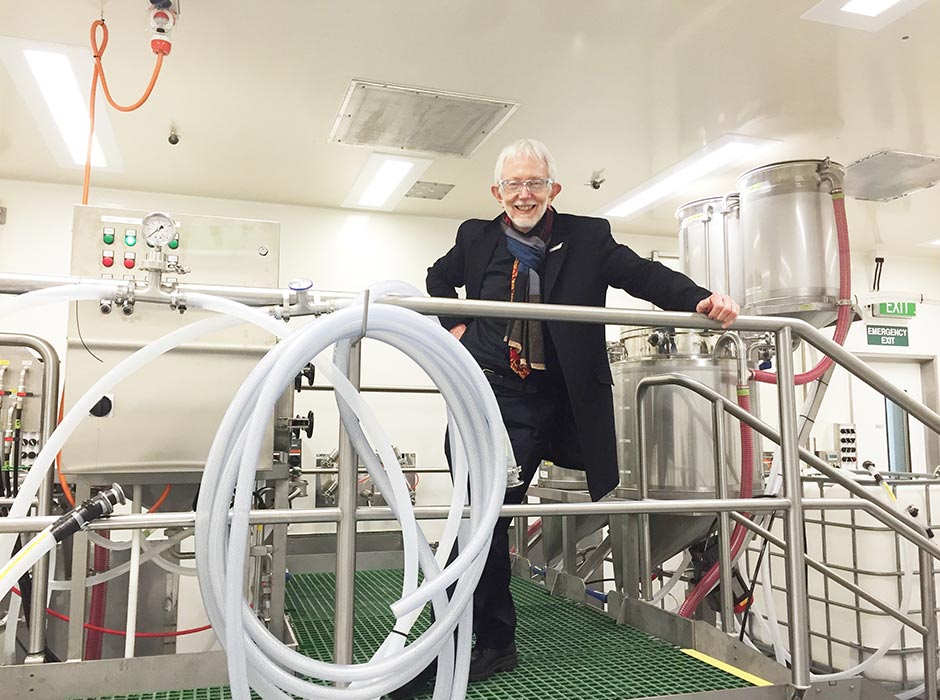
Emeritus Professor Lyall Hanton at the Chitogel manufacturing facility in Lower Hutt, Wellington.
For a boy from Mataura in rural Southland, moving to Dunedin for study in 1973 was a big deal. Professor Lyall Hanton had already settled on studying chemistry – a spark ignited by his third form teacher – and from his room at University College he looked across to the Science II Building.
“I was just a boy from Mataura, and thinking that’s where I wanted to be, I tried to manifest myself doing amazing things in that building,” Emeritus Professor Lyall Hanton says. “And goodness me, 52 years later here I am.”
Following his graduation from Otago and a PhD at the University of Cambridge, Lyall started work in the Department of Chemistry in 1981. This year marks his 44th year on staff, a period that’s included eight years as Head of Department and his appointment to Mellor Professor since 2013.
Over his four decades of teaching, research and community work, Lyall’s achievements have been akin to an exploding hydrogen balloon – his signature class activity he commences every teaching year with.
His accolades include teaching awards and recognition for Distinguished Service to the Sciences. Lyall’s research success in materials chemistry has also included commercialising a wound healing medical gel that’s now making international waves.
In advance of his retirement next month and following his recent recognition as Emeritus Professor, Guy Frederick, Communications Adviser for Sciences, caught up with Lyall for a recap on his time at Otago University, both as a member of staff and (the fun bit) as a student in the 1970s.
Can you give a taste of life as an Otago student in the 1970s?
A big thing in first-year lectures was throwing paper darts at the teacher during class. While many of the lecturers handled it very well, others didn’t, and they would storm out of the room. In my third term, I never had any calculus lectures for this reason! Other antics in class included stamping our feet when the lecturer made a spelling mistake on the blackboard and hissing when students arrived late for class. The joke I make is that today students don't attend lectures, but back then, because of the paper darts, it was the lecturers who weren’t guaranteed to show up.
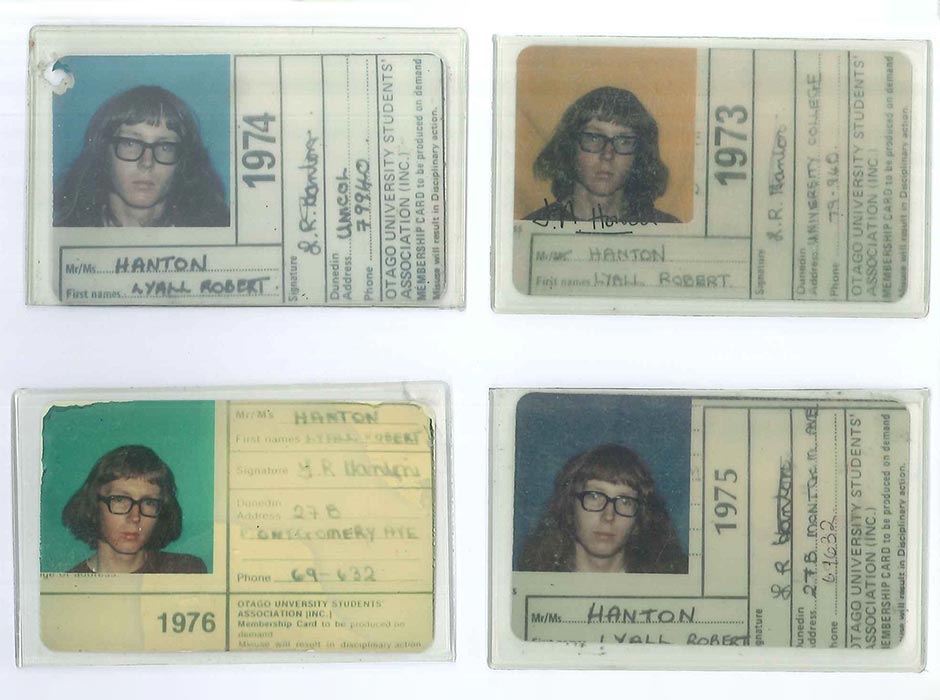
Lyall’s collection of University of Otago student ID cards during his years of undergraduate study.
Where did your passion for chemistry begin?
In my third form at Gore High School I had an amazing chemistry teacher called Shorty Matthews. He introduced the idea that if you understood the compounds you’re working with, then you could apply them to solving everyday practical problems like clearing drains or removing stains. But it was in the sixth form, when I was introduced to the mole concept that underpins all of chemistry, which was the most exciting revelation for me, and from that point there was no turning back.
Fire seems to be a common feature in photos taken of you?
Due to my chemistry experiments, I’ve become known as the explosions and fire guy. What’s not commonly known is that on my first day as a fourth-year honours student, I managed to set the lab on fire. Somehow, I calmly fetched the fire extinguisher and put it out without anyone knowing. In 2017, I reenacted the fireball experiment for the University’s promotional video, which went a little bit far as I managed to singe my eyebrows. With this history of fire, there’s a touch of irony that I became the University’s laboratory manager in 2016 – a role that’s focused on improving the compliance and safety in our labs.
What’s your secret ingredient to being the great teacher you are?
I think to be a good teacher, you've got to be a good storyteller. When I'm teaching 500 students in St David lecture theatre, I treat it as a performance when you must be on your ‘A game’ every time. In every class, I aim to get a good belly laugh out of the class as students will forgive anything if you're enthusiastic - but I have to say that Generation Z is a tough audience to make laugh!
I don’t think this has anything to do with my success as a teacher, but right from the start of my teaching, as a tradition I always wear a black shirt and colourful tie to class. I like to make this effort out of respect for the traditional science of chemistry, but also to show that chemists can be stylish, of course!
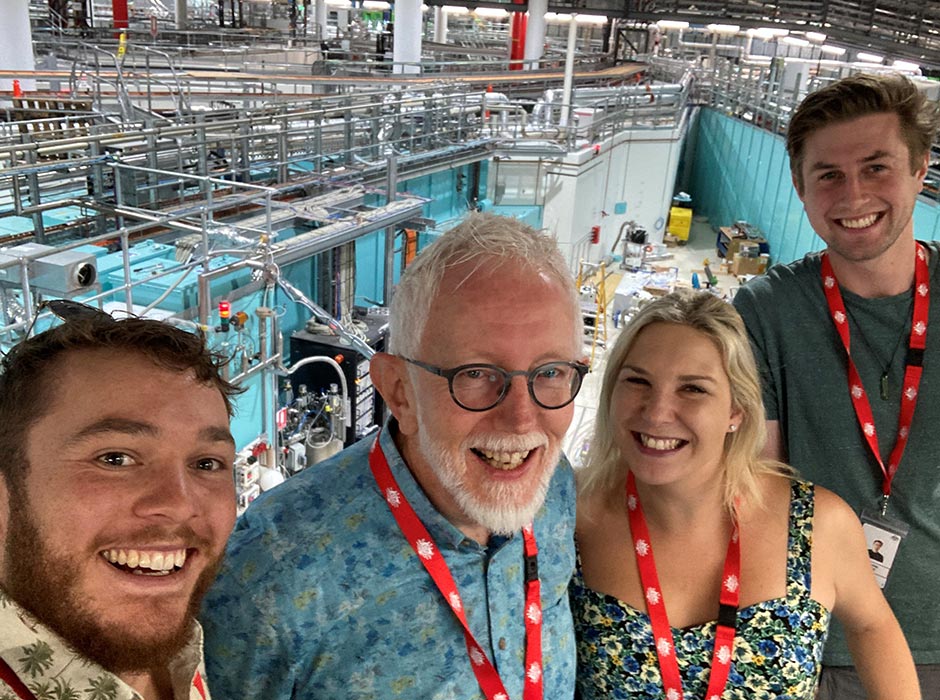
Visiting the Australian Synchrotron facility in Melbourne with researchers (from left) Elliot Nicholson (PhD student), Professor Lyall Hanton, Dr Lauren Macreadie (University of New South Wales) and Nick Page (PhD student).
What’s exciting about your research?
As an inorganic chemist, my research is concerned with the structure and function of extended 3D chemical systems as new functional materials. A fascinating application of my current research is working on metal organic frameworks and their design for storage of hydrogen and other gases. Our work is now exploring flexible frameworks with earth abundant metals that will have massive implications and opportunities in my area of materials chemistry. We’ve also developed tough polymer hydrogels that are mostly water, and ‘wetware gel actuators’, which can expand and contract under stimuli.
What was it like to commercialise your research?
Starting 16 years ago, it’s been an incredible journey that I’d best describe as ‘90% there and 90% to go!’. It took me out of my comfort zone, but the opportunity to work on the project alongside two other chemists and two medical surgeons has been highly collaborative and insightful. The wound healing medical gel, that’s been commercialised through the company Chitogel, has been used to treat over 17,500 patients since 2019 and is currently in a global expansion phase that includes a new manufacturing factory in Upper Hutt. I don’t consider myself an entrepreneur, but in many ways, I feel quite fortunate as not every researcher gets to successfully commercialise their work.
What University projects are you particularly proud of?
During my time as Head of Department, it was a privilege to contribute to the planning and development of the new Mellor Laboratories building. It was an excellent opportunity to consider what a modern-day chemistry teaching environment could be like and bring the state-of-the-art design into reality. One of my favourite parts of the building is the exterior installation of the molecular structure of Laurenene - an extract from the rimu tree with a unique chemical structure. It was named after Denis Lauren, who discovered it in 1970 as a PhD chemistry student in the department.
What does life after Otago look like for you, and any final remarks?
I’m very grateful for my Emeritus appointment, as having future access to laboratory space to tinker away in from time to time will be great. Chitogel is now a fully functioning company, so I will continue to contribute to it in an advisory capacity. I have an only daughter and two grandchildren in Wellington, so there will be more regular trips there. I've got books to read, there'll be some travel, and I like wine, so there’s going to be wine.
It only feels like yesterday that I was a first-year at University College ducking the incoming skyrockets while dreaming of my future in chemistry. It feels simply incredible to have manifested this life and to have had such a fulfilling career. Otago has been right at the heart of it all which I’m very grateful for - and I’m also very pleased I didn’t burn the place down along the way.