
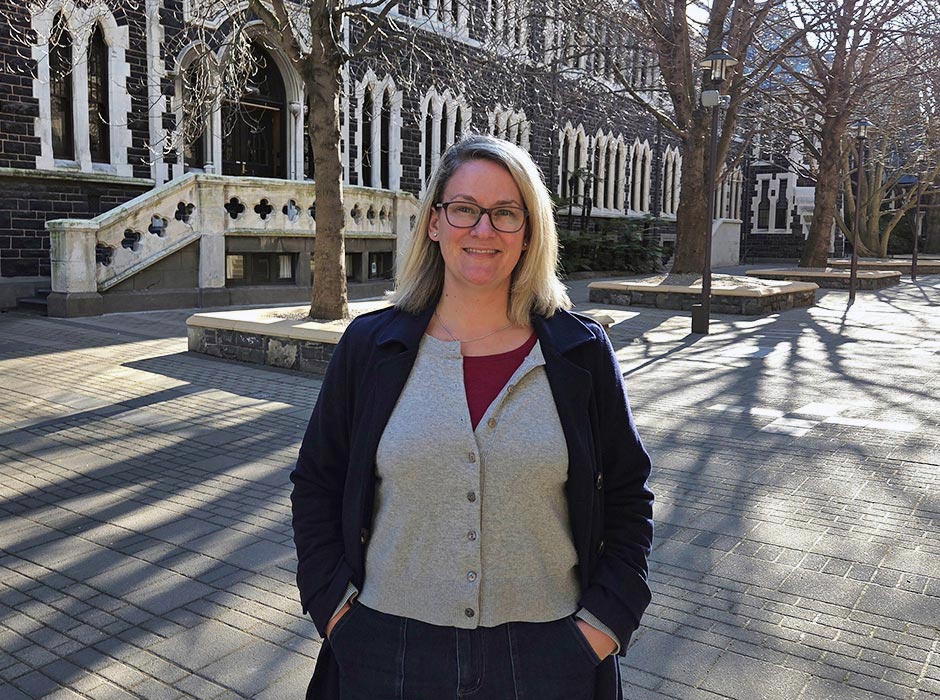
Dr Michelle Walker has temporarily swapped Otago for Oxford, where she will spend the next two years on a Girdlers’ Health Research Council of New Zealand Fellowship.
Early reviews are in – Oxford is officially lovely.
So says Dr Michelle Walker, who recently arrived in the United Kingdom to take up the Girdlers’ Health Research Council of New Zealand Fellowship.
“The fellowship is three years, with two years spent at Oxford University and one year back at Otago University as a Research Fellow with the Department of Psychological Medicine,” she says.
While there, Michelle will focus on the experiences of mothers and their families during postnatal psychiatric illness.
“Suicide is a leading cause of death for new mothers in the months after childbirth worldwide. Understanding women’s experiences of seeking and receiving support for postpartum psychiatric illness is far from complete.”
“I’ll be working at the Nuffield Department of Primary Care Health Sciences (NDPCHS), University of Oxford, which is the top-ranked centre for academic primary health care in the UK.”
Michelle has joined the Medical Sociology & Health Experiences Research Group (MS&HERG) hosted within the NDPCHS. The MS&HERG conducts studies on the experiences of health and illness, and has the Health Experiences Insights (HEXI) website and archive, which is one of the key resources she will explore while in Oxford.
“Being part of this research group will offer me the necessary training in medical sociology and professional development to carry out my proposed research to understand the contemporary factors at play with maternal mental health systems and practice,” she says.
“Suicide is a leading cause of death for new mothers in the months after childbirth worldwide. Understanding women’s experiences of seeking and receiving support for postpartum psychiatric illness is far from complete.
“Such research has the potential to support health and economic improvements by understanding how to improve equitable access to quality healthcare.”
Michelle’s 2024 doctoral thesis was titled ‘Aotearoa’s Postpartum Psychiatric “Problem”: Exploring New Zealand’s hidden “epidemic of suffering”, 1850-1980’.
“It’s an inherently challenging topic because people have not historically left records of things they were embarrassed and ashamed about,” she says.
“The current movement towards open discourse about maternal mental health struggles is positive to see, reflecting the persistent efforts of groups like the Mental Health Foundation of NZ and Perinatal Anxiety and Depression Aotearoa to educate and shift public attitudes about postpartum health concerns.
“I hope to be able to strengthen this movement by connecting contemporary health experiences with past narratives of mothers and women in my work-in-progress monograph.”
Read more about Michelle’s PhD
Michelle now aims to focus on applied research and expand her expertise and impact into contemporary maternal mental health fields both in the UK and Aotearoa.
“I’m thrilled to be working with Professor Lisa Hinton and Professor Sue Ziebland, who are both incredibly skilled social scientists. I feel very inspired by their journeys, as well as their kind approaches to health research.”
“With guidance from my supervisors and the broader MS&HERG team of researchers, I’ll shift my research from a historical analysis foundation towards qualitative research.”
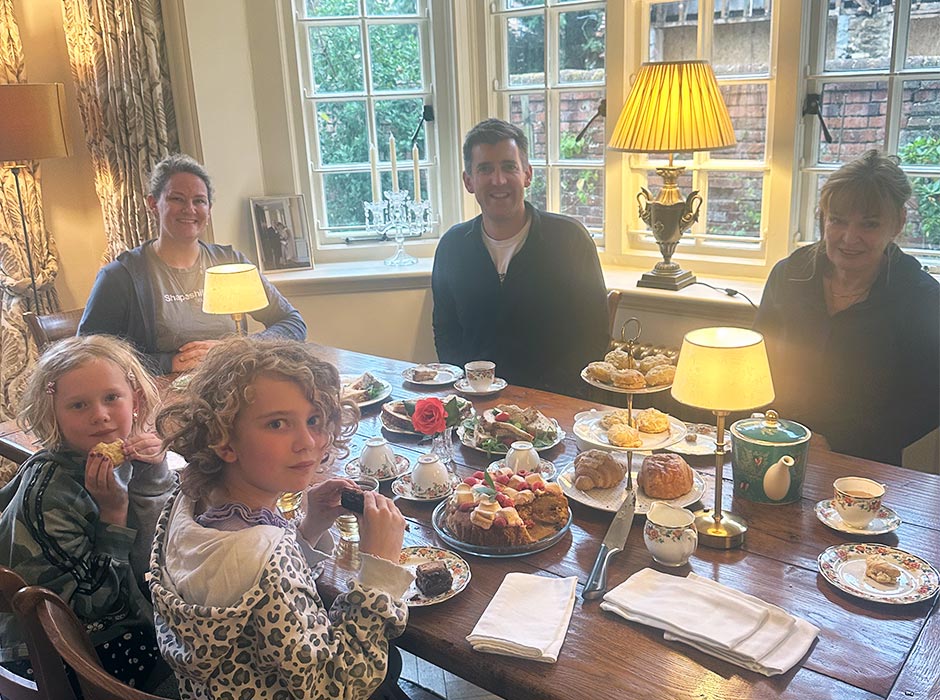
Professor Dame Carol Robinson and Otago alumni Professor David Paterson (acting as photographer) hosted the Walker family for a high tea. Pictured from front left are Olivia and Lizzy Walker and from back left, Michelle Walker, her husband Tim, and Dame Carol.
Michelle isn’t flying solo in Oxford. Her husband Tim, and their daughters, Lizzy (10) and Olivia (8) have also relocated.
“We’re combining an amazing research opportunity with an amazing life opportunity,” she says.
“We’ve been welcomed into the Oxford community and we’ve enjoyed visiting the local sites at the weekends, including Avebury Henge, the Uffington Horse, and Clivedon House. We look forward to skiing in Austria in February, too.
“We’re renting a house from a former Theology and Religion lecturer at Oxford in a lovely suburb, which is only a 10-minute walk from my work.
“Connections are a nice part of Oxford life, with visiting researchers providing a warm reminder that you are still only a few degrees separated from your family and home.”
Case in point, a colleague at Oxford invited Michelle to listen to Visiting Professor Garry Nixon from the Centre for Rural Health in the Faculty of Medicine, University of Otago.
“What are the odds that a professor from a small town in Central Otago would be working on the floor below me? It turns out Garry not only lives and works in my home area, but also worked with my mum, Joss Willyams, for 30 years. It is a very Kiwi experience knowing that someone really does know your parents even on the other side of the world.”
Michelle, who worked as the Research Advisor in Te Kete Aronui Division of Humanities from 2022 until her move in August this year, spent more than a year and a half preparing her Girdler’s application.
“The skills I learned in my job definitely helped and I am grateful for the support of Ali Cameron in the Research Office,” she says.
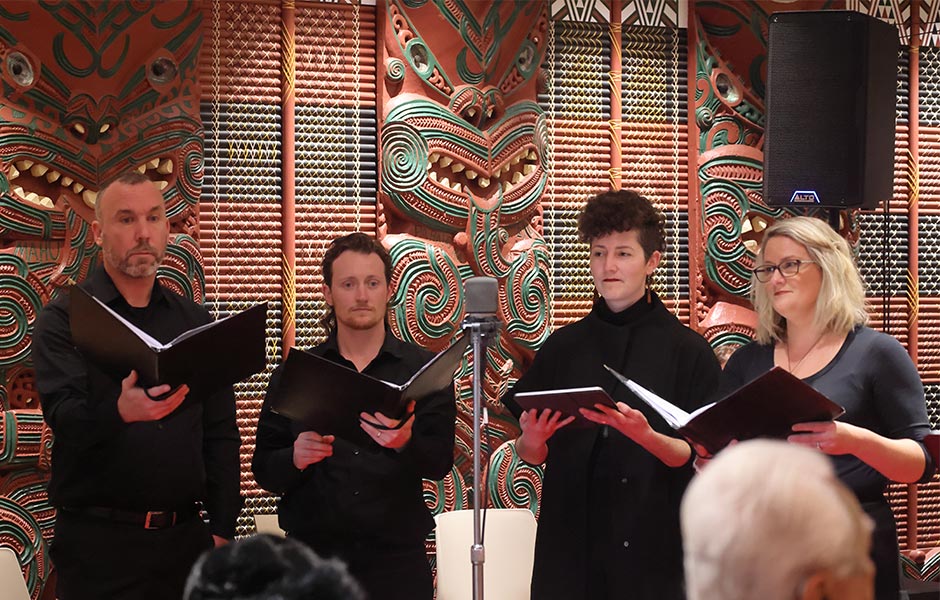
Ngāti Awa marked the 20th anniversary of the Ngāti Awa Claims Settlement Act 2005 last year and the 150th anniversary of the building of the whare. Opus Orchestra, along with soloists and chamber choir, premiered Dame Gillian Whitehead’s opera The Journey of Mataatua Whare there. Pictured are, from left, Richard Holland, Griffin Nichol Madill, Dr Tessa Romano, and Dr Michelle Walker. Photo: Richard Lummus, Opus Orchestra
As well as having a PhD in History and Preventive and Social Medicine, Michelle also has a Bachelor and Master’s in History, and a Bachelor in Classical Performance in Voice.
While that may seem like an unusual combination, her degrees are intertwined, she says.
“There was never a question of one or the other – History or Music. I was very fortunate to pursue both passions.”
“There is real strength and insight to thinking about research topics with an interdisciplinary lens. Performance and music provide incredible physical and aural avenues to experience narratives and uncomfortable histories.”
A good example of this interdisciplinary approach was performing in Dame Gillian Whitehead’s historical opera The Journey of Mataatua Whare, she says. The opera was brought to life through the efforts of Ngāti Awa, Dame Whitehead, and with Tessa Petersen in the Music Department.
“This opera demonstrated there is a real place for robust methodological research processes, musical research and collaboration and performance as a way to cultural healing.”
Michelle, who has worked as a professional singer with Voices New Zealand Chamber Choir since 2014, is excited about opportunities for singing in the UK and is exploring options as family commitments allow.
“While I am a medical historian, I can also be a professional musician, and with this Fellowship, I now seek to build new methodological skills within medical sociology.”
Being based in Europe also means Michelle can participate in training workshops and connect with other HERG collaboration countries, she says.
“I am thrilled to see that previous Girdlers Fellow, Dr Cervantée Wild is launching Health Experience Aotearoa NZ this November, along with three co-directors Professor Maria Stubbe (Otago), Dr Ally Gibson (Victoria) and Cheryl Davies (Tu Kotahi Māori Asthma Trust). This is an exciting development for Aotearoa and fills a much-needed gap in our health care systems.”
Michelle hopes to use this fellowship to build relationships with communities and stakeholders who support new mothers and families.
“I look forward to working with Associate Professor Tess Patterson and Professor Sarah Derrett on my return. They are also hosting me as an Honorary Research Fellow of Otago, while I reside in Oxford to maintain a strong connection, and it is an honour to work with them.
“On return to NZ, I hope my new skills will contribute towards research that will make positive changes for NZ mothers.”
– Kōrero by Internal Communications Adviser Laura Hewson
More about the fellowship
Michelle is the 16th Girdlers Fellow. The Girdlers’ Health Research Council of New Zealand Fellowship was first awarded in 1986 and was originally founded as a result of a collaboration between The Girdlers' Company and Green College. The Girdlers have had a close link to New Zealand since 1933, and in 1999 the Health Research Council of New Zealand became a joint funder.
The fellowship is a two-year visiting post-doctoral research fellowship to conduct healthcare-related research at Oxford University. The fellowship award funds the full salary costs and the college membership fees for Green Templeton College. The fellowship is only open to New Zealand nationals.