
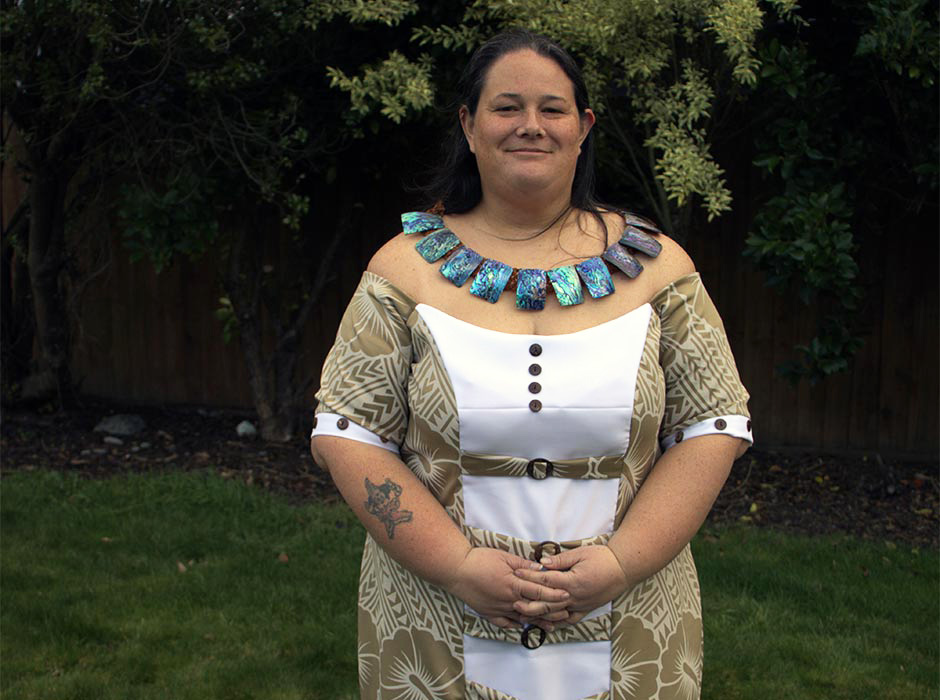
PhD Medicine tauira and gynaecological cancer researcher Alexandria Tino, from the Faculty of Medicine – Christchurch Ōtautahi, will graduate tomorrow.
Alexandria (Alex) Tino has undertaken a remarkable journey to gain her PhD – from the manufacturing assembly line to the halls of academia.
It comes after a decade making aluminium mag wheels for Ford, and later, working night shifts assembling refrigerators and washing machines while raising a young child.
This month, the Faculty of Medicine – Christchurch Ōtautahi researcher graduates with a Doctor of Philosophy in Medicine, the first person in her family to earn a degree, let alone a PhD. It marks the culmination of a remarkable journey defined by determination, sacrifice, the legacy of her grandparents and the unwavering support of her aiga.
Born and raised in South Auckland, Alex is a proud Samoan New Zealander. Her maternal grandmother is from the villages of Togafuafua and maternal grandfather’s family from the village of Moata’a, both in Apia. They came to New Zealand separately but with a shared dream of creating a better life for their family. Her paternal grandparents also moved from Christchurch and Wellington to Auckland in search of better opportunities.
Alex left school with School Certificate as her highest qualification, juggling factory work with marriage and motherhood.
While gaining a forklift license and qualifying as a workplace trainer and assessor, insecure employment made her realise she needed new skills to create better opportunities for her family.
"I took every learning opportunity I could. But after being made redundant and then kept on a casual contract, I realised I needed to upskill myself," she recalls.
The family's move to Christchurch in 2008 proved life changing. Soon after arriving, she and her husband discovered they were expecting their second child. Together they made a decision that would reshape their future.
"My main motivation was to be an example for my children," Alex says.
"I felt I couldn't ask them to go to university if I hadn't even given it a go myself."
She enrolled in a University Entrance bridging programme at the University of Canterbury when her daughter was just six-months old.
"I wanted to know if I could actually keep up with study while caring for a baby and a toddler. That bridging course gave me the confidence to believe I belonged at university."
While gaining a Bachelor of Science, postgraduate study was never part of the plan. However, following the Canterbury earthquakes, she met Otago Department of Obstetrics and Gynaecology researcher Dr Kenny Chitcholtan, who encouraged her to undertake a Master's project in ovarian cancer research.
With cancer having claimed the lives of several family members, including her grandfather, the research resonated deeply.
"I wanted to do something meaningful in their memory," she says.
Awarded a Health Research Council Master's scholarship, Alex completed her thesis just one month before the birth of her third child.
She embarked on a part-time PhD under the supervision of Kenny, Professor Gabi Dachs and Associate Professor Peter Sykes. Her research ranged from developing new ovarian cancer cell models and testing potential anti-cancer drugs, to exploring Pacific women's understanding and perceptions of gynaecological cancer.
What followed became a decade-long marathon rather than a sprint.
"I've learnt that your starting point doesn't determine where you finish. If sharing my story encourages even one person to believe they can do something they never thought possible, then it's all been worth it."
Balancing research, paid work and raising a growing family brought repeated challenges. Covid-19 disrupted progress, financial pressures mounted, and significant health problems, including months of debilitating pain while waiting for surgery, forced multiple interruptions.
“I deferred quite a few times, so that I could look after my family, my own physical and mental health. Returning to study was always a struggle but I couldn’t let my husband and parents down after they had done so much to support me. I knew I had to succeed for my kids and to honour my grandparents.”
Alex says every time she came back, it felt like starting all over again.
"During COVID it was almost impossible trying to study while the kids were home, and financially we were really struggling. I also had to step away for my own mental health and later because of serious health issues,” she explains.
Through it all, one constant kept her moving forward.
"My village carried me. My husband and my parents supported me financially, logistically and mentally through everything.
"I couldn't let them down after everything they had sacrificed. Most importantly, I needed to show my children that perseverance matters,” she recalls.
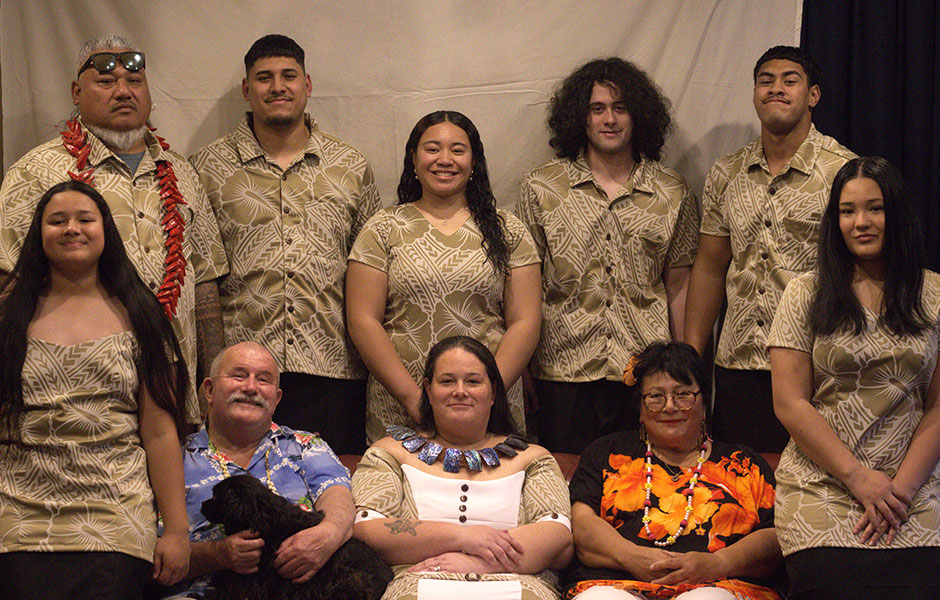
Alexandria Tino is pictured with her supporters. Back row: Sivatia Meki Tino, Alexander Tino, Meleane Aranui, Daniel Collins and Joejerry Loto Uili. Front row: Telesia Tino, Alexander Collins holding Tui the dog, Alexandria Tino, Theresa Collins and Frankie Tino.
Today, Alex's "village" fills a busy multigenerational household of 10 people, including her parents, husband, children, tamaiti whāngai, nephews, and extended family members.
"They give me perspective on what is truly meaningful in life," she says. "Without my aiga, I simply wouldn't be here."
Now employed as a postdoctoral research fellow in the Department of Obstetrics and Gynaecology, she is working on the Ngā Haerenga – Journeys project, examining the experiences of women with gynaecological cancer from first symptoms to treatment, while developing future research exploring the intersection of Pacific health, gynaecological cancer survivorship and cardiovascular disease.
She also serves as President of the Christchurch branch of PACIFICA Inc, remaining closely connected to the communities that inspired her research.
Reflecting on her graduation, she says she feels an overwhelming sense of pride. So too do her family – her husband, parents, six children in the household, her three closest friends, plus her mentor Dr Allamanda Fa’atoese will all be there in support.
"I never imagined I'd become the first PhD in my family.
"I've learnt that your starting point doesn't determine where you finish. If sharing my story encourages even one person to believe they can do something they never thought possible, then it's all been worth it."
– Kōrero by Lorelei Mason
University of Otago, Christchurch
Research and study in Christchurch for a career in Medicine and Health Science.
More from Christchurch