
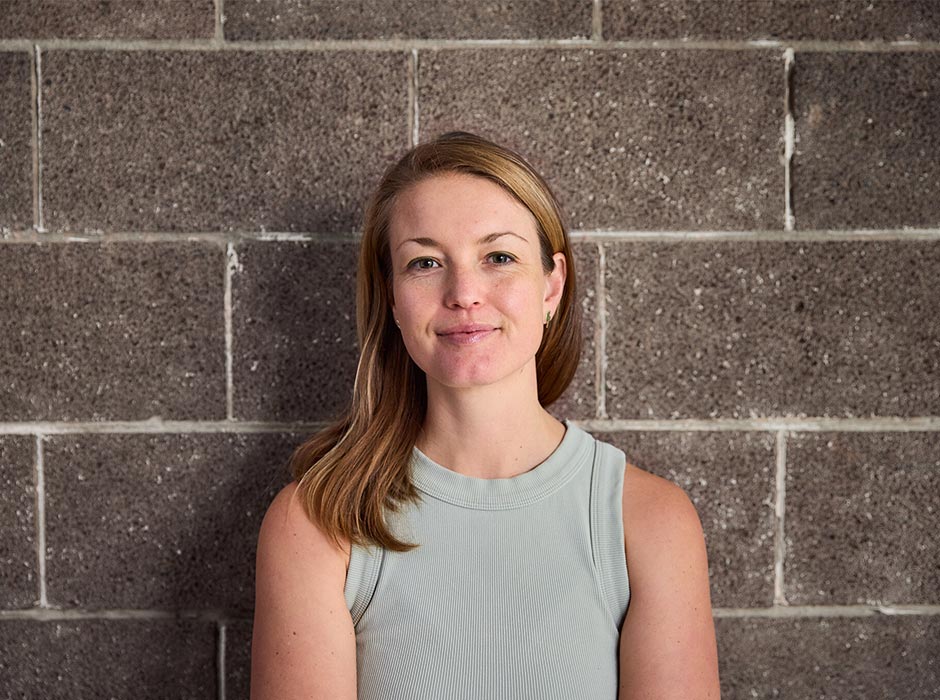
University of Otago Law alumna Phoebe Harrop Meadows is now a partner at Blackbird, Australasia's largest venture capital investment firm.
Some of the people Phoebe Harrop Meadows works with are making ferries foil above the water. Others are building software that takes clinical notes for doctors so they can spend more time with patients.
Others are working on a fuel source that packs 10 times the energy of a standard battery into a single device. Her job is to find people like this early, back them, and help them grow.
Phoebe is a partner at Blackbird, Australasia’s largest venture capital investment firm. She studied Law at Otago and has never practiced it for a day in her life. Though, she may tell you the degree is a big part of why she's good at what she does.
Despite making the big move from New Plymouth to Dunedin for her studies, Phoebe says she found her people at the University of Otago. She felt surrounded by people who were interested in ideas, who were switched on and ambitious.
“Meeting lots of fellow nerds, basically, helped me realise I was in a place that I fit in,” she says.
She loved the city too, declaring as such through a regular column in the Critic, the student magazine, in her final year. Her pieces documented places, festivals and things to explore beyond the North Dunedin bubble. Thirteen years on, many of her recommendations still hold up.
While Phoebe did not study business at University, focusing instead on Law and Spanish, she realised throughout the course of her degree that business could be a tool for making a positive impact in the world.
“That's why I got into it, rather than loving companies or being particularly interested in M&A or any of those things that a commercial lawyer would actually want to do.”
Within her law degree she had an interest in emerging technologies, writing her honours dissertation in the field with Professor Colin Gavaghan, then Director of the New Zealand Law Foundation Centre for Law and Policy in Emerging Technologies.
In addition to the technology side, what she loved most in her law degree was jurisprudence, topics like critical theory. The papers that asked big questions about how power works, how decisions get made, how to process information and form a view. What she valued about law was less the content and more what studying it trained her to do.
“It's a way of teaching how to think, how to process information, how to make decisions, much more than it is about how to be a lawyer. And that's why I think it's such a powerful degree.”
“It's a way of teaching how to think, how to process information, how to make decisions, much more than it is about how to be a lawyer. And that's why I think it's such a powerful degree.”
Studying Spanish, Phoebe also went on exchange to Madrid, which she describes as one of her greatest decisions. With a friend from Otago, she attempted to take Spanish literature, which involved
Shakespearian analysis in a language she wasn’t quite fluent in.
“It was just so far beyond our capability, but the lecturer took pity on us and let us pass anyway.”
Her Spanish abilities grew, along with her hope of someday working abroad.
As she came to finish her law degree, Phoebe didn’t feel ready to focus on a particular area of law. She wanted to work overseas and stay a generalist for longer, while adding new skills to her toolkit, like working with financial data and customer research alongside legal reasoning.
So she joined Bain & Company as a consultant, first in Melbourne and then in London, and got the breadth of training she wanted, along with a steep learning curve.
"I'd never opened a spreadsheet in my life,” she says. “Econ 101 was my worst and only business-related paper at University. My time at Bain was a massive learning curve, and I had a lot of anxiety and imposter syndrome, not in the sense of I'm not good enough, but more like I have no idea what I'm doing.”
Every three months brought a new project, a new client, a new set of problems to get across. She describes it as something like getting paid to do an MBA while working. Surveying customers, building financial models, designing organisational charts for companies cutting their headcount. Companies like Westpac, Coca-Cola and LEGO. What she brought with her to each new client, and what she traces back to Law at Otago, was the ability to work out which information mattered.
“Knowing what information matters, where to drill in, what questions to focus on – it comes so naturally to lawyers, but not to most people.”
The second thing, she says, is that law is fundamentally about people and their stories.
“It's understanding their motivations, understanding why things go wrong, how they go wrong. Business, and especially investing, is a lot about psychologising individual people.
“When you are looking at a founder with a team of two people and trying to decide whether they can go on to build a publicly listed company, whether they can attract the talent and raise the hundreds of millions of dollars it would take to do so, you are really just trying to read a person.
“Law is fundamentally about people, so there’s definitely that connection as well.”
At Bain in London, Phoebe spent a lot of time advising private equity funds, going to companies for a month, understanding them, and advising on whether they were worth buying. Although she was learning a lot, she found herself less and less interested in old legacy businesses. What she wanted to work with were technology companies building something new, led by founders who were passionate about a problem. She also wanted to stop advising on investments and start making them herself.
“Instead of dating a lot of companies for a month at a time, getting married to several companies and following their trajectory over many years.”
She left Bain and joined Generation, a sustainability-focused growth equity fund chaired by former United States Vice President Al Gore.
The fund-backed companies that they believed deserved to be around. Those that were on the right side of history, making systems more efficient, helping workers be more effective, and importantly, not borrowing from the environment. She found Gore himself incredible.
“We could call up some of these really hot companies that were hard to get on the phone and say that we worked with Al Gore, and most of them were positively disposed to that reputation.”
“He’s on the road something like 320 days a year. He is just an absolute workhorse and uses his name and experience to help Generation drive real change.
“We could call up some of these really hot companies that were hard to get on the phone and say that we worked with Al Gore, and most of them were positively disposed to that reputation.”
Three years at Generation gave her a full picture of how the investment process works, between raising money through to sitting on boards and helping companies grow. After that, Pheobe came home and brought with her all that she had learnt. She joined Blackbird's Aotearoa team five years ago and has been based in Auckland since.
At Blackbird she works with early-stage companies. Sometimes that is a founder with just an idea. Sometimes it is a small team with a product and a few early customers.
Four of the companies she currently sits on the boards of give a sense of the possibilities – Vessev, which builds hydrofoiling electric ferries that lift out of the water to cut drag and emissions; Carepatron, an AI native operating system for health providers that automates everything from scheduling and clinical notes to billing; Tracksuit, which gathers brand perception data from consumers around the world on behalf of more than a thousand customers across 25 countries; and Ternary, which converts ethanol into a renewable fuel through a device with 10 times the energy density of a standard battery.
All four are headquartered in New Zealand and building for global markets.
“I am feeling very pumped about the New Zealand startup ecosystem right now,” she says.
New Zealand companies like Halter, recently valued at $3.3 billion, are getting big enough that the people who built careers inside them will eventually leave and start their own. Phoebe describes a network effect in its beginning stages. Ambition can be contagious.
“It's never been a better time to build companies here,” she says. “AI fundamentals are available to everyone, and a company no longer needs to be based in a major overseas city to reach a global market.
“We have companies like Partly that has attracted a world-class engineering team and is building a global company, but their headquarters is still squarely in Christchurch.
"Your parents probably still want you to be a doctor or a lawyer, an accountant or something, not a startup founder. But I think that will change."
For students thinking about venture capital as a career, she has advice about where to put your energy.
The mechanics of how VC funds work are easy enough to pick up. The harder thing is developing good judgement about people, which is really what the job comes down to.
“The core job, the hardest thing, is going and finding great founders before other people find them," she says.
That means spending time where founders spend time, developing a feel for what good products look like at early stages, and getting sharp at reading people. She thinks those skills will matter even more as AI does more of the technical work.
“You've got to use AI to be competitive, and then it's all about your personal charisma and magnetism and ability to build relationships.”
Her broader advice for graduates who want to be a part of this space is to go where the future is being built.
“I would probably go to San Francisco, if I was graduating Otago right now… or China. Don't go work for a law firm in London. Go where the future's being built.”
This world is moving fast. She went to London herself, after all. But in the end, Phoebe came back to New Zealand.
If she has it her way, it won’t be long before the future will be being built right here at home.
– Kōrero by Melanie Bishop