
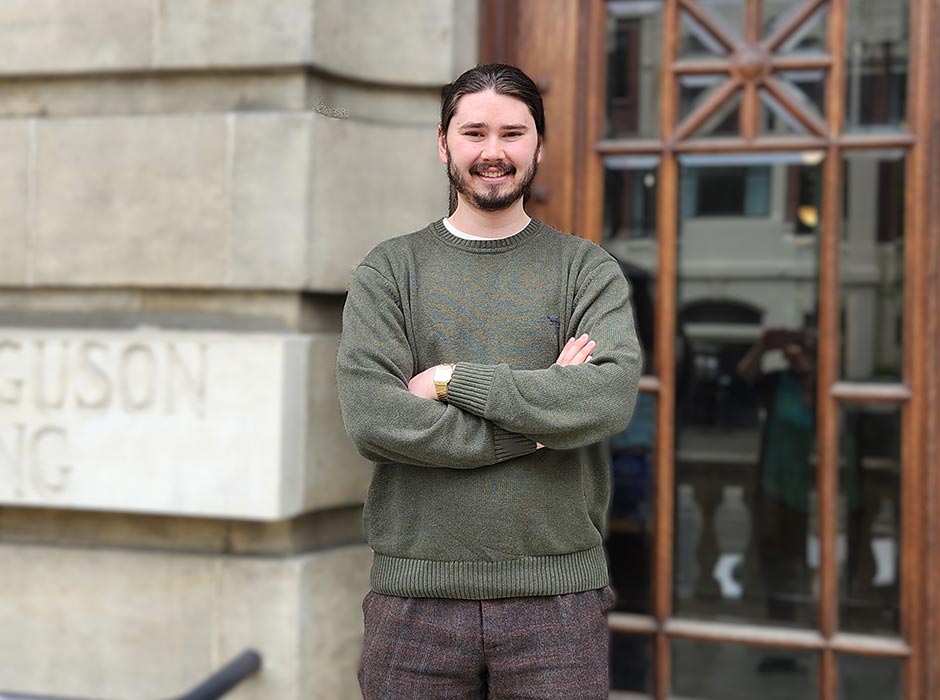
Otago medical graduand Mana Mitchell isn’t cutting his ties with Otago just yet – this talented tauira still has a PhD to complete.
Improving health outcomes for Māori is a key focus for Otago medical graduand Mana Mitchell (Ngāti Maniapoto).
Like many Māori, he has lost whānau members to preventable diseases that affect Māori disproportionately and, through clinical practice and research, he hopes to do his bit to help address the disparity.
“Having lost whānau members to rheumatic heart disease and end-stage kidney failure, I’ve observed first hand how our health system is failing to deliver adequate care to a number of populations within our country,” Mana says.
“Going through medical and health science education, it's easy to see the statistics as kind of inevitable, but really the diseases that we're losing people to are deeply preventable ones.”
Mana, who has been based in Ōtepoti Dunedin for his medical training, graduates with a Bachelor of Medicine and Bachelor of Surgery (MB ChB) in Dunedin on Saturday. He will start as a house officer at Dunedin Hospital in January.
He may have finished his training as a doctor, but his connection with Otago doesn’t end there. He is doing an intercalated MB ChB/PhD and hopes to submit his PhD thesis, on using mātauranga Māori to guide biomedical research, within the next year.
Mana grew up in Auckland and attended high school on the Gold Coast, Australia. As well as family reasons for his interest in studying medicine, a friend’s father was an ear, nose and throat surgeon and visiting his workplace contributed to the view that medicine was “a really cool job”.
He was tossing up between studying at Otago or Auckland, but says Otago’s excellent reputation and a better scholarship swung the balance.
Moving to Dunedin to do Health Sciences First Year at Otago was a big step – it was the first time Mana had been to the South Island.
However, his mother and a cousin began health-related study on campus at the same time, which meant they could support each other and compare notes.
Mana says the highlight of his time as a medical student is the welcoming and supportive environment that Otago provides. In particular, he is grateful for the support from Kōhatu Centre for Hauora Māori, with kaimahi providing continuity from his first day on campus until he completed his medical studies.
Kōhatu remains an integral part of his Otago experience as his PhD supervisors are Director Associate Professor Esther Willing and Professor Peter Crampton, and Professor Karyn Paringatai from Te Tumu.
It’s becoming increasingly important for researchers to have a more comprehensive understanding of kaupapa Māori methodologies and ethical strategies, particularly for Indigenous health research. In his PhD, Mana is analysing some Māori primary sources, including 393 mōteatea (poetic songs, often laments), collected by prominent Aotearoa statesman Sir Āpirana Ngata, to identify some central tenets that underlie Māori philosophies.
In recognition of the significance of his research, Mana received a $138,800 Health Research Council 2022 Māori Health PhD Scholarship.
He is a fluent te reo Māori speaker and will be submitting his thesis in te reo.
In the precious little time he has had between study and research, he enjoys reading, especially te reo translations. He’s looking forward to reading the second book from JK Rowling’s popular Harry Potter series, which has recently been translated into te reo - Hare Pota me te Pakohu Kura Huna (Harry Potter and the Chamber of Secrets).
Mana says he is excited to graduate and begin his career as a doctor, but he is realistic about the stresses and strains of the system he is joining.
“I’ve seen first hand how overworked everyone in the health system is, not just doctors.
“People tend not to do their best critical thinking in their fourteenth or fifteenth hour of work.”
In time, he hopes to become both a clinician and an academic, and would like to return to his earlier interest in neuroscience research at some point.
- Kōrero by Andrea Jones, Team Leader, Divisional Communications
Study Medicine at Otago
Embark on a rewarding career dedicated to providing high-quality, patient-centred, evidence-based care and improving health outcomes for generations of New Zealanders.
Find out more