
Tuesday 8 September 2020 9:47am
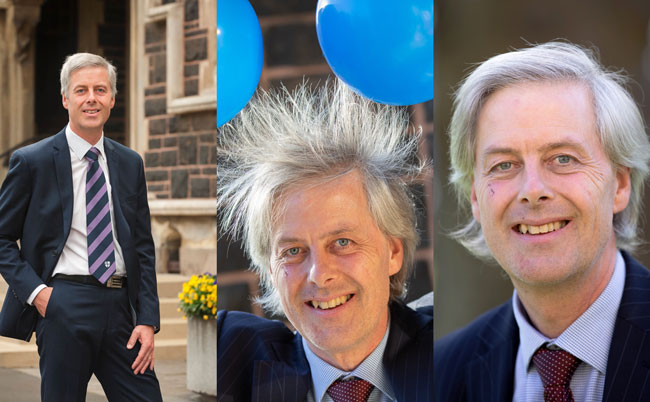
Professor Richard Blaikie as his usual debonair self, the true new state of his hair revealed with balloons and static electricity, and months’-worth of his new totally natural unstyled-style.
What is going on with Professor Richard Blaikie’s hair?
Our usually very dapper Deputy Vice-Chancellor Research and Enterprise is going a bit wild on the follicle front and has been heading that way for some time – ever since lockdown.
First, he took a ‘castaway’ approach to isolation, by abandoning shaving and growing a beard to mark the significance of Level 4. Now, he is renouncing haircuts until an approved vaccine is discovered for COVID-19 and has started rolling out, with people being assured the virus can be managed.
He realised during lockdown how easily he could slip back into normal life afterwards, so wanted to remind himself “this thing is not over, coming out of Level 4 is not the end”.
He learnt the importance of vigilance after living in Christchurch during the earthquake in September 2010, celebrating the rapid recovery to normality only to be hit by the more devastating quake in February 2011.
“I don’t think my hair’s going to get down to my waist; there’s lots of people working on a vaccine."
So, when the pandemic lockdown was ending “with everyone deciding the most important thing to do is line up for a haircut, I thought the local hairdressers are not short of business, I will wait until it’s over”.
“It’s a little bit the antithesis of shave for a cure” – which involves people shaving their head to raise money for leukaemia and blood cancer research, patient support and advocacy.
Having to brush unusually long hair away from his face and keep a comb at hand is a constant reminder life is a new normal and we all still need to take precautions, Professor Blaikie says.
While his hair was shoulder-length in earlier days – “I was a child of the ‘70s” – he has never had a ponytail and is not sure if he will end up with one now.
Many possible COVID-19 vaccines are in clinical trials and some are already in phase III, where they are tested on many thousands of people. But countless potential products fail at this point, just before they are approved for sale and start rolling out, with safety monitoring to detect rare or long-term effects, and technical support.
Professor Blaikie says trials usually take two years or more but because of the global COVID-19 crisis, if a trial shows good results, the timeframe could be shortened.
He is discounting the vaccine produced by Russia, but decisions on another vaccine could be made next week or in three to nine months: “Who knows?”
He gives a bemused smile aimed at himself and says: “I might actually lose my hair in the meantime.”
However, he is truly upbeat about the possibility a vaccine will be discovered soon.
“I don’t think my hair’s going to get down to my waist; there’s lots of people working on a vaccine,” Professor Blaikie says.