
Q&A with Jim Davies, 20Twenties Young Alumni Award winner 2025
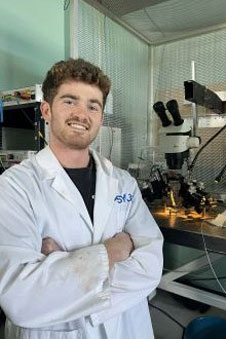 Jim graduated with a BSc (Hons) in Neuroscience in 2022 and has recently completed his PhD at Otago – and just been crowned the 3MT (three-minute thesis competition) PhD winner!
A skilled science communicator, Jim won the Otago Medical School Research Society award for his essay, ‘Unlocking hope in treating Alzheimer’s’, which was published in the Otago Daily Times.
He has also won oral presentation awards at the Australasian Winter Conference on Brain Research and the Kiwicam conference, and recently won the best oral presentation at a national online symposium for early career neuroscience researchers.
Jim’s experience in providing care to older citizens as a support worker, and seeing his grandmother struggle with dementia, has helped shape his career.
Q: How did you react when you heard you had received the award, and what does it mean to you?
It's an honour and I was genuinely surprised. I am surrounded by people at Otago doing extraordinary work, so I never imagined that my own contribution would receive this kind of recognition.
Q: What path have you followed since graduation?
I recently completed my PhD in neuroscience, investigating whether gene therapy could strengthen the brain’s resilience to Alzheimer’s disease.
I am now exploring various postdoctoral opportunities to broaden my skillset and see where my long-term interests lie. Alzheimer’s disease is fascinating, and working with animal models has been a privilege, but I am still early in my career.
Before specialising, I want to find new questions, methods and fields.
Q: What inspires and motivates you to work in your field?
My early work in retirement homes and in a Care of the Elderly ward in a hospital in the UK were largely motivated by my desire to go to medical school. I thought the experience would enhance my application.
What I didn't realise was how it would affect me emotionally. Many older adults die in hospitals, sometimes alone, in busy wards where overstretched staff cannot provide all the companionship and care they deserve.
It showed me how easily medicine can become preoccupied with symptoms and disease while losing sight of the person experiencing them. This, and seeing my grandmother develop dementia, have galvanised me into working in the field of neurodegenerative diseases.
My grandmother still recognises me, but our conversations are often repetitive and circular. Crucially, I can see that, while she doesn't always remember what she's said, she realises that she's repetitive and I can see this distresses her and leads to her withdrawing. This breaks my heart and I wish there was something I could do for her.
Q: What are your plans for the future?
A few years ago, I was worried sick about what I was going to do with my life. I had failed to get in to medical school and felt adrift. I studied neuroscience because I found it interesting, continued into an Honours year and was then offered the opportunity to pursue a PhD.
I remember telling my supervisor, Cliff Abraham, "I don't know if neuroscience is my passion”. He replied, "Jim, I don't know if neuroscience is my passion. I just get up every day and try to do something interesting and useful."
I have kept that with me ever since. I no longer feel compelled to map out my career. I want to pursue things that excite me, develop my abilities and offer something useful.
Q: Tell us about the highlights of your time at Otago, and how it has influenced you in your career and following your interests?
Dunedin is an amazing city – big enough that we can still get a kebab at 2am, but small enough that we can walk everywhere, see students everywhere, and feel part of a genuine community.
Otago taught me that education is not confined to lectures, laboratories or grades. Friendships, mistakes, late nights and unexpected interests made me more curious and less afraid of uncertainty.
To any student worrying about where to take their life, my advice would be have fun, make mistakes, look after your friends and pay attention to the people who enlarge you, and those who diminish you. You do not need to construct a perfect life. The courage to explore will carry you further than any single grade.