
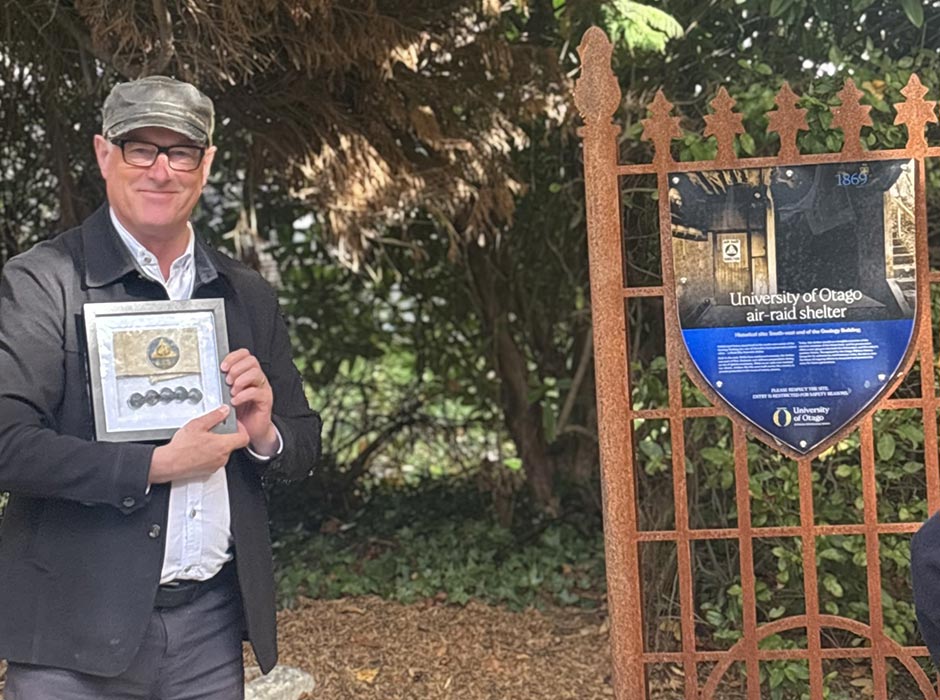
Pro-Vice-Chancellor (Humanities) Professor Hugh Campbell with the civil defence armband and jacket buttons presented to the University by Peter Trevathan (Otago Military History Group).
An air raid shelter hidden just below street level at the southeast corner of the University’s Geology Building is considered one of the best-preserved examples of its kind in New Zealand, according to Otago Military History Group representative Peter Trevathan.
Known by staff and students as ‘the bomb shelter’, the basement – previously used to store fossils and whale skeletons – was long suspected to have a deeper history. It was not until Peter investigated the site in 2024 that this was confirmed.
Built in the early years of the Second World War, after Japan entered the conflict and the threat to New Zealand felt more imminent, the shelter was one of a handful of government-built shelters on campus and part of a wider network of hundreds of public and private shelters across Dunedin.
Shelters took many forms, including trenches, underground pipes and basements.
Peter says most of them are a distant memory today.
“If you look at that map, 99 per cent of that stuff is gone – pipes removed, trenches filled in, government shelters demolished.”
It is estimated that fewer than two per cent of the original shelters remain intact and accessible, making the Geology Building shelter a particularly rare wartime relic.
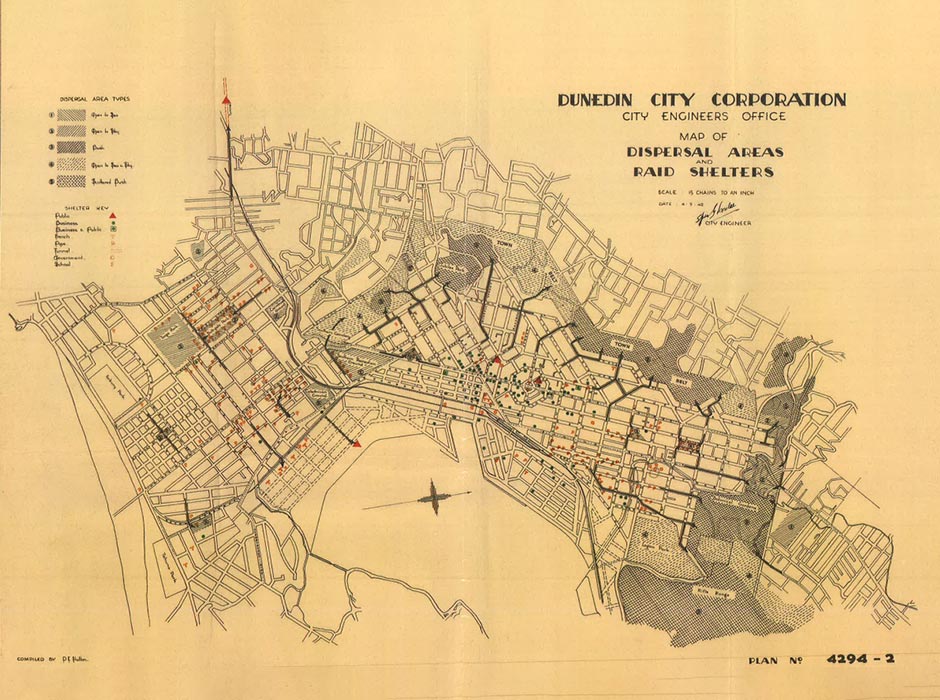
This map by the Dunedin City Council (formerly Dunedin City Corporation) shows the location of air raid shelters throughout Dunedin.
New interpretive signage recognising the shelter’s authenticity and historical value was formally unveiled earlier this month at a ceremony attended by representatives from the Otago Military History Group, Civil Defence and the University.
Peter also presented the University with a Second World War Civil Defence armband that would have been worn by wardens overseeing the shelters.
During the war, air raid drills were common, requiring members of the public to stop what they were doing and head to the nearest shelter, he says.
Part of the importance of acknowledging the shelter is to encourage people to remember, contemplate history and imagine what life was like for those who lived through the wartime.
“You could be sitting in class and if an alarm went off, you’d have to run because you didn’t want to be stuck in a building when there’s bombs coming down.
“It was a real threat and people need to know that just because we lived in New Zealand, that doesn’t mean that we weren’t impacted.”
While businesses and individuals were encouraged to build their own shelters, public shelters were an important part of the country’s Civil Defense plan, and were common in institutions like hospitals, schools and universities.
The Geology Building shelter is one of four government shelters built on the University of Otago campus.
Otago Pro-Vice-Chancellor (Humanities) Professor Hugh Campbell says the work to uncover and recognise the shelter is greatly appreciated by the University.
“It highlights not only a special little piece of our history, but also the value we place on our relationship with the armed forces, with other groups, like Civil Defence, who serve our community, and also the great host of amateur historians who spend endless hours chasing down meaningful stories from our past,” Hugh says.
“Otago is richer because of these stories and the relationships that lie behind them.”
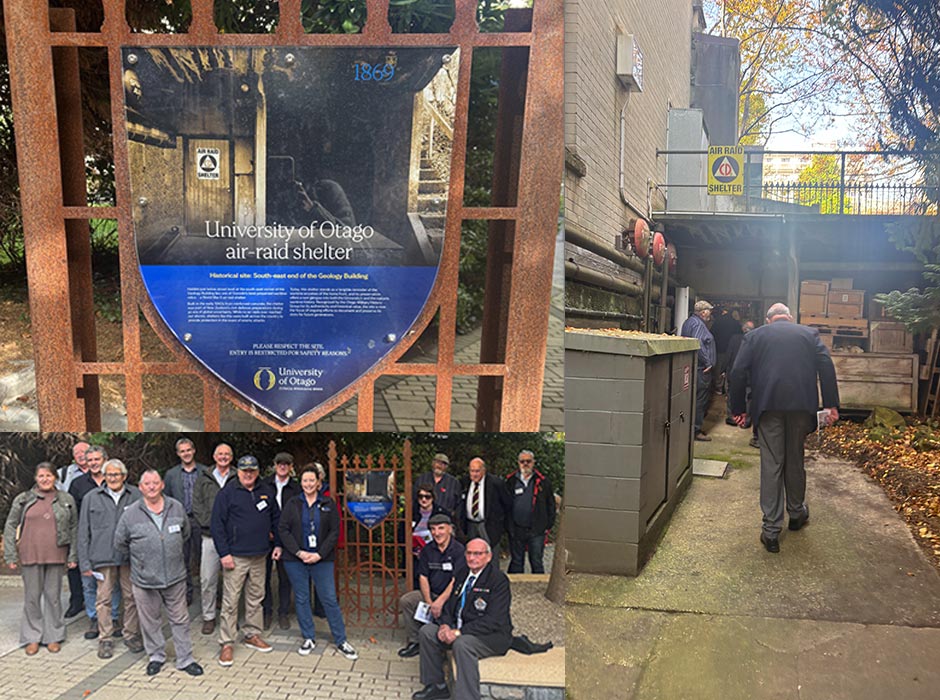
Clockwise from top left: The new signage. Attendees are given a guided tour of the shelter - the entrance to the original shelter shows the reinforced concrete overhang, believed to be included in the shelter design to extend the capacity of the shelter. Representatives from Otago Military History Group, Civil Defence and the University of Otago following the unveiling of the air raid shelter signage.
As well as being remarkably well preserved, the shelter is unique in featuring an overhang, which Peter believes was added to provide protection if the shelter reached capacity.
“The bunker might hold about 50 people inside, but they appear to have extended it in case it filled up. I can’t think of any other reason it would be there,” he says.
The recognition of the shelter goes a long way to protecting an important piece of Dunedin and New Zealand’s history, Peter says. He hopes it will inspire wartime descendants and future generations to learn the stories of their ancestors, and keep them alive.
“Most of the people who were living during that era can’t tell the story because they’re gone now.”
The shelter is now marked by a replica air raid sign, and an interpretive panel detailing its history can be found at the southern end of the University Quad, near the old Stock Exchange bell.
Watch: Take a virtual tour of the Geology Building air raid shelter
~ Kōrero by Gess Sheridan, Communications Advisor, Operations.