
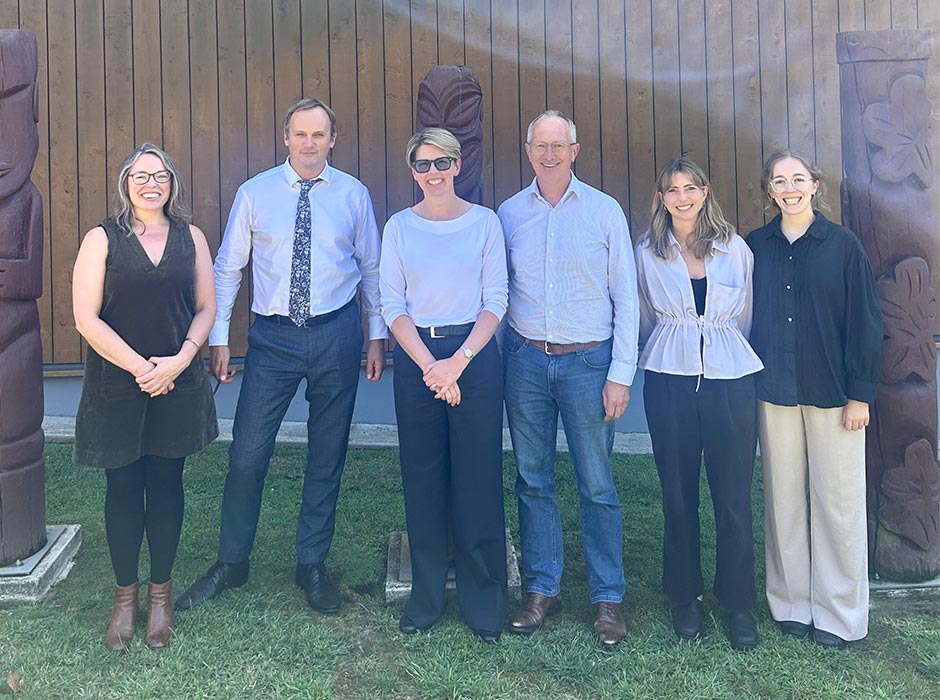
Founders of Lawyers for Climate Action NZ (LCANZI), pictured centre with team members, are Jenny Cooper KC and James Every-Palmer KC. From left: Sally Gepp KC, Davey Salmon KC, Jenny, James, Laura MacKay and Molly McDouall.
When James Every-Palmer and Jenny Cooper sat down for this interview, the streets of Wellington were flooding. Cars were being swallowed and swept along by brown water. Slips were closing roads across the city. It was, as James noted, exactly what the climate science had predicted: greater intensity, greater frequency, more of this.
The irony of the setting was not lost on either of them. They have spent the better part of a decade arguing in courtrooms and before policy makers that Aotearoa needs to take climate change seriously. Outside James's window, the city was making its case for them.
A few weeks later, just as the first draft of this article was being finished, news broke that the Government intended to amend the Climate Change Response Act to prevent New Zealanders from bringing tort claims against major emitters for climate-related damage. The announcement was made in direct response to the ongoing Smith v Fonterra proceedings, in which LCANZI had appeared as intervener. The need for lawyers to engage seriously with both climate law and climate policy seemed sharper than ever.
Jenny and James have known each other since their days at the University of Otago, where both completed BA and LLB (Hons) degrees before going on to postgraduate study overseas.
Both became Kings Counsel. Both built distinguished careers at the commercial bar. And in 2019, they co-founded Lawyers for Climate Action NZ (LCANZI), an organisation that has since grown to more than 400 members and brought some of the most consequential climate cases in New Zealand's legal history.
Both are proud Otago graduates. James, smiling, says that he likes to tell people "I went to the top law school in the world and also to Harvard and Oxford."
Otago, he says, taught him to think about the law in a social context, not just as it is, but also as it could be.
After graduating from Otago, Jenny won a Rhodes Scholarship to Oxford, where she completed a BCL (first class) and an MPhil in international relations. She went on to work for the United Kingdom Foreign and Commonwealth Office in London before returning to New Zealand, joining Bell Gully in 2003 and making partner in 2009.
She has been at the independent bar since 2011 and is ranked by Chambers and Partners in Band 1 for Dispute Resolution. She became a King's Counsel in 2017 in recognition of her standing as one of New Zealand's leading commercial litigators.
James took a different route to similar heights. After Otago, he went to Harvard Law School, and then to Oxford for a doctorate in Artificial Intelligence and Legal Reasoning. Along the way he worked as an intern in the legal division of the IMF in Washington DC and as a consultant on internet regulation at the OECD in Paris.
He spent over a decade as a partner at Russell McVeagh, where he chaired the national litigation team, before joining the independent bar in 2013. He also served as a member of the University of Otago Council from 2004 to 2012. Like Jenny, he was appointed King's Counsel in 2017.
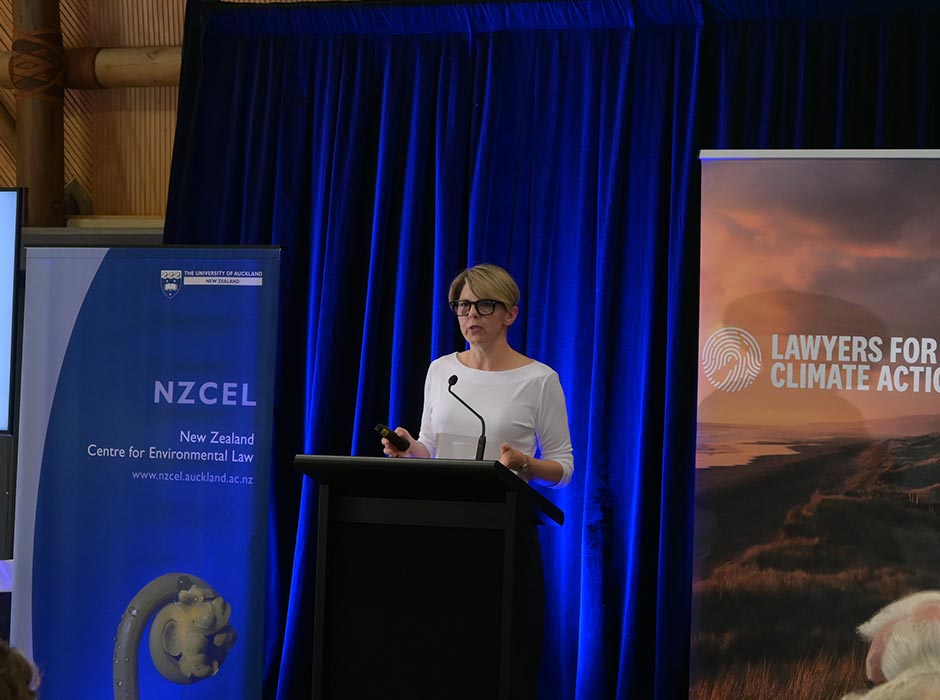
Jenny Cooper KC presenting at a joint LCANZI and New Zealand Centre for Environmental Law conference.
While there were a number of different influences that led Jenny and James to found LCANZI, the stars aligned when both attended the valedictory conference for Chief Justice Dame Sian Elias in 2018.
There, a presentation on climate change from fellow Otago Law graduate and friend Davey Salmon KC, timed not long after the IPCC's sobering report on 1.5 degrees of warming, provided the necessary spark.
They went for a drink afterwards with friends and colleagues, and somewhere in that conversation, the name Lawyers for Climate Action was first said out loud.
"It was sort of serious, but also just kind of chatting over drinks," Jenny says.
Then she went home, dived into the IPCC report and thought: we really should do this. From that, LCANZI was formed.
James is quick to note what Jenny breezes over in the telling.
"All of a sudden there was an incorporated society because Jenny wrote the rules and cajoled, strong-armed, and persuaded a dozen people to sign up to it."
Without that, he says, it simply would not have happened.
There was also a more personal moment in Jenny's thinking. She had stepchildren who were around ten or twelve at the time, and she and her partner Jason were talking about climate change at home.
Jason said that their generation would really have to do a lot of work to sort it out. But they were kids. They didn't have much influence yet. Perhaps, she said, the adults in the room should be doing a bit more in the interim.
From all of this came a question that drove them to found LCANZI.
"Here we are," Jenny says, "a group of people with immense privilege, who have the ability to spend some time using some of the skills we've acquired. So it was sort of hard to find an excuse not to. We wanted to do it, and there was no good excuse not to do it."
Their position at the bar mattered too. As barristers, they did not carry the conflicts of interest that lawyers in firms or government lawyers face. They were, practically, free to act, and felt they had the responsibility to do so.
That is not to say there were no nerves. When they started, climate change was not widely discussed in legal circles. It felt, Jenny says, a little provocative to even raise it. There was the usual anxiety about sticking your neck out: attracting criticism, getting things wrong, wondering how clients might react.
"I was a bit worried, but not worried enough not to do it."
In the end, her clients were either supportive or unbothered.
LCANZI is now a well-established organisation with full-time staff and a strong Otago connection. In addition to Jenny and James, who are co-founders and President and Board Member respectively, Otago graduates Sally Gepp KC and Sophie Meares serve as Board Member and Board Secretary. The full-time team led by Executive Director Jessica Palairet includes Otago Law graduates Laura MacKay as Senior Lawyer and solicitor Molly McDouall.
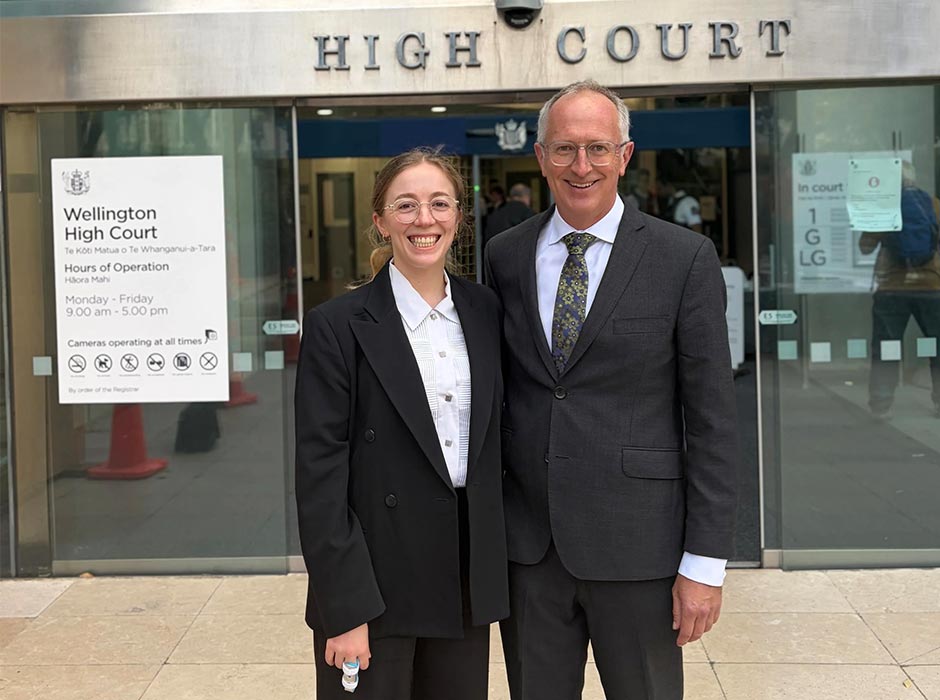
Otago alumni Molly McDouall and James Every-Palmer KC outside the Wellington High Court.
The cases LCANZI has brought do not all end in clear-cut courtroom victories. But James and Jenny are clear that this is not the only measure of success.
Their first major case challenged the Climate Change Commission and the Minister over a lack of ambition in New Zealand's emissions budgets and its Nationally Determined Contribution, and the use of an accounting technique called gross-net accounting.
It was ultimately unsuccessful in the courts. But James argues it achieved something important anyway.
"It created a real sense of an organisation looking over people's shoulders."
Anecdotally, they have heard that the prospect of litigation has been internalised by officials as a reason to think more carefully.
A judicial review against the Minister over annual ETS settings resulted in a substantial win. The Government had released more emissions units than was appropriate, partly out of concern about the political fallout from rising prices. The Crown ultimately agreed LCANZI was right, and the case was resolved by consent order.
The greenwashing case against Z Energy, which alleged misleading fair-trading claims about its environmental credentials, was settled without admissions but has created pressure across the corporate world to think carefully about environmental advertising.
As mentioned above LCANZI also appeared as intervener in the landmark Smith v Fonterra Supreme Court case, and has most recently brought High Court proceedings challenging the Government's emissions reduction plan on grounds of both process and ambition. A decision is awaited.
Jenny reflects on what binds these cases together.
"We haven't been asking the courts to make significant new law. We've just been asking them to apply the law to climate-related situations."
Then, in May 2026, the Government announced it would amend the Climate Change Response Act to limit tort claims arising from climate change damage. The practical effect, LCANZI says, would be to insulate major emitters from liability for the harm their emissions cause, leaving individuals and communities with no avenue to seek compensation.
Jenny's response was direct.
"What it looks like is a kneejerk reaction to legislate over the top of the unanimous Supreme Court decision in Smith and Fonterra before that's gone to trial."
The Supreme Court ruled in February 2024 that Mike Smith's case was arguable and that he deserved his day in court. The proposed amendment would extinguish that possibility entirely.
"It's really hard to understand why we would want to legislate now to say we could never bring claims against emitters for the harms and losses we've suffered," Jenny says.
"If they are not responsible for paying, then who does? Well, everybody, basically."
In their press release, LCANZI also raised the constitutional dimension. Courts have a critical role in ensuring the rule of law survives the climate crisis, and they have risen to comparable challenges before. The law of nuisance developed in direct response to the pollution crisis of the Industrial Revolution.
Climate change is a novel problem, but the courts' capacity to respond to novel problems is not, and Parliament, LCANZI argues, should not legislate that capacity away.
Even if claims in tort relating to climate change harms are limited by Parliament, as discussed above, LCANZI is employing the full range of legal strategies with judicial review proceedings currently afoot challenging the government’s emissions reduction plan.
But litigation was never the whole picture. From the start, LCANZI has placed equal weight on legislative reform, policy advocacy, and education.
James points to a long tradition of law and social change moving together. Homosexual law reform, the Smokefree Environments Act: these are examples, he says, of legislation leading society rather than simply following it.
"It's not that law has to follow. It can also, to an extent, lead. And that's been a big motivator for me."
The courtroom is one tool. The select committee, the policy submission, public education are others. And when the Government moves to close one door, LCANZI, it seems clear, will be looking for the next one to advocate through.
"Unless we take serious action in accordance with the science, we have no moral authority to tell others to get in line." – James Every-Palmer
Jenny and James firmly believe that New Zealand is uniquely positioned to lead on climate. She counts four reasons and James adds a fifth.
First, New Zealand is well-regarded internationally and carries slightly more influence in global affairs than our size might suggest.
Second, we are not a major fossil fuel producer and so we have little vested interest in maintaining dependence on oil and gas. Decarbonisation is an economic opportunity.
Third, New Zealanders are quite environmentally conscious. Fourth, we have a stable democracy, competent institutions, and strong independent courts. And fifth, we have a track record of leading on big issues: the nuclear-free movement, women's suffrage, social welfare reform.
"There are lots of times that we've shown you can make change on an issue," Jenny says, "and that can help other countries move forward."
James builds on this with an argument about moral authority. New Zealand's emissions are a small percentage of the global total. What our country does by itself will not, at the margins, determine the global temperature. But if we can act as a role model, we earn the standing to make the case to others.
"Unless we take serious action in accordance with the science, we have no moral authority to tell others to get in line," he says.
He is not without sympathy for the complexity of agriculture, New Zealand's biggest emissions challenge. But he is frustrated by how little has been done elsewhere.
Electrifying transport and decarbonising industrial heat, he says, should be decisions that are straightforward.
"We kind of did nothing," he says of the country's broader response. "And all we've really done is encourage a bit of forestry on marginal sheep and beef land. Better than nothing, but only barely."
A Message for the Next Generation
Both James and Jenny are keen to engage students, and not only as future members.
Jenny describes how LCANZI worked with a group of Auckland law students on transport advocacy, lobbying Auckland Transport to adopt more environmentally friendly programmes. It was quite successful, she says.
But beyond specific projects, her message to students is about habits.
"It's getting students to actively be thinking about these issues now, and talking to each other, and joining groups," she says.
"Making that a habit they carry on into their careers. Because once you're in a different environment where these things aren't talked about all the time, they can sort of fall by the wayside."
LCANZI has also been advocating for what it calls climate-conscious lawyering, encouraging lawyers, in any area of practice, to bring an awareness of climate into their advice and the decisions they make about their careers.
Membership to LCANZI is purposefully accessible and is also open to law students and others without a law degree.
Jenny stresses that joining does not mean being thrown into a three-month pro bono hearing.
"We have lots of essentially passive members. We're really happy to have people show their support by becoming members, with no expectation they'll become actively involved. Although if they want to, great."
James has the final word, and it is addressed directly to students. He says to young people: you are entering a world that does not quite make sense. The science has been accurately predicting climate change for the last four decades. Yet we are not even taking basic steps towards decarbonisation and reducing reliance on fossil fuels, even though there would also be great co-benefits. That dissonance can be discombobulating. It can be depressing. It can be overwhelming.
Whether that means becoming an overt climate activist or simply being a climate-conscious lawyer in whatever job you end up in, it is through those combinations of actions, large, small, and medium, that the best hope of making a difference lies, he says.
Outside, the water was still rising. But in the conversation, there was something that felt like the opposite of despair. An organisation of professionals working towards ensuring a better future for everyone. Founded by Otago University friends, who asked themselves a question and decided they could not answer it by doing nothing.
About Lawyers for Climate Action NZ
LCANZI is a New Zealand registered charity. Membership is open to anyone with a law degree and associate membership is open to law students and others . Members receive a monthly newsletter and access to opportunities to get involved. Visit lawyersforclimateaction.nz to join.