
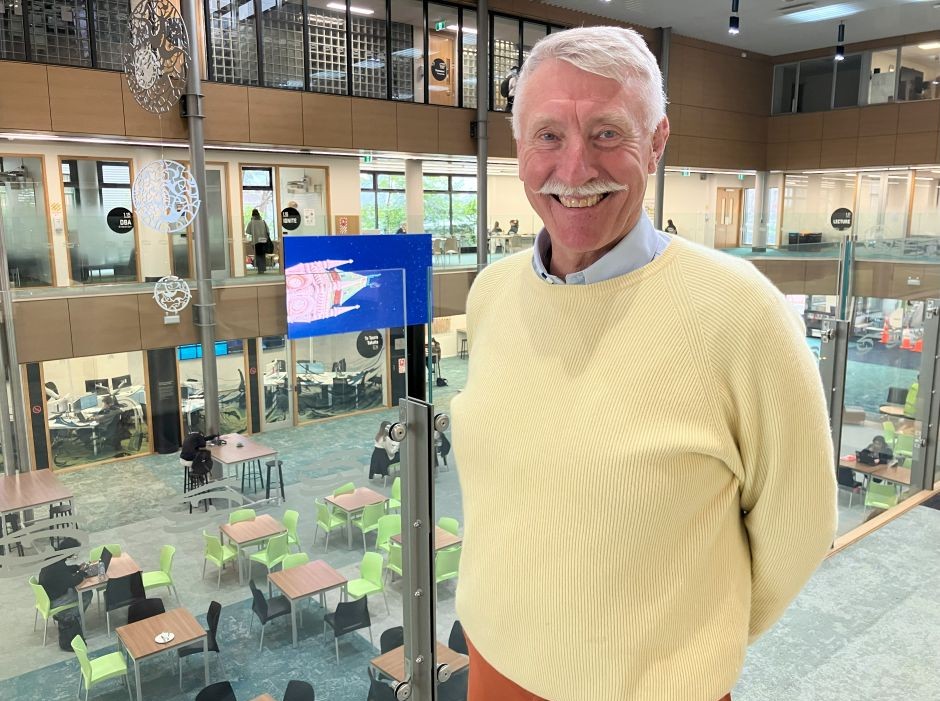
Recent Executive in Residence, Otago Economics alumnus Craig Stobo, during his week at the Otago Business School.
In this Q&A we catch up with alumnus Craig Stobo, who was our recent Executive in Residence at the Otago Business School. Craig has packed a lot in since graduating with a Bachelor of Arts (Honours) in Economics in the 1980s.
Chairperson of the New Zealand Financial Markets Authority, the Local Government Funding Agency and founding Director of the Auckland Future Fund, he has a wealth of experience as a diplomat, economist, chief investment officer and chief executive.
Craig has also maintained his connection with Otago and is a Co-Director of the Otago Tourism Policy School, an Otago Business School Adviser, a Co-Director of the Assembly of Investment Chairs and a Member of the Climate and Energy Finance Group.
Q&A with Craig Stobo
Could you tell us about your time at Otago and how it influenced you?
I came out of Waitaki Boys’ in Ōamaru with a very general background, but had a particular love of economics, which was stimulated by a teacher there. It made a whole lot of sense to me.
For my first year at university, I came down to Carrington Hall. You’re with a bunch of other students from all around the country and you're in this environment where you don't know a lot. You're trying to figure out social relationships. You're trying to get to your lectures.
I chose Economics and English. I have a love of the English language, and other languages and also political science. I also did Russian in my first year. The reason for that is at school I'd studied French and Latin and there's a degree of similarity. Actually Russian was my best subject!
But I applied for Honours in Economics and kept my English going. When I look back I kind of wish I'd kept Russian going, partly because of where we are today with Russia. I came out with First Class Honours in Economics, specialising in understanding trade flows.
But Otago wasn’t all work?
The other part of university, of course, is the social scene, and I made an effort to participate in societies and clubs.
It's a really integrated environment between the hostels, the flats and the university and it's all very central. I chose rugby and debating. I loved the debating society and ended up debating for Otago University with Michael Laws and Rod Carr and made a whole lot of friends.
It taught you there's always two sides to an argument and what you have to do is persuade the people that your arguments are the better ones, so it helped you think on your feet, to listen carefully, and those skills are still with me today.
In my last year I was social controller for Capping week. That's around ‘controlling’ the events, so you learn a whole lot of organisational skills across different areas. You're given licence to have a go and create something, and I found that really liberating.
What did you do once you graduated?
It was the early 80s, very much last century, and New Zealand was in a bit of a funk, a kind of recessionary mode. Most things were controlled, to use that word again – wages, prices, rents, foreign exchange. It was a very different place. It was akin to the equivalent of an Albania in the South Pacific.
I had an offer from the Treasury, but what was most interesting to me was Foreign Affairs. I joined Foreign Affairs in their economics division. Every year the New Zealanders seconded a young foreign service officer to the Australian Department of Foreign Affairs and Trade and I was fortunately selected to do that and went to Canberra.
Initially, I was a part of a broader group of what they call Commonwealth Scholars who came from around the old English Commonwealth to Canberra, to learn the art and science of diplomacy.
You visited parts of Australia to understand the Australian context and then I had time in the Middle Eastern division. I saw Hawke and Keating come to power [in Australia] and the Labour government started to deregulate financial markets, and I thought that's going to happen in New Zealand at some point.
What prompted your move from diplomacy into finance?
I came back to New Zealand and worked in the Australian division of the Ministry of Foreign Affairs, but the opportunity came up to apply for a job for the Development Finance Corporation, which was building a new investment bank called Zealcorp. I joined as an economist, and then went sideways and worked for Zealcorp as their market economist, and then ran their money and bond market team.
They did some amazing capital markets work – no-one knew in New Zealand at that time how deregulated financial markets worked, so those that had any experience or could learn fast were highly valued and you did really, really well. That was a great experience.
Then Bankers Trust asked me to come up to Auckland and I joined the investment bank up there, I think I was the 34th or 35th employee. I was in the treasury dealing room working on the interest rate desk, John Key was working on the foreign exchange desk doing spot foreign exchange.
I was working on economics and fixed income sales domestically during the day then at night you'd be advising clients in Asia, then London, and then the US. We had lots of demands on our time, but it was very rewarding in terms of learning and producing results. And I love that environment.
I put my hand up to start BT Funds Management in New Zealand from scratch. Two of us started it, we got a cash mandate and then slowly grew that from the mid-1990s through to 2004, when I resigned as CEO, to $3 billion under management.
We won best place to work in New Zealand and were fund manager of the year from different organisations twice.
What do you think makes a business a great place to work?
I'm kind of a consensus, team-oriented person, so I like flat management structures. I like giving responsibility to people. We're not going to crucify you if you fail. We're going to say, ‘well, what do we learn from that?’
I think they [staff at BT Funds] probably felt that they were able to do stuff without having to ask permission. They were able to utilise their skills and make progress themselves and contribute to the wider organisation.
Why did you decide to move into advising the Government on tax?
I got a love of learning from the University, regardless of the subject matter. And if you're not learning, you’re not growing.
I struck out on my own with professional directorships, consultancy work and then building my own businesses, but not by myself, always with other people, because I think when you've got people with different skills you can build something. And that led to a number of different opportunities but also trying to think more carefully about the system that we operate in.
I got asked by the IRD, Treasury and, probably ultimately the Minister of Finance, Dr Michael Cullen, to review the taxation of investment income. Broadly speaking, depending what product you chose, for example a unit trust or a super scheme, you had different tax rates, so tax was a driver of the use of products, which was pretty dumb policy. But no one had been able to crack the nut on aligning those tax rates.
In 2004, I went around 70 different firms, with IRD and Treasury officials, and said, ‘look, we can't stay where we are, we need to build a better model’ and out of that came the report called ‘Towards Consensus on the Taxation of Investment Income’, which was published in late 2004.
So, long story short, they chose to put in place the PIE (Portfolio Investment Entity) regime, which means regardless of the product you choose, we're all taxed up to $0.28 in the dollar and it’s tax paid in the scheme or the unit trust.
And that change underpinned the decision to start Kiwi Saver in 2007. It's now over NZ$120 billion and growing very quickly.
You also helped establish the Local Government Funding Agency. What's its role?
Its purpose is to benefit local communities through efficient financing. It's all been designed to help communities, basically ratepayers, and what we do is we borrow in New Zealand dollars and other currencies around the world, and after charging a minimum margin to councils, we then lend to them for their capital needs.
So now we are a $25 billion dollar business from scratch, with millions of dollars of cash flow every year. That was an example of an idea that came out of a need.
Finance is an area where you can be very creative about solving problems. I'm always of the view that the purpose of business is to profitably solve society's problems.
And you are currently involved in Government advisory groups?
I am a member of an advisory panel to the Director General of Conservation [Penny Nelson], helping the Director understand how to use a commercial lens to try and improve what they can do with scarce resources. The Department of Conservation has to think differently and prioritise all those things we normally do in business trade-offs. Bringing those concepts in to help her and her senior leadership team.
And more recently I've been asked to be part of another advisory group, to take the school property portfolio out of the Ministry of Education and put it into a standalone agency which will be responsible for maintaining classrooms around the country. We want to have kids happily going to school in classrooms that are warm and dry and mean they can learn in a good environment.
A bit of me is all around system change, doing things better than we've done before, by thinking with a commercial lens across the government sector.
Can you explain the goals of the Financial Markets Authority (FMA)?
The main objective of the FMA is to facilitate the development of New Zealand's financial markets with fairness, efficiency and transparency, and I'm naturally a builder, so it really appealed to me.
It’s about developing New Zealand's financial markets with those three lenses, not just about enforcement or supervision, it's thinking how to grow our marketplace, more businesses, more investors, more consumers, who are also all confident about what they're doing.
What has driven you to move more into the public sector?
The purpose of business is to profitably solve society's problems. Businesses are very good at thinking creatively to solve problems and they get stuff done quickly. Government finds it difficult to do, typically because they are more risk averse than the private sector.
In business, you've just got to take some risks sometimes to service customers. Bureaucracies don't think like that. Bureaucracies are around advice and process, not so much around growth or thinking about things in an efficient manner.
So you bring those skills to those problems. I'm not inside the system, I'm outside advising, I think you can use your authenticity, your experience, (your) credibility. It’s a way to say, ‘why do we do things like that? Are you really serious? Is there a better way?’ We all want the same outcome.
What is behind your close connection with Otago?
I'm grateful for Waitaki Boys’ and the varsity for giving me a love of learning and a curiosity which hasn't stopped. One thing I think about is how the University can improve in a couple of areas.
One is to encourage their academics to meet, to mingle, to work with policymakers and businesses. Get all three in a room together.
Then you get connections going and ideas sometimes not related to the meeting, but because you've simply got people together. And academics can't sit in isolation. They've got to be connected to the world around them. The Tourism Policy School started in 2019, when I pitched the idea to the Dean of the Business School at the time, (Professor) Robin Gauld. And he said, ‘I'll back you, go for it’.
We put up research, ideas from the students and from the staff, for businesses and policymakers to look at, and we sometimes do workshops at the end on specific topics where local or central government needs more insights into how others are doing things and create ideas for the Minister.
At the same time, I started the Assembly of Investment Chairs in Auckland, again to connect academics at Otago's Climate Energy Finance group with investment chairs, or chairs of investment committees of pro bono organisations.
The idea is to try and encourage those members who have to think about investments, to come to this as an opportunity to think about leading ideas. We're now doing training courses and we try and bring in overseas speakers.
During your time as Executive in Residence, what did you concentrate on?
It's really mixed in the sense that the audience is not just students and within students, there's undergrads, the Doctor of Business Administration students, sometimes staff. So I met with climate, energy, finance and broader staff and the Business School on ideas around research on sustainability.
I've had a discussion with the Commerce Students’ Association on career profiles. What do you need to think about when you exit the university and build a career?
What's it like being back on campus again?
Wonderful. You know, I thought maybe I should have continued here as an academic, but I think what I can do is bring my outside experiences back in.
Walking around and seeing the students moving to and from the Link and between the Students’ Association building and the library, or seeing students talking in cafes and going to the Bloomberg Room in the Business School, you feel Otago is in good heart.
What would you say to a student who's thinking about their future?
I think the key is to get that love of learning sorted out, open a door, have a look on the other side. You've also got to put some work in down here to be able to get good grades. You need to do your best because you only get one shot at this.
Also participate in the University. Build those social skills, participate in clubs and societies. Build skills that will provide you with a means of dealing with issues down the track that aren't technically related to your subject matter.
Go to lectures, ask questions, be curious, but learn how to work with others to get stuff done. There’ s no other university village in New Zealand quite like Dunedin.
Alumni & Friends
If you're a former student, staff member, friend or supporter of the University of Otago, we warmly welcome you as a member of our alumni community.
Find out more