
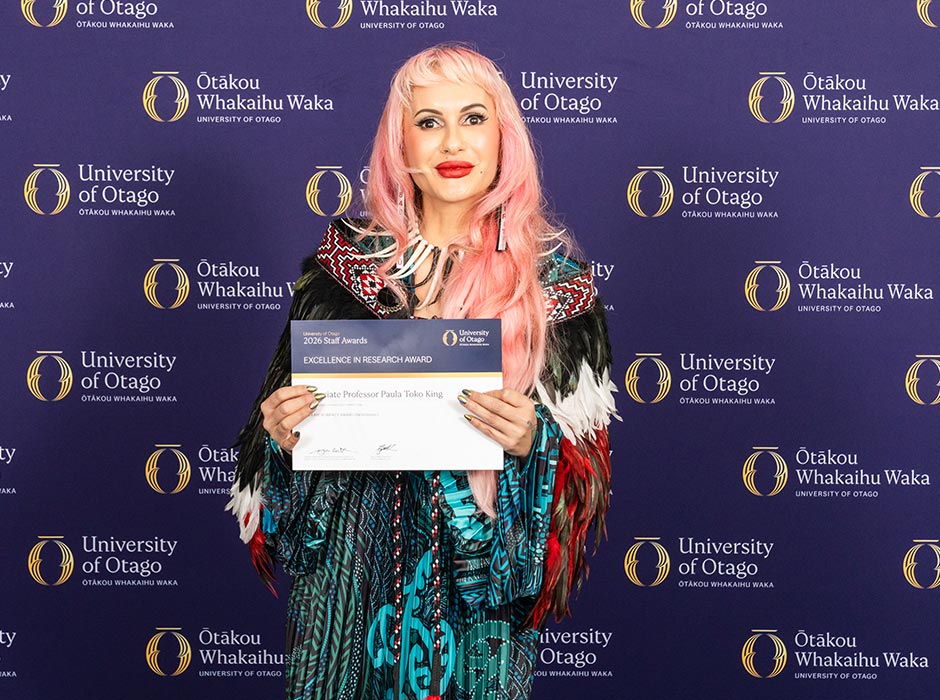
Research Associate Professor Paula Toko King’s research centres Māori experiences and has had a powerful impact across a range of important health practice, policy and community settings.
Research impact was in the spotlight at the Otago Staff Awards, celebrating the outstanding work of kaimahi who bridge the gap between research and the communities it benefits.
The Research Impact Awards – presented for the first time this year – recognise outstanding research impact by a researcher and a research team. At Otago, research impact encompasses the beneficial and sustainable effects of research and creative practice on quality of life.
Research Associate Professor Paula Toko King (Te Aupōuri, Te Rarawa, Ngāpuhi, Ngāti Whātua, Waikato Tainui, Ngāti Maniapoto) was presented with the Individual Award and the Edgar Diabetes and Obesity Research Centre (EDOR) won the Group Award.
Deputy Vice-Chancellor Research and Innovation Professor Greg Cook says the calibre of nominations received was uniformly outstanding and the final selections were by small margins.
“Many of the nominations were worthy of award, which made for lively selection panel discussions.
“Paula’s research stood out for the power and immediacy of its impact. Her work centres Māori experiences and has had strikingly powerful direct impact across a range of important health practice, policy and community settings.
“The Edgar Diabetes and Obesity Research Centre’s primary aspiration has been to make a real difference, which they have achieved globally and across multiple research impact areas with stunning effect.”
The new Research Impact Awards seem to have struck a chord with researchers across the University, Greg says.
“At a time of global uncertainty, it is deeply heartening and inspiring to see the tangible good our research is achieving in the lives of people outside the University.”
Individual Award: Research Associate Professor Paula Toko King
Kaupapa Māori research makes vital impact
The voices of those with lived experience should guide the research that helps them flourish and thrive, says Research Associate Professor Paula Toko King, the University’s inaugural Individual Research Impact Award winner.
“Research that makes a real difference upholds the rangatiratanga of people with lived experience as the experts over their own lives,” Paula says.
“Their experiences and aspirations must set the priorities, rather than our own assumptions about what they need.”
From Otago’s Department of Public Health – Wellington, Paula is a public health medicine specialist and Kaupapa Māori researcher working across epidemiology, qualitative and participatory creative methods, and ethical co-designing. Her research explores the intersection of racism, ableism and disablism, state care, youth justice residences and prisons and Māori health equity.
As part of her doctoral research, Paula developed the Oranga Mokopuna framework, which sets out a tāngata whenua rights approach to mokopuna Māori wellbeing. The WHO–UNICEF–Lancet Commission on Child Health and Wellbeing incorporated her research on the voices of mokopuna Māori in its final report, and in its internationally distributed resources 'Children's Voices', as did Wellington’s Te Wao Nui Child Health Service and Hospital, in its child-centred environmental design.
Her research has had a powerful direct impact across a range of important health practice and policy settings, including directly influencing the Minister of Corrections’ decision to remove tie-down beds from all prisons across the country, and informing the Waitangi Tribunal on disability issues impacting Māori.
She also co-hosts TIAKI, a six-episode podcast series that shines a light on the health and wellbeing of Māori leaving prison and explores what a safe and just Aotearoa New Zealand could look like without the harms of prisons.
Paula is very clear that the award does not belong to her alone.
“Research impact doesn’t happen without working as a collective. Ehara taku toa i te toa takitahi engari taku toa he toa takitini. My strength is not that of one but of many,” she says.
For Paula, Kaupapa Māori research is not about knowledge for knowledge’s sake but must resonate with Māori experiences and create positive change for the communities it serves.
To have impact, knowledge must be accessible, she says, and while academic journals have their place, they often sit behind a paywall or are written in academic jargon that does not resonate with those most affected.
“We share research in New Zealand Sign Language, and through art, theatre marae, poetry and kōrero, so that somewhere across all of it there’s something that reaches every whānau.
“For me, the research worth celebrating is research that takes whānau knowledge and world-perspectives and gives them back to whānau and communities.”
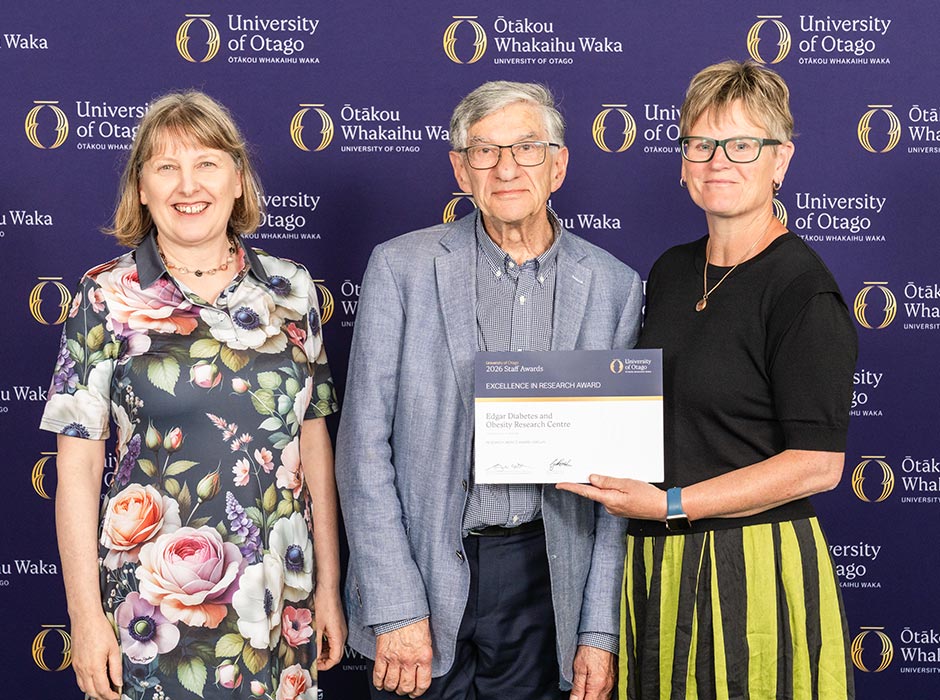
From left, Dr Cherie Stayner, Professor Jim Mann and Professor Rachael Taylor. The Edgar Diabetes and Obesity Research Centre has built an exceptional record of impact through world-leading research since they began 23 years ago.
Group Award: Edgar Diabetes and Obesity Research Centre (EDOR)
Group fulfils aspiration of long-term impact
A team with a two-decade track record of impact won the University’s inaugural Group Research Impact Award.
EDOR Director Professor Rachael Taylor says the team is honoured to receive this award, with the recognition belonging to everyone involved – including the communities and participants who make their research possible.
“It’s especially meaningful because it acknowledges impact, not just output. It says that the work is making a difference beyond the University,” she says.
EDOR was established in 2003 as diabetes and obesity were emerging as major public health challenges in Aotearoa New Zealand. Since then, the Centre has built an exceptional record of impact through world-leading research, contributing to the development of health policy, building enduring partnerships with Māori, and advocating for communities affected by both type 1 and type 2 diabetes, and obesity.
Early EDOR initiatives, including Ngati and Healthy Prevent Diabetes Project with Ngati Porou Hauora and Te Whai mātauranga o te ahua noho programme, showed that kaiāwhina (care and support staff) can play a vital role in diabetes prevention and management, despite lacking formal health qualifications.
EDOR has also made significant contributions advocating for sleep as a cornerstone of weight management initiatives alongside food and activity, with research-backed evidence from studies – such as screen time and sleep – and trialling different approaches to improving sleep behaviours.
The Cost of Diabetes Report, produced with Diabetes New Zealand, helped inform Te Whatu Ora Health New Zealand’s Diabetes Roadmap, which sets the national direction for improving diabetes prevention, care and outcomes and includes policies linked to many EDOR initiatives.
EDOR researchers have also shaped World Health Organization nutrition guidelines and European diabetes dietary guidelines. Their findings on baby-led weaning and infant sleep interventions have informed guidance from Plunket, the Ministry of Health, Kidz First, and the UK Scientific Advisory Committee on Nutrition.
For the EDOR team, impact is vital because it deals with people’s lives and their health, Rachael says.
“Diabetes and obesity aren’t abstract problems. They shape the everyday wellbeing of whānau and communities across Aotearoa, and they fall hardest on Māori and Pacific peoples. Making a real difference has been our aspiration since we began 23 years ago.”
A further strength of the Centre is its commitment to knowledge exchange and advocacy, ensuring that research findings are translated into accessible information for the people, communities, and decision makers who can benefit most from their research.
This has all been made possible by strong support, Rachael says.
“We’re grateful to the Edgar family, whose vision and generosity made the Centre possible, and to everyone who has been part of EDOR over two decades.”
~ Kōrero by Sandra French, Adviser, Internal Communications