
Two Ōtākou Whakaihu Waka tauira have made history as the inaugural recipients of new scholarships that celebrates excellence in 100-level mathematics and statistics papers.
Tom Dyer (Ngāi Tahu) and Sky Mills (Ngāti Hāmoa) have each been recognised for their academic performance in mathematics.
Tom received the Iti Rearea Prize for Māori tauira, while Sky was awarded the Mana Ola Prize for Pacific students.
Dr Tilman Davies, Department of Mathematics and Statistics 100-level Director of Studies for Statistics and departmental Pacific Liaison, established the scholarships, and says they aim to reward outstanding performance in 100-level papers.
“The Iti Rearea Prize for Māori tauira was set up alongside its counterpart for Pacific students, the Mana Ola Prize,” Dr Davies says.
“Historically, Māori and Pacific students have been underrepresented in maths and stats, and these awards aim to both reward achievement and help motivate students who might not initially think about pursuing our majors or minors.”
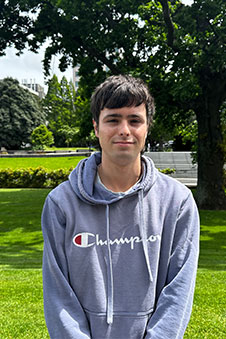
Tom Dyer
For Tom, who is studying mathematics and physics, receiving the inaugural Iti Rearea Prize was both humbling and unexpected.
“I’ve never worked hard in my studies with the goal of winning awards, it’s always been about following my passion for maths and physics,” Tom says.
“I was really surprised when I received the email letting me know I’d won. I told my mum straight away and gave her a big hug. To be the first recipient is incredibly humbling.”
Born and raised in Dunedin, Tom attended John McGlashan College and is passionate about furthering his education at Otago.
“I’ve always loved this city, which is a big reason why I chose to stay,” he says.
“This scholarship will help cover my course fees for the year, which means I can stress less about money and focus more on doing what I love — learning and showing that Māori students can thrive in the sciences.”
Although Tom didn’t explore his Māori heritage much growing up, he says Otago’s environment has helped him connect with that part of his identity.
“The programmes and environment here have helped me learn more about my whakapapa, and that’s been really special.”

Sky Mills
For Sky, who is studying physics with a mathematics minor, the award represents more than academic success, it is a celebration of her family’s sacrifices and her journey as a proud Pacific student.
“It is a huge honour,” Sky says.
“Not only to be a representation of Samoans looking to get into mathematics and statistics, but also, it’s a nice reminder that my hard work doesn’t go unnoticed.”
With proud Samoan roots, Sky was raised in Dubai and Malaysia and admits her path into science wasn’t always clear.
“I wasn’t quite sure what I wanted to pursue in university until year 13 when I had some great math and physics teachers who inspired me,” she says.
Sky says receiving the Mana Ola Prize has given her both recognition and responsibility to continue representing her culture and to inspire other Pacific students who might doubt their place in science, technology, engineering and mathematics.
“I hope this helps remove the stigma that mathematics and statistics are a difficult subject to get into. If you are passionate enough and try your hardest, you can achieve anything you put your mind to.”
Behind Sky’s success is a deep sense of family pride and intergenerational resilience.
“I have huge respect for my family for giving me the opportunities that I can take advantage of now,” she says.
“From my Nana making the hard move out of Samoa to give her kids a better life, to my parents moving abroad to make enough money so me and my brother could live comfortably. It’s fair to say that I owe a lot of my accomplishments to my family.”
Sky’s academic journey has not been without challenges. Coming from a demanding Asian schooling system, she faced the pressure of high expectations and constant comparison.
“With the pressures set by peers, teachers and just the general culture, it was easy to compare yourself and participate in negative self-talk,” she says.
“That, mixed with a lack of identity away from my culture and dyslexia, it made it hard to keep up sometimes. However, with the help of perseverance and a good community by my side, I ended up where I am today.”
For Sky, mathematics is more than numbers.
“I really enjoy the modelling and the predictions aspect of mathematics,” she says.
“Combined with my physics degree, I hope to do something either in research or general experimentation. However, I still am exploring other paths and am working hard to give myself that freedom of choice.”
She is also keen to remind others that excellence comes through effort, not innate talent.
“I wasn’t naturally gifted to begin with, it took a lot of trial and error to get where I am today academically, so it doesn’t come without its challenges.”
Sky’s message to others is simple.
“Anyone can get good at a subject with the right teaching and guidance and it is very easy to have this notion that you aren’t a ‘numbers person’ or good at math. However, I think if you apply yourself, use the resources available and have the right guidance, you can learn anything,” she says.
Both Sky and Tom say that excellence doesn’t just come with natural talent, but that students can achieve anything they set their mind to, even if it does feel foreign, through effort, dedication, and community support.