
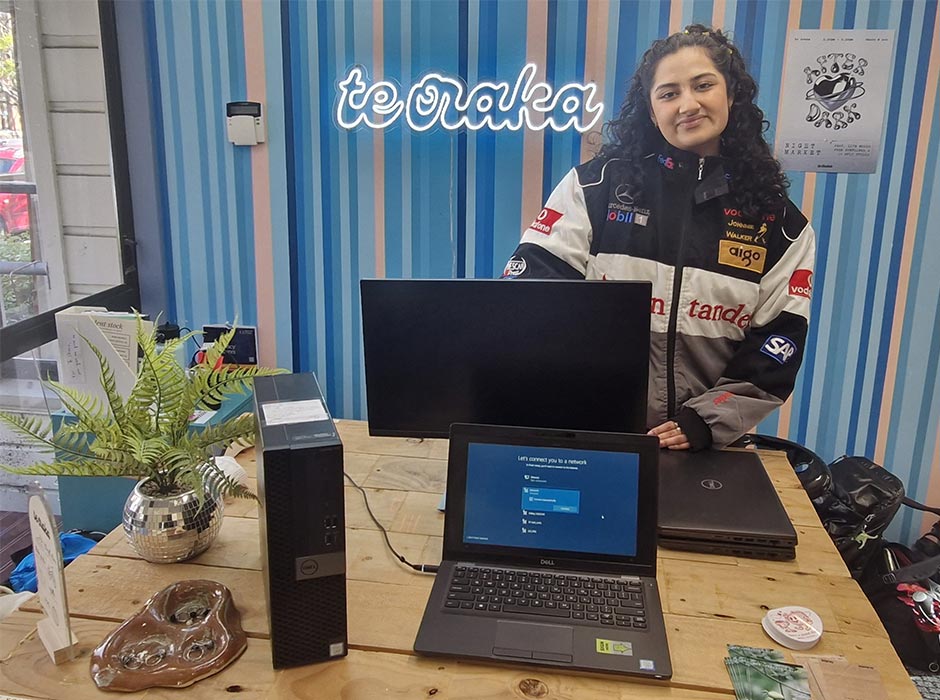
ITS Infrastructure Intern Shreya Das with some of the IT equipment available for purchase by students and staff at Te Oraka.
The University of Otago – Ōtākou Whakaihu Waka’s innovative approach of transforming its end-of-life IT equipment into opportunities for re-use is helping to bridge the digital divide and look after the environment.
Since last year, old University IT equipment such as monitors, cords and a few desktops have been offered for sale at Te Oraka – the on-campus thrift shop.
Now Otago students and staff can also purchase rescued laptops from the shop for reasonable prices. The laptops are tested, processed and currently have a new drive installed before being re-sold. All profits go back into Te Oraka and student-led wages at the shop.
Sustainable E-Waste and E-Rescue Manager Garreth Taylor says Otago’s approach is innovative. It challenges traditional IT asset management by making hardware re-use standard practice, with recycling becoming a last resort rather than the default.
Garreth says his team’s efforts, in collaboration with Toitū te Taiao, the University’s Sustainability Office, has seen the percentage of old University IT assets rescued and re-used continue to climb towards 50% over 2025.
As well as providing opportunities for students and staff to purchase rescued IT equipment at Te Oraka, Garreth’s team has also developed internal partnerships to provide equipment directly to vulnerable students as well as community partnerships to provide equipment to vulnerable families around the region and beyond.
“To date, over 1240 desktops and laptops have been rescued and re-purposed for community use. This is a much more sustainable practice than disposal or even sending the equipment for recycling for the precious metals within them,” he says.
Garreth says research shows this type of digital inclusion provides significant benefits to people, whānau, communities and society. It helps people and communities stay connected, broadens their horizons, increases their access to goods and services, and opens doors to new economic and social opportunities.
An example that stands out for Garreth was when a community partner asked for some old Dell Optiplex 9020s – desktops which first came onto the market well over 10 years ago – for community re-use.
“I asked our community partner three separate times if they were sure they really wanted to provide this very old style of desktop,” he says.
“In turns out the families they were providing them to were absolutely loving them because they were more than good enough for children to do homework on, but too old for them to download games and be distracted on.”
Acting Chief Operating Officer Jared Hayes says Otago’s work in the e-rescue space contributes to Pae Tata – the University’s strategic plan to 2030 – as well as Ti Kōuka, its Sustainability Strategic Framework.
Jared says it does this by addressing three important objectives – reducing environmental impact through responsible disposal, improving student access to affordable technology, and building meaningful community partnerships.
“This mahi is also delivering on Otago’s vision statement of ‘our people and knowledge transforming lives, connecting communities, and nurturing the environment in Otago, Te Waipounamu, Aotearoa, the Pacific, and the world’,” he says.
E-rescue items
Find out more about the e-rescue items available for purchase by students and staff from Te Oraka. Enquiries can also be emailed to e-rescue@otago.ac.nz.
Find out more