
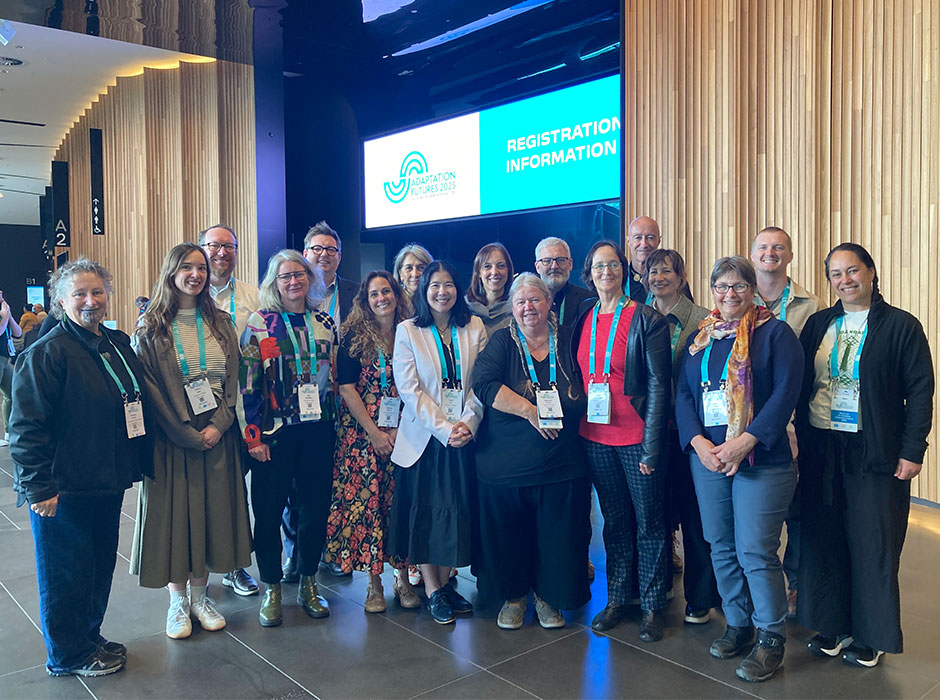
Otago researchers and alumni attended the international Adaptation Futures Conference held recently in Ōtautahi Christchurch. Front row (from left): Dr Mawera Karetai, Ariane Bray (PhD student), Professor Alexandra Macmillan, Dr Gianna Savoie, Dr Celia Lie, Dr Deborah Davies, Research Professor Janet Stephenson, Professor Janice Lord, Dr Maria Rawiri. Back row (from left): Craig Cliff, Associate Professor Ben France-Hudson, Research Associate Professor Katharina Ruckstuhl, Dr Francesca Marzatico, Ray O’Brien, Professor Paul Tapsell, Associate Professor Sophie Bond, Dr Ben Tombs.
Otago researchers recently attended the international Adaptation Futures Conference as the flagship event of the United Nations World Adaptation Science Programme.
Held in Ōtautahi Christchurch in October, the eighth international climate change adaptation conference brought together nearly 2000 practitioners working at the forefront of climate impacts.
Otago researchers, including students and alumni, joined international researchers, policy makers and educators to learn, be inspired and to collaborate towards a sustainable and fairer future.
Professor Janice Lord, based in the Department of Botany, described the event as one of the most exciting, inspiring and eye-opening conferences she’s ever attended. She says that even nationally it’s often difficult to keep up with the valuable work being done across governmental, university, and private research sectors.
“The conference showcased incredible climate adaptation projects from all around Aotearoa New Zealand and the Pacific,” Janice says.
“Looking ahead, we shouldn’t have to wait for an international conference to bring together New Zealand’s policy makers, researchers, and practitioners in the climate adaptation space. We need to be meeting on a regular basis nationally and across the Pacific region to fast-track the adaptations needed to meet the challenge of climate change.
“If we have learned anything from recent significant weather events, it is that the best approach to managing risk, responding to disasters and planning for adaptation is to devolve power and investment to communities.”
Guy Frederick, Communications Advisor Sciences, caught up with the researchers at the conference and asked them to share their reflections of the event.
Craig Cliff, Sustainability Office
From all the presentations, workshops and sideline conversations, a key theme is that human beings are always adapting. Climate change is providing many reasons to adapt, but by no means the only reasons. It was special to spend a week with nearly 2000 people from around the world, including many different Indigenous cultures, thinking about how we can do right by future generations.
Within the University's sustainability office, we've been leading work on reducing greenhouse gas emissions and assessing the risks of climate change. The adaptation futures conference provided lots of great ideas and the inspiration to keep up this momentum and bring these pieces of work closer together.
Associate Professor Ben France-Hudson, Faculty of Law
I was struck by the degree to which there have been incredible advances in thinking about adaptation, both in relation to the science predicting what we might have to deal with, and the ways in which we can plan to meet it. However, I was also reminded that as great as this thinking is, we have completely inadequate legal frameworks to enable much (if any) of it to be implemented. These legal frameworks cannot develop on their own and will need serious consideration and engagement by politicians and policy makers.
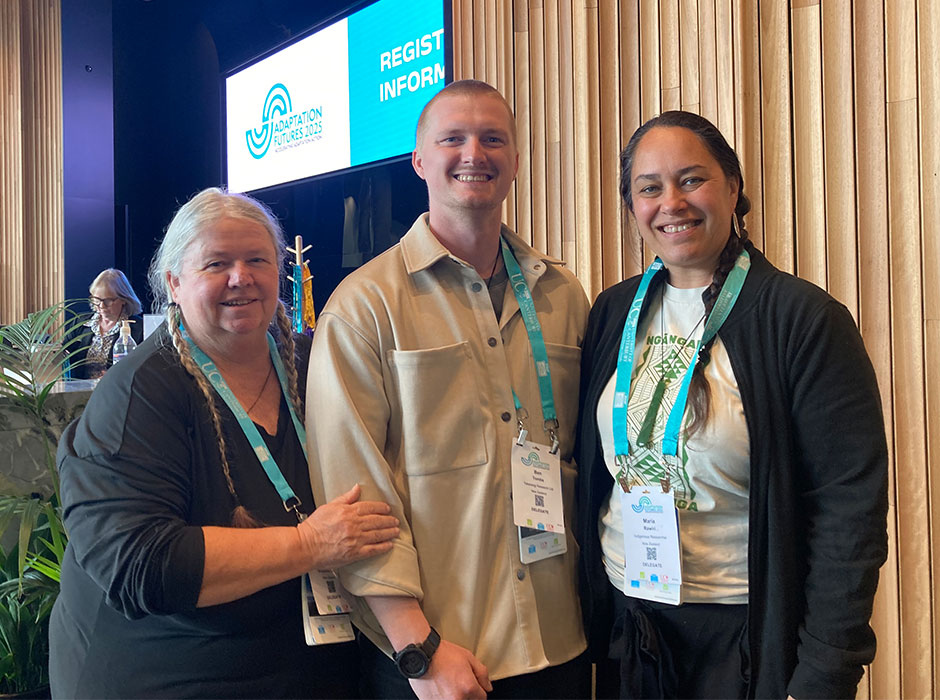
Otago Alumni at the conference (from left), Dr Deborah Davies (Geography), Dr Ben Tombs (Law) and Dr Maria Rawiri (Geography).
Dr Francesca Marzatico, School of Surveying
It was deeply encouraging to see how much resilience the Indigenous and local communities continue to demonstrate in the face of climate change. Traditional and local knowledge play a crucial role in shaping context-specific and culturally-responsive climate adaptation strategies, grounded in Indigenous wisdom and local experience.
The conference’s ability to bring together researchers, practitioners, funding agencies, and private sector representatives was particularly valuable. This diverse participation created meaningful opportunities for dialogue between communities, academics, and funders, fostering collaboration and mutual understanding. Some community members were able to directly discuss with potential funders, opportunities for locally-based solutions to the effects of climate change.
Professor Janice Lord, Department of Botany
My favourite quote came out of a climate finance session with Sarah Bogle in KPMG. Sarah said the most important word in the conference was “and”, emphasising the fundamental role of an inclusive, community-centric, collaborative, multi-disciplinary mind-set in tackling the complexity of climate change impacts, mitigation and adaptation.
Ray O’Brien, Sustainability Office
A key theme of the conference was the interconnectedness and complexity of the challenges that climate change is and will present us with. Seeing Otago staff from so many disciplines converging on this challenge was a healthy sign that we have the multi-disciplinary capability to contribute meaningfully.
Research Associate Professor Katharina Ruckstuhl, Otago School of Business
There was a remarkable agreement that working with Indigenous and local communities and using traditional knowledge would be key to any adaptation, no matter the amount of funding or innovation of any intervention. There was a strong call for an adaptation platform to be developed that would share knowledge, practice and be resourced. Finally, there are huge efforts all over the globe where local communities are taking the initiative, despite political or financial barriers. Adaptation needs acceleration and that has to come from all sectors of society, including the private sector.
Research Professor Janet Stephenson, Centre for Sustainability
Climate change is often presented in the media and online as terrifying, uncontrollable and doom-filled. Yet what I experienced at the conference was an overwhelming sense of positivity. Every presentation I saw was about people coming together to work on climate challenges, often led by Indigenous and other place-based communities. It made me realise that this is what we need to be sharing with our students and others. Climate change will inevitably lead to big changes, but by working together we can create a future to look forward to.
Kā Rakahau o Te Ao Tūroa
The Centre for Sustainability is an interdisciplinary research centre hosted by the School of Geography in the Division of Humanities at the University of Otago.
View