
A new study led by an academic staff member from the University of Otago – Ōtākou Whakaihu Waka has analysed trust between police and ethnic minorities in Aotearoa New Zealand and the United States, revealing meaningful similarities between Māori and Black Americans.
The study found both minorities had less trust in the police compared to participants who self-identified as either White American or New Zealander of European descent (referred to in the paper as White New Zealander) because they felt police did not care about their community’s needs and didn’t share the same values, customs, or background.
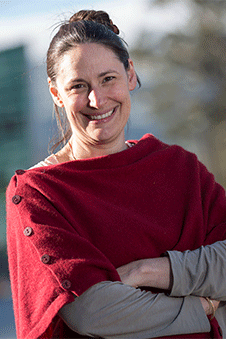 Dr Mariska Kappmeier
Dr Mariska Kappmeier, of Otago’s Department of Psychology, led the study alongside Dr Jacinta Cording, of the University of Canterbury, and Hector Kaiwai, Director of Wai Rangahau.
Dr Kappmeier says trust between police and the community is essential but has been in decline for the past decade.
“Trust is vital for police officers to work and engage safely in the communities, while people need to trust the police so they feel comfortable to reach out to them if in need.”
Published in the journal Psychology, Crime and Law, researchers analysed surveys undertaken in Auckland (331 people) in 2022-23 and Boston (252 people) in 2016.
Trust was assessed using the Intergroup Trust Model that broadly splits trust into two categories: cognitive (a rational assessment of how trustworthy someone is) and affective (a more intuitive assessment, taking the specific relationship with someone into account).
“In both cities, we found Māori and Black Americans’ lower trust was driven by a perceived lack of compassion and compatibility towards them,” Dr Kappmeier says.
“This shows that for marginalised communities, trust in the police seems to be more relational and affective; trust depends on the extent to which the police are perceived as attuned to their group’s welfare and sharing the same values, customs or background, rather than just whether or not the police are perceived as effective.”
These similarities between Māori and Black Americans, when it comes to trust in the police, were fascinating, especially given the surveys took place in different countries years apart, she says.
White Americans’ trust was integrity-based, the perception that the police are honest, and White New Zealanders’ was competence-based, the perception that the police are effective in their job. Like Māori, White New Zealanders’ trust was also based on compassion.
Dr Kappmeier says when building trust in communities, a one-size-fits-all approach is not sufficient.
“Instead, trust interventions need to recognise the different pathways through which trust can be built,” she says.
“Recognising trust’s multidimensional nature will enable the police to design more nuanced strategies to rebuild trust within the communities in which they work.
“Understanding and enhancing trust in the police is beneficial to communities and police alike.”
Publication details:
Mariska Kappmeier, Jacinta Cording, and Hector Kaiwai
Psychology, Crime & Law
Department of Psychology
Psychology is the science that asks why people do the things they do.
Find out more about Otago's undergraduate and postgraduate courses