
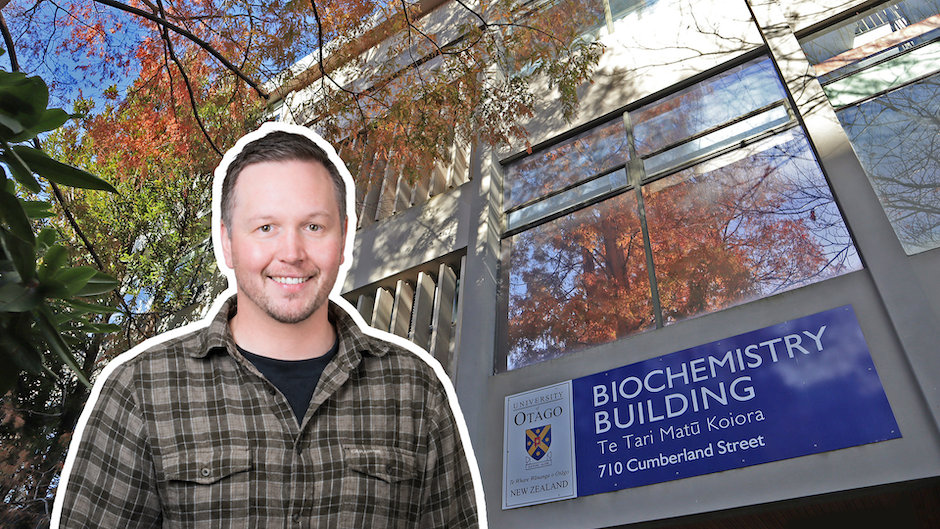
New Department of Biochemistry lecturer Dr Ross Eaglesfield.
The latest new academic in the Department of Biochemistry, Dr Ross Eaglesfield, is aiming high with his research: he wants to make a positive impact on both environment and economy by getting bacteria to re-use waste and create high value resources. With his roots in Scotland, he is quickly adjusting to life in Dunedin. He has already launched into teaching this semester, and we watch with anticipation as he starts his new research group.
We decided to find out a little more about him...
Where did you come from originally?
I was born and raised in Edinburgh, Scotland. I spent some time as a student moving around the central belt of Scotland, from Stirling (where I did my undergrad) to Glasgow (for my PhD). In 2023 I moved to Colorado in the USA where I worked for the last 3 years before moving to Dunedin.
What brought you to the Department of Biochemistry?
The opportunity to start my own lab in a welcoming and supportive department was a big draw. Also, I couldn’t pass up the opportunity to live in such a beautiful part of the world.
What questions or problems are currently at the heart of your research?
I work on ways to engineer industrially interesting bacteria to use waste resources as nutrients and produce advanced biomaterials, fossil-free chemicals and other high value resources. My long-term vision is to see clean and renewable biomanufacturing overtake fossil-derived manufacturing and really tackle some of the drivers of climate change using biotechnology.
What drew you to this field, and how did your research journey begin?
After some fruitful years in the medical biochemistry space studying mitochondrial dynamics and reactive oxygen species, I had the opportunity to re-evaluate what I wanted to achieve in science and society more generally. I have always had a passion for reducing waste and limiting human impacts on the environment and when an opportunity came up to do a postdoc in the USA looking at ways to harness bacteria for cleaning up plastic waste it really felt like the right project at the right time. I learned so much in my time there and it really reshaped my scientific vision and led me to where I am today.
What methods, organisms, systems, or approaches do you work with most?
I work mainly with ‘non-model’ bacteria (basically a term for anything that’s not E. coli or B. subtilis) such as Pseudomonas putida and Cupriavidus necator. These organisms have exceptional metabolic flexibility, and I use genetic engineering approaches to alter their genomes to improve substrate use and product synthesis. I also use adaptive evolution approaches that harness the fast growth rates of bacteria to evolve useful traits for using waste substrates.
What’s one aspect of research that you find especially rewarding?
Working with bacteria is not always the most glamorous thing in the world. But when you are able to see the results of all your hard work and think about the big picture potential of these tiny little biological factories, that is truly rewarding for me.
When you’re not doing research, what do you enjoy spending time on?
I enjoy reading fantasy novels and playing video games. I also love the outdoors, so if I’m not in the city you will probably find me either snowboarding in the mountains or tramping in the wilderness somewhere.
What’s something you like about living in Dunedin?
Having moved all over the world and experienced many big and fast paced cities, I really appreciate the peace and quiet you can get in Dunedin. Also being so close to some amazing beaches and nature is a huge bonus.
What advice would you give to students or early career researchers?
Take your time to really figure out what excites you about science (or anything else). Then don’t be afraid to take a leap into the unknown and follow your passions. You never know where that one email or phone call will lead you.
Favourite piece of lab equipment or software?
Logphase 600. It’s a glorified plate reader that lets you grow ~400 different bacterial strains at once and track their growth over long time periods. May not sound exciting, but invaluable for my work.
Is there anything else you’d like the department to know about you?
My partner and I are always looking for people who enjoy nerdy activities like boardgames and D&D, so reach out if you want to play!