

KneeCAPs programme participant Alison Lawson says the programme gave her the encouragement, motivation and tools to manage her osteoarthritis – and enabling her to cycle and take holidays again. PHOTO: Supplied
One in four New Zealand adults live with knee osteoarthritis – a painful, long-term condition for which surgery is often thought to be the only option. For those struggling with pain and mobility, an Otago-led programme is offering hope.
At age 55, early childhood educator Alison Lawson was excited about a new chapter in her life. With her children more independent, she and her husband were training for cycling adventures together.
But, following a trip to the physiotherapist, severe arthritis was found in both of her hips, requiring urgent surgery.
That surgery went well, but in the following months she began to experience debilitating pain in her knees.
“My job requires me to be mobile and move up and down with the children. I was on a lot of pain medication to just keep going. I was also feeling quite anxious about how ongoing pain would affect my life.”
Fortuitously, a trip to her local pharmacy would provide Alison with significant relief for both the pain and the anxiety.
Alison’s pharmacy was part of Otago’s Te Tauwhiro Turi mā te Rongoā | Knee Care for Arthritis through Pharmacy Study (KneeCAPS), which trialled the effectiveness of providing evidence-based information and access to care through community pharmacies for people with knee osteoarthritis (OA).
After a discussion with her pharmacist to determine her goals and needs, Alison was provided with a booklet about OA and treatment by a dietitian and physiotherapist.
The 12-month intervention was enormously beneficial.
“My physiotherapist gave me an exercise programme to follow,” Alison says. “My dietitian gave me advice on good things to eat. Having their support was amazing. I felt like I was not dealing with it on my own and they gave me encouragement, motivation and tools to manage in future.”
Alison is back cycling, able to manage her physical job and excited about the adventures in her future.
Professor Ben Darlow is a specialist musculoskeletal physiotherapist, lecturer and researcher at the University’s Wellington campus. He has led KneeCAPS over its decade-long evolution.
In 2015, funding from the Division of Health Sciences brought together multidisciplinary experts to explore consumer’s understanding of OA and its management. A booklet on the condition was co-designed by people with lived experience of OA, health professionals and arthritis educators. The team then explored optimal ways for community pharmacy to deliver the initiative. A major four-year Health Research Council-funded study began in 2022.
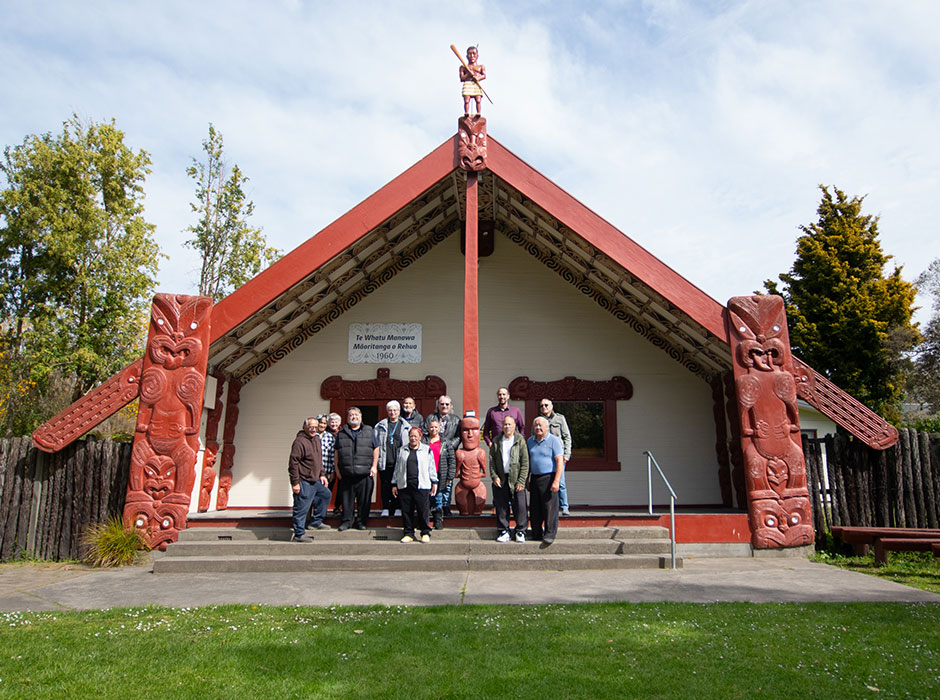
Physiotherapist Kore Tombs has taken the KneeCAPs programme to Renhua Marae – building whanaungatanga with kaumatua – and helping to pick up on early signs of osteoarthritis and provide evidence-based, personalised care. PHOTO: Luke Pilkinton-Ching
Ben says knee OA affects one in four New Zealand adults. Surgery is an option for some with late-stage OA, but there is a gap in accessible care and advice for most people living with the long-term condition.
This gap was motivation for the KneeCAPS study.
“The study, ultimately, looked at whether KneeCAPS reduces pain, impairment and costs,” Ben says. “Our goal was to provide care to those who currently have the least access. A third of participants were from the most deprived communities in Aotearoa.”
Ben says community pharmacies are ideal places for the identification of people with knee OA.
“People with joint pain visit community pharmacies seeking pain relief, anti-inflammatories or joint health products. Pharmacists are skilled health professionals and often have trusting relationships with people and understand their ongoing health conditions.”
The 65 participating community pharmacists in Canterbury and Waikato, and more than 70 dieticians and physiotherapists, were given training to provide high quality and empowering OA care.
Participants were randomised into one of two groups. Half received information on OA and what positive things they can do, as well as access to pharmacists to review medications, dieticians to develop nutritional programmes, and physiotherapists to develop exercise and physical activity programmes, depending on their needs. The other half received the Pharmaceutical Society of New Zealand information currently available in pharmacies.
Ben says as they analyse results, the team is exploring different ways to deliver KneeCAPS.
Rehua Marae in Christchurch is offering the KneeCAPS information and care options to kaumatua through visiting health professionals.
One of those health professionals is Otago-trained physiotherapist and Māori health advocate Kore Tombs. He says: ''Being present and visible at the Marae builds whanaungatanga with kaumatua, which then enables us to pick up on early signs of OA and provide them with evidence-based, personalised care that empowers them to manage their health.”
Partnerships have been developed with the Oamaru Pacific Island Trust, as part of a community allied health service, and Tū Ora Compass Health Primary Health Organisation in Wellington to deliver KneeCAPS in those settings.
Ben says he is excited about the potential of the team’s mahi to help the large number of New Zealanders impacted by OA.
“We can make a real difference to the significant impact osteoarthritis has on people’s lives. KneeCAPS shows how effective care can be delivered to those who need it through health services already in their communities.”
-Kōrero by Kim Thomas, He Kitenga
This story first appeared in He Kitenga 2025 – Impacts. He Kitenga is the University of Otago’s flagship research publication, which showcases the University’s cutting-edge research and explores how it is making a difference to the lives of New Zealanders.
School of Physiotherapy
Physiotherapists are health professionals essential to the rehabilitation and maintenance of optimal physical ability and healthy lifestyles.
View