
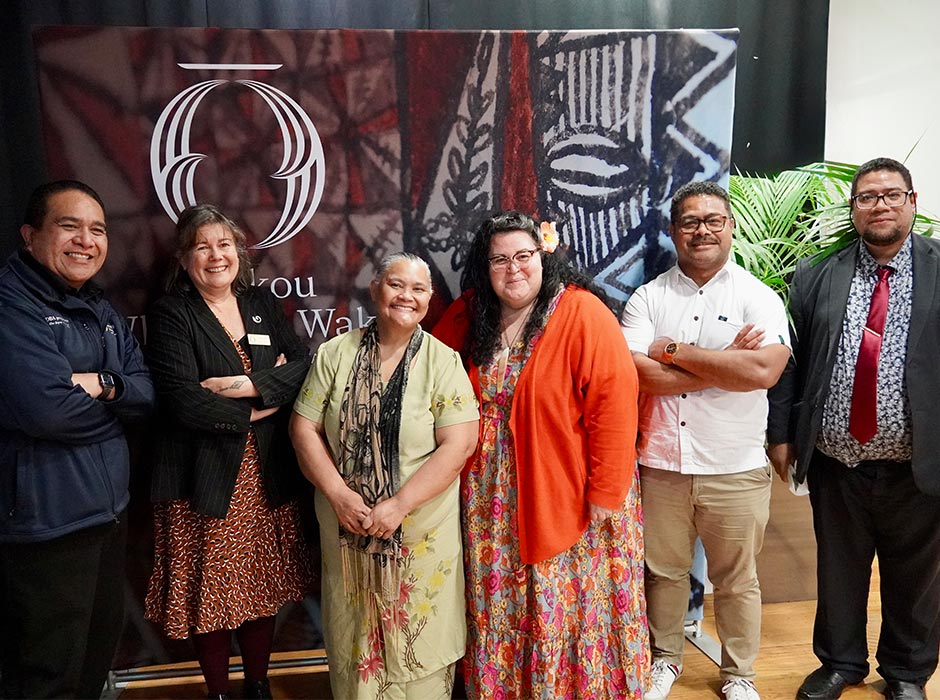
From left to right: Doctor of Business Administration candidate Amanaki Misa, Head of the Tourism Department Associate Professor Anna Carr, Doctor of Business Administration candidate Oloa Lipine, Fran Cockerell, and Business School Lecturers Dr. Jekope Maiono and Dr. Iki Mafi Uele — all smiles after their presentations at the symposium.
When University of Otago postgraduate student Amanaki Lelei He Lotu Misa returned to this year’s Pacific Voices Symposium he had more than just slides and data – he brought a story of growth.
A year earlier, Amanaki stood before his peers presenting the early stages of his doctoral research. His work was full of questions: “Why were Pacific families disengaging from oral-health services? What barriers stood in their way?”
This year, the questions had evolved into answers rooted in collaboration, reflection, and the voices of the very families his research represents.
“Last year I was still in my fieldwork stage,” Amanaki says.
“This year, I could finally talk about what I’ve learned, about our families, our systems, and how understanding Pacific voices can transform health outcomes.”
Amanaki, of Tongan descent, is in the final year of his Doctor of Business Administration (DBA) at Otago.
His doctoral study, Tala Kae Pau, explores oral-health services provided to Pacific families in the Canterbury region. Using participatory action research, Amanaki explores why Tongan families, though enrolled in public dental care, have high missed-appointment rates.
“Pacific communities in Aotearoa have a history of not engaging with the health system,” he says.
“Such a system appears to sustain the invisibility experienced by many Pacific people known to the health system but who may have been forgotten or overlooked.”
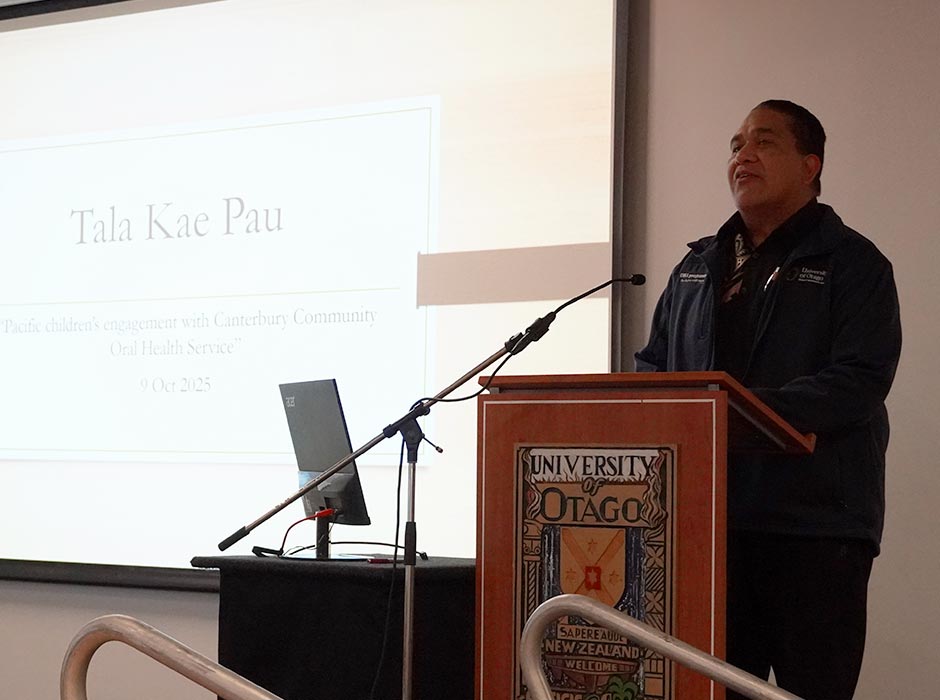
Doctor of Business Administration candidate Amanaki Misa presenting his research at the symposium.
Since his 2024 presentation, Amanaki’s research has grown in scope and depth, shifting from identifying barriers to developing culturally safe, family-centred strategies to improve oral health engagement.
“You cannot have a health system without the voices of health consumers,” he says.
“Families are the owners of their health journeys; they are the drivers of change.”
Amanaki’s research emphasises the need for partnership and empathy, to design health systems that value relationships as much as results.
“When people walk into a clinic, they should feel safe, culturally and relationally, Cultural safety is not just about what the professionals know; it’s about how our families feel,” he says.
“But this research isn’t just about oral health. It’s about creating systems that understand and value our people. That’s what Pacific research is, it’s about bringing humanity back into the conversation.”
Amanaki’s academic and professional journey continues to inspire many in the Pacific postgraduate community.
Born and raised in Havelu, Tonga, and now based in Christchurch, he has built a career spanning policy, community development, and health management.
Balancing full-time work with doctoral research has required both discipline and sacrifice.
“It’s not a stroll in the park,” Amanaki says.
“The cost – financially, emotionally, spiritually – is huge. But I’ve always wanted to push myself. I’m the first in my family to graduate from university, and I want to keep going so I can pass this knowledge on.”
Faith, he says, keeps him grounded.
“Anchoring my faith in God helps me reset when things get hard. It keeps me sane and focused on why I started.”
Amanaki’s personal resilience mirrors the collective spirit seen throughout the symposium.
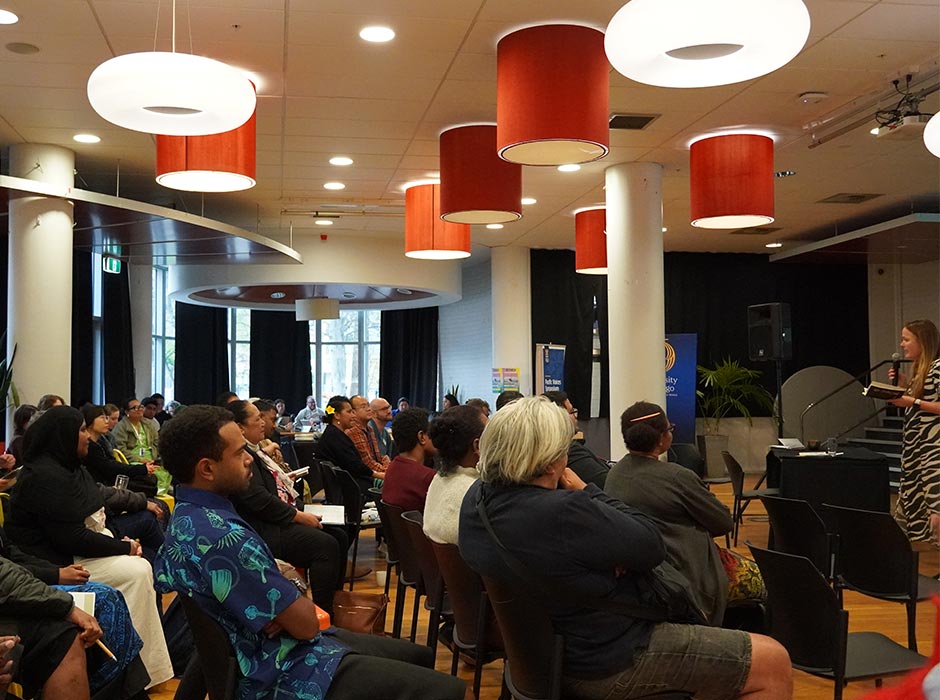
Pro Vice-Chancellor Professor Maree Thyne presents her feedback of presentations to the audeince after the DBA cohort of presentations.
Now in its 22nd year, the Pacific Voices Symposium is a key event for Pacific postgraduates at Otago.
This year’s symposium, held last Thursday, reached new heights, with 26 submissions,18 presentations, and its largest crowd yet. Throughout the day, students, whānau, and supporters filtered in and out of the venue.
The diversity of research was striking, from Fran Cockerell’s exploration of traditional Tokelauan female leadership concepts within a Western tertiary institution, to Cam Young’s biomedical study on maternal protein intake during pregnancy and its impact on offspring heart health later in life.
In his foreword featured in the symposium book of abstracts, Associate Dean Pacific of Biomedical Sciences Dr Sakiusa Baleivanualala beautifully captured that spirit of unity and purpose.
“Pacific Voices has taught me that Pacific postgraduate research is not just about individual achievement, but about community, responsibility, and connection. The work we do here has value because it connects to our homelands, to the families and communities who inspire us, and to the Pacific region we serve,” Sakiusa says.
The Pacific Voices Organising Committee hopes to grow the symposium next year and appreciates any feedback on how to improve it. Feedback can be emailed to pacificvoices@otago.ac.nz.
Past Pacific Voices Symposium booklets can be viewed here.
~ Talanoa by Viena Faiva, Adviser Communications (Pacific).
Pacific at Otago
The University of Otago provides a welcoming and supportive environment to Pacific students during their tertiary education journey.
Find out more