
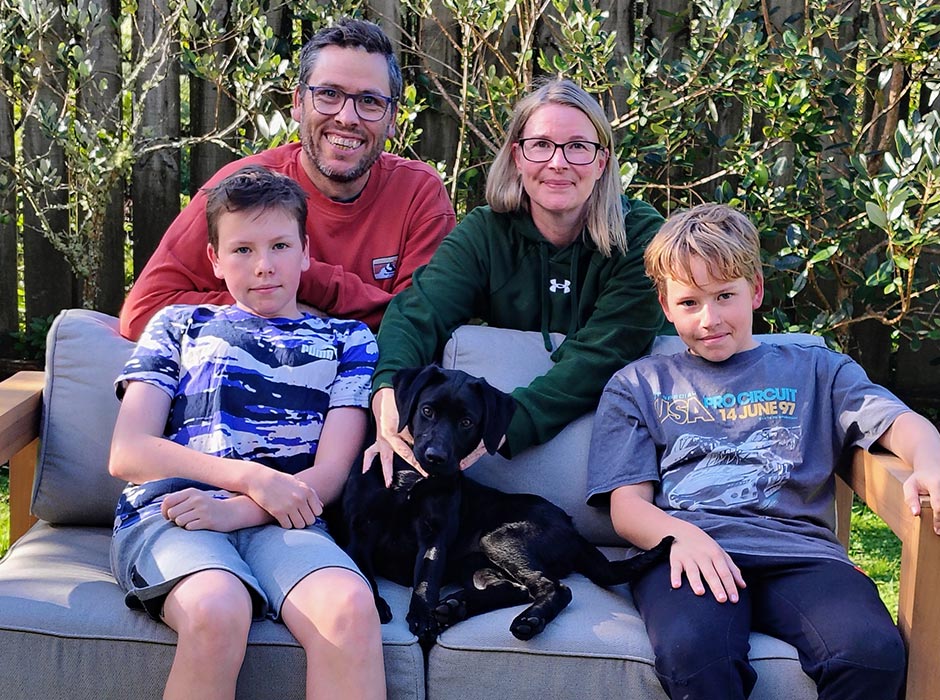
Faculty of Biomedical Sciences PhD graduate Lauren Jelley with husband Brendan, sons Ollie and Toby (left to right) and new puppy Sam.
Lauren Jelley’s dedication to tracking viral infection in New Zealand over the last few years could boost the country’s pandemic preparedness.
Lauren graduated from the University of Otago – Otākou Whakaihu Waka on 9 May with a PhD in Genomic Epidemiology.
Working with Professor Jemma Geoghegan from the Department of Microbiology and Immunology, she has been studying the introductions, transmission and circulation of influenza and Respiratory Syncytial Virus (RSV), with an aim to guide public health policy.
Her thesis, Genomic epidemiology of respiratory viruses in Aotearoa New Zealand: Lessons for New Zealand’s prevention and response to viral pandemic threats, made it to the University’s Health Sciences Divisional List of Exceptional Doctoral theses.
Studying remotely as a mature student, while working part-time and juggling the needs of a family over the last five years had its challenges, but Lauren has no regrets.
“I had great support and encouragement from family and the team at work, and I was fortunate to be able to work with Jemma. She is a world expert in viral evolution and an amazing supervisor – University of Otago is very lucky to have her.”
One of the more challenging parts of the study was being based in Wellington, Lauren says.
Although she caught up with Jemma regularly online, working remotely meant she missed the collegial support of fellow students.
“One of the best things about the frequent visits to the Otago campus was working in the write-up room with like-minded post-grads. It was good to talk over a problem – big or small – instead of trying to hunt for a solution on YouTube.”
She’s always been fascinated with the world of viruses, she says.
She gained a Bachelor of Science at Te Herenga Waka – Victoria University of Wellington before moving to Australia and working at the Victorian Infectious Diseases Reference Laboratory in Melbourne, and then with the WHO Collaborating Centre for Reference and Research on Influenza at the Doherty Institute. The Institute is part of the World Health Organization Global Influenza Surveillance and Response System, which monitors changes in influenza viruses.
She completed her master’s with the Centre in Melbourne before returning to Wellington in 2015 with her partner and two young children to work with Professor Sue Huang at ESR – now the New Zealand Institute for Public Health and Forensic Science (PHF Science) – on viral surveillance.
PHF Science’s surveillance platforms monitor the spread of viruses in different severity settings, such as in hospitals and in the community, with the aim of getting prompt information on the severity of a viral outbreak. This informs the public health response, preventing wider infection.
As Technical Lead for the Clinical Virology Laboratory, Lauren’s work includes viral surveillance – monitoring what is happening with numerous respiratory viruses, including influenza and RSV.
A once-in-a-lifetime opportunity then came up to study viral introductions and transmission in New Zealand post Covid-19 border restrictions, when seasonal respiratory viruses, which had ceased to circulate in New Zealand, were being reintroduced.
So 20 years after starting tertiary studies, Lauren committed to a PhD. “I had to do it,” she says.
Starting in 2021, Lauren’s PhD study examined data collected by PHF Science. Looking at the genomic sequences of viruses circulating in New Zealand, she compared them with information overseas to see where they came from, how they were introduced, and how they circulated within the community.
It was especially interesting to follow RSV re-establishing after the Covid-19 lockdown, during the quarantine-free travel bubble with Australia.
Across four different published studies (including in the Nature Communications journal), Lauren produced a comprehensive picture of the introduction and circulation of influenza and RSV specific to New Zealand.
She confirmed that influenza viruses come in via international travellers, with most cases being detected in the three North Island health regions. Knowing this helps to prioritise surveillance and management in the Northern health region.
The lessons for New Zealand’s prevention and response to viral pandemic threats are preparedness, Lauren says. Having improved surveillance data, including genomics, will ensure a well-informed public health policy.
“A growing population and urbanisation mean humans have closer contact in densely populated developments. Therefore, it’s increasingly easy to spread viruses, while more intensive farming practises and deforestation mean more people are encountering animals, which increases the likelihood of spillover events. Each respiratory virus is different, so it’s important to study each one and have a plan in place,” she explains.
“Viral genomics has become essential for pandemic preparedness; using innovative sequencing technology has accelerated viral identification. The next step is to use whole genome sequencing as part of routine surveillance to give a full picture of seasonal viral outbreaks in real time.”
There are no more plans for study – Lauren says she’s done – but she is committed to working on disease surveillance.
Lauren’s children are equally excited about their future family time with a new, fun-loving black Labrador called Sam, a fulfilled promise to her sons when the thesis was finally handed in.
– Kōrero by Claire Grant, Communications Advisor, Faculty of Biomedical Sciences
Study Microbiology at Otago
Explore the hidden world of microbes and discover how they shape life, health and our planet.
Explore Microbiology