
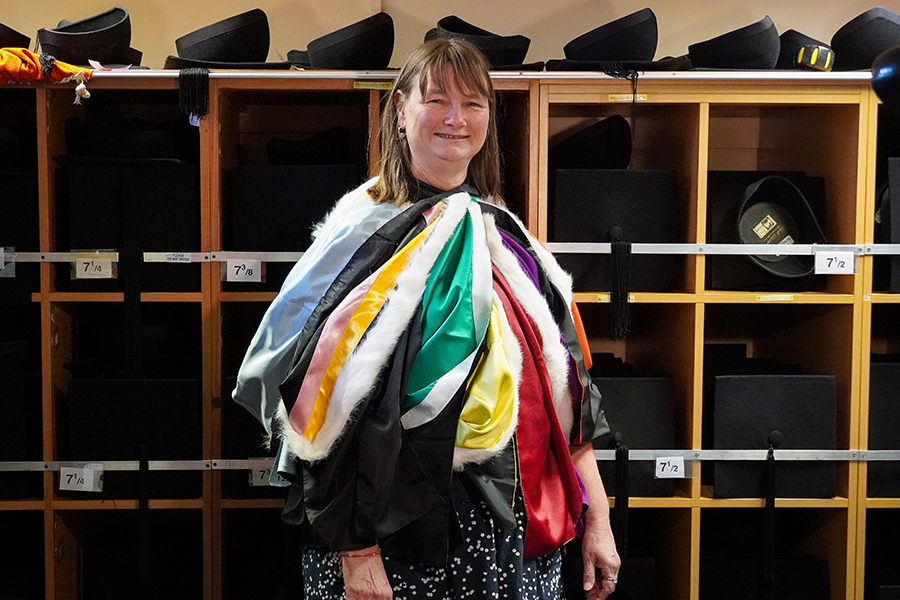
Gown manager Dr Jules Gross demonstrates how not to wear a hood, but displays some of the range of vibrant colours featured on Otago hoods.
There are (at least) two stories about the evolution of academic hoods.
For both, one must bear in mind that academic dress has been around since the 12th century and it was worn as a matter of course for hundreds of years.
The first story is possibly the more well-known. It involves the most educated, therefore more senior, getting to sit nearest the fire – so Doctors of Philosophy (PhDs) need no fur around their hoods to keep them warm, while Bachelors, who sit furthest from the fire, have hoods edged with fur.
The second story is that everyone started out with fur on their hoods, but the longer they were in education, the more worn and rubbed their hoods became, meaning the most educated had the least fur left – hence you will find no fur on the academic hood of a Doctor of Philosophy.
One of these stories - or perhaps another one entirely – have led to the Otago University of today, where the black hoods of those who have achieved a Bachelor degree are lined with coloured satin bordered with white fur, while those who have completed an Honours’ degree wear black hoods lined with coloured satin bordered with white ribbon.
Masters’ of their disciplines wear black hoods lined with coloured satin, some are also bordered with ribbon, while Doctors of Philosophy wear hoods usually made of scarlet satin and also lined with scarlet or another colour satin.
We speak of hoods because this week, about 500 excited graduands and University staff members will file through the Clocktower’s academic gown rooms assembling their dress for the big day this Saturday.
Academic regalia at Otago is owned and managed by Graduate Women Otago (GWO). GWO has about 90 members, who manage academic dress as a fund-raising activity.
Proceeds from academic gown hire provide funds for fellowships, awards, grants and special projects in the community.
When it comes to hoods, Gown Room manager Dr Jules Gross says the August graduation, while the smallest, is also one of the more interesting.
There is usually a far wider range of degrees conferred, therefore – as the colour of the hood’s lining denotes the degree – more colours are on display during the parade and two ceremonies.
There are, naturally, rules to wearing hoods. Only one hood is worn at a time, so if you are receiving two degrees you have to choose which hood you will wear at the ceremony and they must be worn hanging down the back and never with the colour showing from the front (though one might delicately balance the very edge of the hood on a shoulder for a photo if one is very careful).
Choosing the colour for the hood for a degree is quite the business.
When the GWO started providing academic dress in 1931, they purchased six hoods, for degrees in the arts, science, education, and commerce.
Now there are more than 70 different hood colours listed on Otago’s Academic Dress Statute 2011.
The statute is regularly updated (last in 2022), with colours for new degrees. These are suggested by GWO and decided in collaboration with the academic programme involved and the senior leadership of the University before the choice is presented to the Registrar and the University Council for final approval.
The colours are based as closely as possible on the colours of the British Colour Council (BCC) Dictionary of Colour Standards or the Munsell Book of Colour system of colour classification.
What colour is chosen depends on many factors and can be a real juggle, says Dr Gross.
There is the availability of colours and how easy it is to get fabrics, with a main factor usually the latter.
Degrees within a discipline feature hoods in the same colour range – for example, hoods for science subjects will feature lido blue (BCC colour number 89).
Though over time suppliers and colours alter, the GWO tries to source fabric as true to the original colours as possible.
The colours themselves are as varied in name as hue.
Education degrees have a flame (BCC 95) coloured hood. Social work gets sulphur, while Medical Science gets mauve crocus and dentistry graduates wear hoods in spectrum violet.
Graduate women pay for, source, and make all the hoods, ranging in cost from $100-150 Disciplines also come and go and the number of new hoods required in a year depends – some graduations the team might need dozens of new ones because there are hundreds graduating in one discipline, then it might not need that many again.
It is the ever-changing nature of the challenge that keeps it interesting says Dr Gross, and whatever excitement there is in the busy lead-up to another graduation, it is always a joy to see the colours of the rainbow brightening up Ōtepoti’s George St in the parade on graduation day.
-Kōrero by Debbie Porteous