
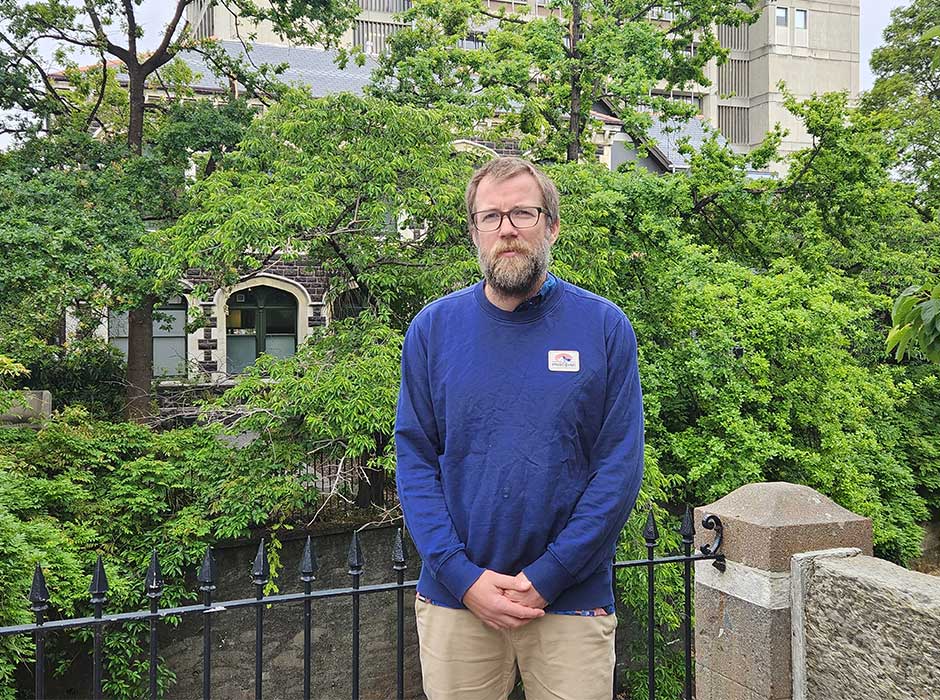
The new Director of the Centre for Rural Health, Dr Rory Miller, says the Centre is making a positive difference for rural and remote communities.
Continuing to raise the profile and importance of rural health is front of mind for the new Director of Otago’s Centre for Rural Health.
Dr Rory Miller was appointed as Director in late November, replacing Professor Garry Nixon.
The Centre for Rural Health aims to improve healthcare and health outcomes for rural and remote communities in Aotearoa and the South Pacific through teaching and research excellence. It is based on the principles of social accountability and community engagement.
“The goal is that we become the leading rural health academic unit in New Zealand and the Pacific, and make sure that’s sustainable,” Rory says.
“Compared to countries like Australia and Canada, rural health in New Zealand is under resourced and under valued as an academic speciality, but that’s changing and having the Centre will accelerate that change.”
Launched in July 2024, this virtual centre brought together the widely spread rural staff and students from within the section of rural health, (based in what was then called the Department of General Practice and Rural Health), and the Rural Health Academic Centre, Ashburton (RHACA).
The Centre has about 50 staff, based from Hokianga to Balclutha, and almost all are also clinicians.
Rory lives in Whangamatā in the Coromandel and is a rural hospital doctor at Thames Hospital, alongside his part-time Otago academic role.
He says the Centre wants to support future and current clinicians right through the pathway, from before students attend university through until the end of their health professional careers.
“We want to be able to support rural students to enter and succeed in Health Sciences First Year, as well as providing support throughout their training, and then providing ways they can continue their rural medical education.”
The Centre includes the University’s rural postgraduate and continuing medical education programmes, the Rural Medical Immersion Programme, the RHACA, and rural health research and higher degree programmes.
While the Centre predominantly works with medical students and doctors, Rory hopes in time the focus will become more interprofessional.
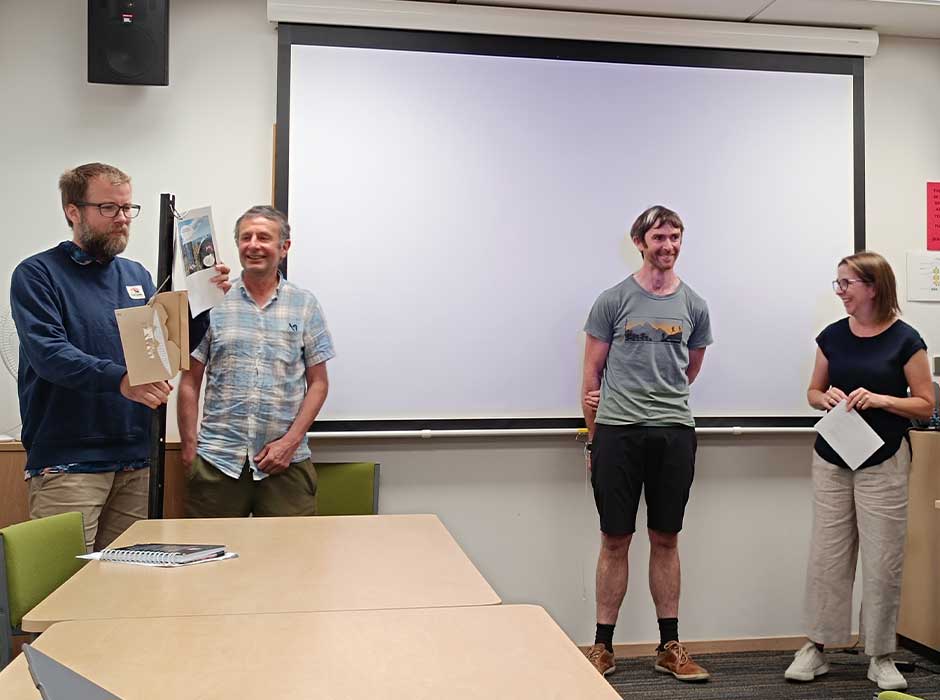
Passing the waratah – Dr Rory Miller (left), the new Director of the Centre for Rural Health, receives the rural equivalent of the baton from former Director Professor Garry Nixon, to the right of Rory, at a presentation in the Hunter Centre, Dunedin in late November.
Recognising the significance of rural health and the work of the Centre, as part of recent structure changes the Division of Health Sciences has elevated the Centre from department level to now reporting directly to the Head of the Faculty of Medicine.
Faculty Head Professor Suzanne Pitama says the Centre is at “an exciting point of growth” as it strengthens partnerships with iwi, Health New Zealand and rural communities across the motu.
She is delighted to welcome Rory to the Director role, saying he brings extensive experience as a rural clinician and has a strong academic track record, including leadership of Otago’s rural postgraduate programme, significant research expertise in rural health inequities and experience managing dispersed teaching teams and research projects.
In recognition of his achievements, Rory has been promoted to Associate Professor, as of 1 February.
Both Suzanne and Rory acknowledge Garry’s huge contribution as an advocate for rural health over many decades.
“Garry’s leadership has shaped the landscape of rural medical education, research and advocacy in Aotearoa New Zealand,” Suzanne says.
Rory says part of the Centre’s role is to increase public and political awareness of rural health and Garry’s research exposing and highlighting the health inequities for people living in rural areas has been an important part of that.
Rory did his medical training at Otago and was based at the Wellington campus for his final three years of his undergraduate studies. He has always been drawn to smaller places and enjoys living in the tightknit community of Whangamatā where he grew up.
“My kids go to the same school I went to.”
The Centre has a key role in responding to rural communities’ health needs and that means close community links are vital.
“Without that connection, that vibe you get, I think your research and teaching would pretty quickly become diluted and become less meaningful.”
- Kōrero by Andrea Jones, Team Leader, Divisional Communications
Centre for Rural Health
The Centre for Rural Health’s aim is to improve healthcare and health outcomes for rural and remote communities in New Zealand and wider South Pacific through teaching and research excellence, and is based on the principle of social accountability and community engagement.
View