
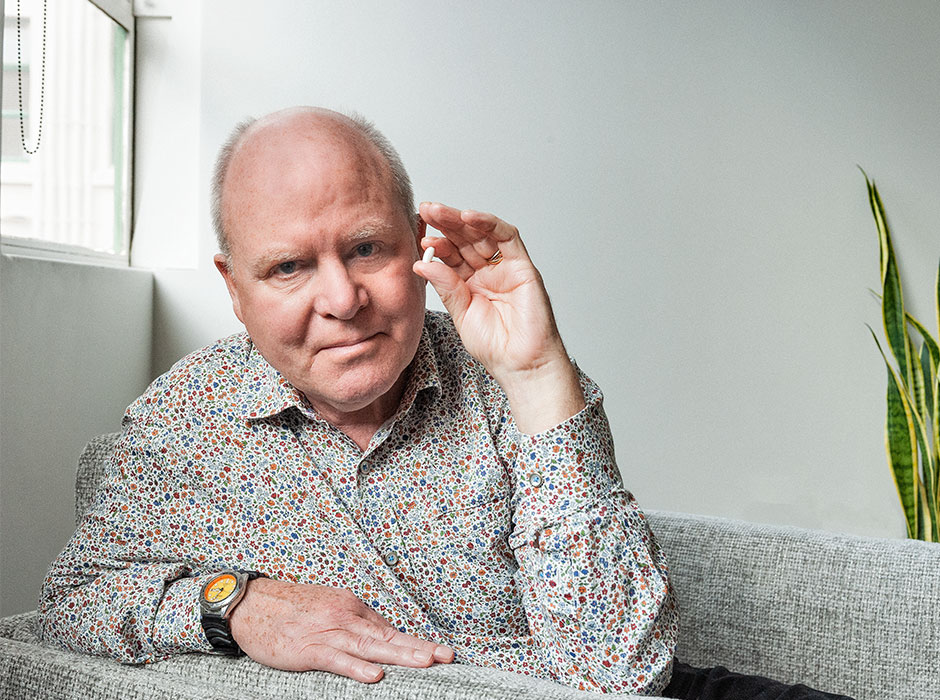
Professor Paul Glue of the Faculty of Medicine – Dunedin has collaborated with Douglas Pharmaceuticals to produce a ketamine pill for patients with treatment-resistant depression. Photo: Alan Dove
For many with treatment-resistant depression, finding an effective treatment can be a long and gruelling journey. A collaboration between Otago and Douglas Pharmaceuticals has explored an intriguing solution.
For Andrew Marshall, living with chronic depression was like being trapped beneath a heavy blanket.
“You go through life as if everything is muffled,” the 42-year-old Dunedin resident says of the mood disorder he was diagnosed with in his late teens.
“You just feel beaten down and unable to do anything.”
After struggling through a “laundry list” of medications that either did not work, did not last or came with unpleasant side-effects, Andrew found himself among the estimated 100,000 New Zealanders with treatment-resistant depression (TRD).
Six years ago, just when he feared he was out of options, he learned that Otago researchers were recruiting people with TRD to trial extended-release tablets of ketamine.
Andrew was aware of the anaesthetic’s street reputation as the illicit party drug ‘Special K’, but had also read enough to know there was growing interest in its potential for treating depression and similar disorders.
“It all sounded very intriguing, so I found out more about the trial, saw that it was going to be just like taking regular medication, then went to my GP for a referral.”
The Otago clinical pharmacologist leading the programme, Professor Paul Glue, had been closely following research on ketamine for decades.
In 2000, Yale University scientists published a landmark study showing an infusion with the drug in patients with TRD eased their symptoms within hours.
Paul says that finding alone was “pretty miraculous”, but he saw a much bigger takeaway.
It challenged a long-standing doctrine that depression is caused simply by an imbalance of serotonin and norepinephrine, the chemical messengers that antidepressants have traditionally targeted.
The Yale study showed ketamine could produce a powerful antidepressant effect through an entirely different route in the brain: influencing a family of proteins called glutamate receptors, he says.
This helped to stimulate the production of neurotrophins, which normalise the firing of brain networks and, in turn, alleviate depressive symptoms.
“At the time, the idea of a drug that interacts with glutamate receptors was just unthinkable, and it really wasn’t until several years later that a much larger study showed exactly the same effect.”
The breakthroughs sparked a flurry of new studies into ketamine.
Paul led one himself, observing the drug’s striking benefits in treating depression among late-stage cancer patients.
“It was almost like watching a magic trick. Patients were dosed and, for the first half-hour, they were very dissociated and their blood pressure went up. But after that period, their symptoms were gone. It was remarkable.”
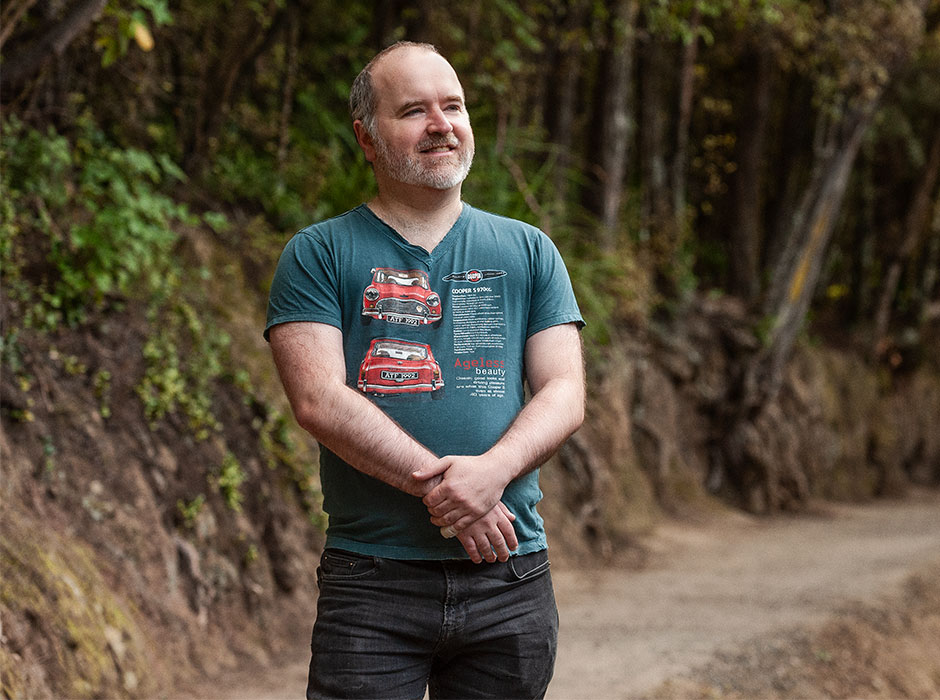
Ketamine study participant Andrew Marshall has lived with chronic depression since he was a teenager, and says this new option feels like a cure. Photo: Alan Dove
Today, ketamine is becoming an established treatment option for TRD, with Tauranga-based Anteris among thousands of private clinics around the world offering services.
But these programmes typically come at a high price, and administration of the drug, whether through lozenges, intravenous injections or nasal sprays, can still bring side-effects.
“You can be talking $800 a dose, along with having to sit around an approved clinic for a couple of hours [for side effect monitoring].”
If Aotearoa New Zealand was ever to publicly fund ketamine for depression (for which it can be currently prescribed off-label), Paul says those factors alone would place a sizeable burden on our health system.
“So, I started wondering, how can we make ketamine better tolerated, and in a form so that people can take it at home?”
In 2016, he began throwing ideas about with Dr Peter Surman, Chief Scientific Officer at Auckland-headquartered Douglas Pharmaceuticals. They discussed a single depot injection that would slowly release ketamine into the body over several weeks, before concluding a tablet would be less complicated.
Meanwhile, Paul delved into the scientific literature on various ketamine formulations to produce a meta-analysis.
“The results were very clear: if you really slow down absorption, then you can avoid a peak level of ketamine, which is what causes the dissociation effect.”
Douglas Pharmaceuticals produced an initial round of tablets for testing by Paul’s team in Dunedin. Encouraged by their delayed absorption profile and minimal side effects, they moved forward to a full-scale clinical trial, dubbed BEDROC.
“The study itself was a slightly unusual one, in that, normally what you’d do would be a head-to-head study with an active drug and a placebo,” Paul says.
“Unfortunately, those studies have a failure rate of about 50 per cent.”
Instead, the team gave all 231 participants active tablets, called R-107, for the first week. By the beginning of the second week, around three-quarters of the cohort felt well. Those whose symptoms hadn’t improved were exited from the study.
The remaining 168 participants were then divided into different groups to see which dose was most effective at preventing recurrence of depression. Over 12 weeks, they took either a range of oral doses of ketamine, or a placebo.
“I don’t think it’s an exaggeration to say that I would probably not be alive today if I wasn’t on this drug.” – Andrew Marshall
Andrew took one tablet a day over the study’s first week and recalls how quickly the ketamine cleared his symptoms.
“On day two, I started to feel an effect. By day three, I basically felt better.”
The trial’s results, published last year in the prestigious international journal Nature Medicine, showed the highest dose of ketamine (180mg) brought the greatest improvements, compared with patients who received a placebo.
“One of the biggest challenges with these types of treatments is how long the effects last, but the trial showed a lovely dose-response curve: the higher the dose, the less likely a patient was to relapse,” Paul says.
“We didn't find any individual factors like body weight, age or gender that popped out as predictors of relapse.”
Buoyed by the success, Douglas Pharmaceuticals is moving ahead to Phase 3 clinical trials, with a freshly formed subsidiary company, Tasman Therapeutics, tasked with raising nearly US$175 million (NZ$292 million) in investment.
To date, Douglas has already invested over NZ$55 million in the development of R-107.
The funding has covered all stages of the programme, from non-clinical and formulation work to clinical trials, to meet the standards of both the US Food and Drug Administration (FDA) and the European Medicines Agency.
Peter acknowledges there is much more work to do before a drug can be brought to market, but adds the new company has a head start over competitors.
“Nobody is as far along as we are. We’re the only group in the world that has strong evidence from a Phase 2 clinical trial and an open [Investigational New Drug] application with the FDA.”
He says the programme’s success to date shows how Aotearoa New Zealand’s small, collaborative research environment can produce world-leading science – and do so at pace.
“Paul’s group is very well recognised in this area, while [Douglas Pharmaceuticals] is nimble in its entrepreneurial ability so, between us, we are very well placed to move things along quickly and efficiently.”
The enterprise also marks a first for both the company and the University, with the parties entering a deal that blends research collaboration with commercial licensing terms.
The University's tech transfer company, Otago Innovation Limited, took the unusual step of investing directly in the early research, sharing the financial risk – but also the potential reward.
Otago Innovation’s Commercialisation Manager, Dr Alex Tickle, who has a background in the pharmaceutical industry, sees potential for a “blockbuster” drug pulling more than a billion dollars in sales annually.
“The potential financial return, including for the University of Otago, is significant.”
Paul expects that using ketamine for TRD, once seen as controversial, will become a more common standard of care – especially once patients can access it in slow-release tablet form.
“The fact the Health Research Council has funded a number of ketamine trials, and that we now have active research going on in Auckland, Christchurch and here in Dunedin, has put it in much more of a mainstream position.”
For Andrew, who is among more than 100 other trial participants receiving an ongoing funded supply of tablets through a “compassionate use” programme, the drug has been life-changing.
“I now take two doses a week and it doesn’t feel like a treatment, it feels like a cure,” he says.
“I’ve not had to worry about relapses. Like, if I have a bad life event, will the depression come galloping back? No, I know that I’m going to be good.”
That newfound resilience proved critical when he was diagnosed with bowel cancer several years ago. Without the treatment, a now cancer-free Andrew says he may not have had the motivation to act until it was too late.
“I don’t think it’s an exaggeration to say that I would probably not be alive today if I wasn’t on this drug.”
– Kōrero by Jamie Morton
This story first appeared in He Kitenga 2025 – Impacts. He Kitenga is the University of Otago’s flagship research publication, which showcases the University’s cutting-edge research and explores how it is making a difference to people’s lives.