
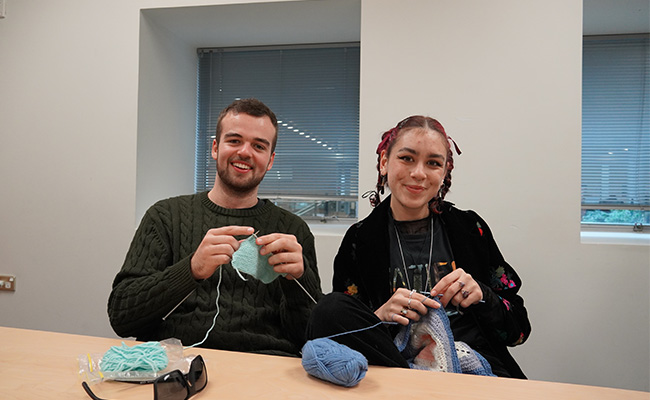
Eva and Jahman, third-year Medical students making blankets.
Pēpī in Dunedin Hospital's neonatal intensive care unit (NICU) are some of the smallest and most vulnerable members of our community, and Otago University's medical and pharmacy students are helping with their care in an unusual way.
Te Whatu Ora Southern has 16 cots in its NICU, which serves Southland and Otago babies who are born prematurely, or who need intensive care in their first three months of life.
Information from The Little Miracles Trust, a charity which supports whānau through their neonatal journey, explains that tiny babies have trouble regulating their temperature, and 100% wool knitted blankets can really help to keep them warm so that their body can focus on growing and developing.
“In contrast shop bought items made from acrylic or other synthetic fabrics can trap moisture and cause babies to cool down, rather than staying warm and dry.”

Anastasia, third-year Medical student and co-president of the knitting for the NICU club.
For a decade, groups of medical students at Otago have been coming together once a week to create beautiful handmade blankets for the babies in the NICU.
This endeavour began in 2013 when then vice-president of the Otago University Medical Students' Association, Rosie Grant, decided to combine her love of knitting with her medical education in order to “give back to the Dunedin community in a meaningful way”.
The knitting club is still going strong with roughly 30 medical and pharmacy students turning up each week to kōrero, share kai, and knit together.
Kay, a third-year medical student who attends each week wants to go into paediatrics eventually, because she loves babies and children.
“Knitting these blankets feels like a way to provide care for those who need it, before I am fully qualified to provide medical care, this is helping in a holistic sense.”

Kay, third-year Medical student who is interested in going into paediatrics.
It's also important to note that the act of knitting can have mental, emotional, and physical benefits for the knitter, says The Little Miracle Trust.
“Knitting can help to manage stress and anxiety, it can help with motor skills, and it is a meditative act that helps with relaxation.”
Eva, a third-year medical student, who is a keen crochet-er, says she has found the group beneficial as a calm break from an otherwise very strenuous course.
“I've made friends, introduced new people to knitting and crochet, and crucially, I've been able to give my brain a break.
“It feels good to make things with a purpose, and an added bonus is that it saves my closet from filling up with crochet items I don't have a use for.”
Many of the knitters describe the weekly meeting as a chance to rest, take a break from their studies and catch up with their peers.
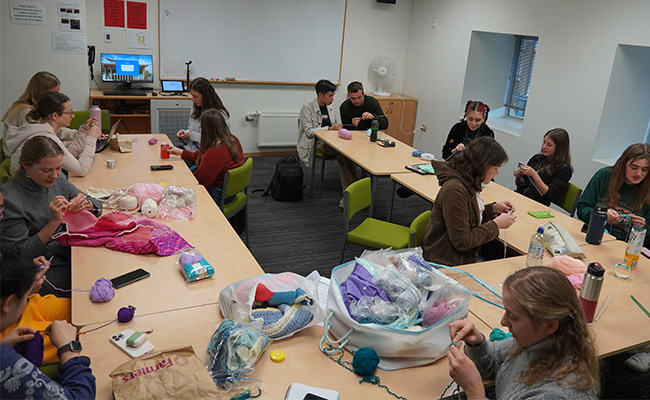
Knitting and chatting, Tiana describes the group as partly a “social gossip club, to share the tea from the week”.
Members also commonly say that as well as having social and emotional benefits for them personally and as a group, they feel they are making a contribution to their community by helping vulnerable pēpī and whānau who need support.

Anastasia's sister Victoria who is a second-year Medical student and her friend Ruiyin, a second-year Pharmacy student.
Anastasia, a third-year medical student and one of this year's group leaders, says she often feels her creativity has to take the back burner during her degree, as the mahi is so intellectually strenuous, so finding a creative outlet with a purpose has been excellent.
If you are an avid knitter and want to make something for the NICU please see the The Little Miracles Trust guidelines here, for the article about Rosie Grant in 2013 click here, and for free neonatal knitting patterns click here.
(Before you start knitting, please be aware that there are some important safety notes around pets and smoking as neonatal babies are very vulnerable to smoke or pet hair.)