
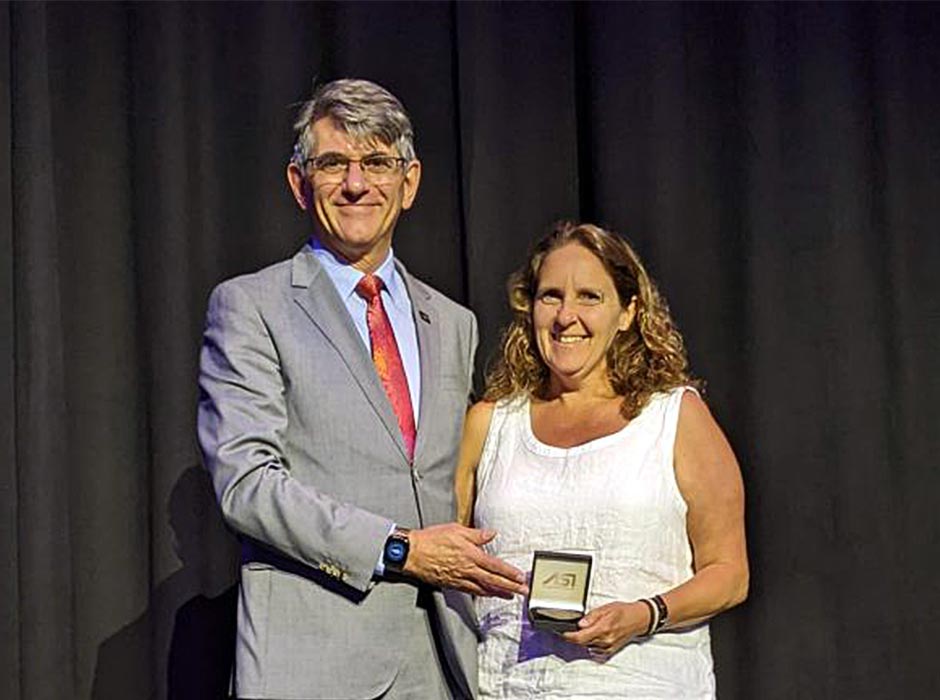
Australian and New Zealand Society for Immunology President Professor Jose Villadangos awards Professor Roslyn Kemp (Department of Microbiology and Immunology) the Derrick Rowley medal for demonstrating outstanding service to the ASI and the discipline of immunology over many years.
Professor Roslyn Kemp’s global contributions to immunology have been recognised by the Australian and New Zealand Society for Immunology (ASI).
Roslyn, of the Faculty of Biomedical Sciences, was awarded the Derrick Rowley Medal for Service to ASI at its annual meeting in Perth, Australia recently. She received the medal for demonstrating outstanding service to the Society and to the discipline of immunology over many years.
She is delighted with the accolade.
“It is a privilege to work with so many wonderful people to improve access to immunology research,” she says.
Roslyn has been an active member of ASI since she started her PhD in 1998, contributing significantly to leadership and promoting equity.
Since 2016, she has been part of the leadership of the International Union of Immunological Societies (IUIS), including in the role of Secretary-General. Her contributions to immunology have made a difference worldwide, particularly to policy on gender equity in science and open access and publishing policies.
One of her initiatives was a review process of international immunology conferences to ensure gender and geographical equity in invited speakers. Earlier this year, Roslyn and colleague Jess Borger published a paper on global perspectives to enhance strategies for advancing women in healthcare and STEMM leadership.
She says she’s proud of the international role, and for supporting the establishment of a Women’s Initiative in Australasia.
This mahi involved creating a mentoring scheme for female immunologists, personally matching over 50 partnerships across Australia and New Zealand. The effort saw her receive the New Zealand Association of Women in Sciences Miriam Dell Award for Mentoring.
She also helped set up a female speaker database, which is now providing immunology expert speakers for international audiences.
Roslyn’s research in the Department of Microbiology and Immunology at Otago looks at the unique features of different subsets of immune cells, focusing on cancer and gut-specific immune responses and how these cell subsets are involved in patient outcomes.
She and her team are currently looking specifically at T cell and myeloid cell subsets in colorectal cancer and inflammatory bowel disease, with the goal of improving cancer diagnosis, prognosis, and treatment.
– Kōrero by Claire Grant, Communications Advisor, Faculty of Biomedical Sciences
Why study Microbiology and Immunology?
Microbes comprise more than 50 per cent of the life-forms on our planet, yet only around one percent have been identified and studied. The relationship between microbes and immune cells is critical for our survival. Immunologists at Otago are investigating how we can protect humans and animals from infectious diseases by using vaccines, and the role of the immune system in non-infectious diseases such as cancer.
Read more here