
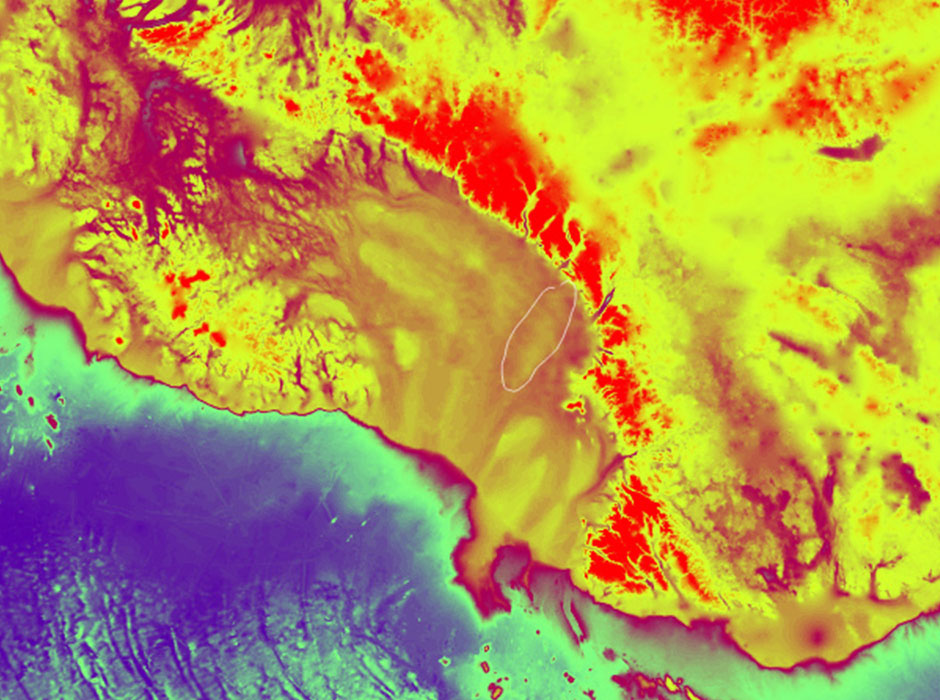
Langhorne Rise, under the Ross Ice Shelf, recognises Emerita Professor Pat Langhorne's lifetime contribution to the science of Antarctic sea-ice physics and ice-ocean interactions.
After dedicating her career to studying Antarctica – and visiting it 25 times – Emerita Professor Pat Langhorne says having a slice of the continent named after her is “beyond my wildest dreams”.
Langhorne Rise – a 320km long and 120km wide feature under the Ross Ice Shelf – was officially named by the New Zealand Geographic Board this month.

Emerita Professor Pat Langhorne
It recognises the University of Otago – Ōtākou Whakaihu Waka physicist’s lifetime contribution to the science of Antarctic sea-ice physics and ice-ocean interactions.
She describes the naming as “a very great and unexpected honour”.
“It is satisfying to get glimpse of how the world works and to have my name on a component of this puzzle is beyond my wildest dreams,” she says.
Professor Langhorne retired in 2020 but continues to publish research on Antarctic sea-ice physics and ice-ocean interactions and is actively associated with the Antarctic Science Platform. She was awarded the New Zealand Antarctic Medal in 2019.
In 2015, she published a landmark paper describing sea ice formation in the presence of supercooled ice shelf water and its relationship to global cryosphere systems – water frozen in solid form on or below land and ocean surfaces.
Langhorne Rise is connected to much of her research as it plays a role in the circulation of ocean waters and the sea-ice cycle in the western Ross Sea, including the formation of Ice Shelf Water.
Dr Stefan Jendersie, PhD graduate of Otago’s Department of Physics, now of Germany’s Leibniz Institute for Baltic Sea Research Warnemünde (IOW), says the geological feature played a crucial role in his doctoral research, which Professor Langhorne co-supervised.
“I became very tired of giving long winded descriptions of location and form every time it needed to be mentioned. It was so important but had no name,” he says.
As the Rise is directly related to Professor Langhorne’s legacy in sea ice and platelet ice research, he thought it fitting to propose it be named after her.
“The Rise forces the circulation of the vast ocean under the Ross Ice Shelf to move anti-clockwise, while almost all other ocean cavities in Antarctica circulate clockwise, which is what the laws of physics dictate. The consequence is that this ocean under the Ross Ice Shelf is much colder than most other ocean cavities.
“Without it, the ocean cavity under the Ross Ice Shelf would not be as cold as it is and the specific situation in McMurdo Sound of massive outflow of supercooled water – water below freezing temperature – with platelet ice would be very different,” Dr Jendersie says.
Professor Inga Smith, of Otago’s Department of Physics, had the pleasure of sharing the naming news with Professor Langhorne, with help from Dr Greg Leonard, of Otago’s School of Surveying, straight from Antarctica where she is undertaking fieldwork.
“It was great to be able to let Pat know the good news from Antarctica, where she taught me so much about sea ice physics and fieldwork.
“The sea ice team here as well as the wider Scott Base crew were excited to hear about the new name and Pat’s legacy,” she says.
Professor Langhorne said it was “so special” to learn about Langhorne Rise from the ice.
“When Greg arranged a meeting with Inga from Scott Base, I was sombre and prepared. I assumed it was some complex science or personnel problem to be sorted, one that was so embarrassing that Greg didn’t tell me what the issue was.
“I feel very humbled by the huge efforts that Stefan, Inga and Greg have gone to bring this to fruition. It has been an enormous privilege to work with people (like them) and to get involved in the science that they do.”