
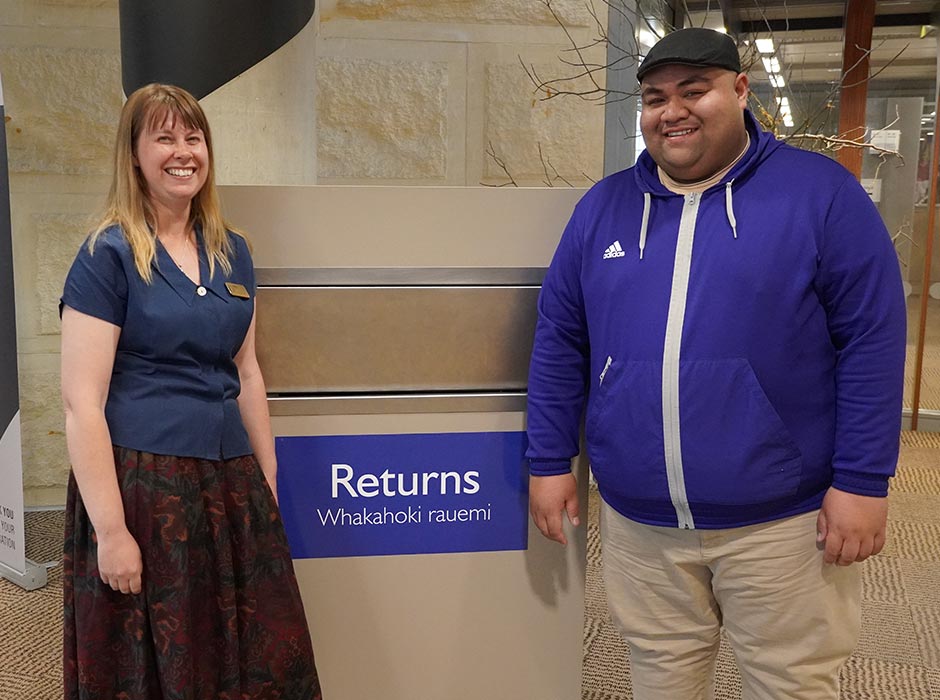
Library Engagement Manager Abbe Hyde and postgraduate student Viliami Lolotakai Ngaluafe are pleased there will be no more fines for overdue books. From now on, an account will be blocked until a late book is returned, which is a more equitable, less punitive approach, Abbe says.
The Library has spoken – fines for overdue books are now officially a thing of the past.
The recent move to scrap late fines reflects a wider movement among public and university libraries, Library Engagement Manager Abbe Hyde says.
“If you think about it, giving people a financial punishment is punitive and that’s not the role of the library.
“We’re not trying to be gatekeepers of knowledge. We want staff and students to feel safe to come and use the resources. It’s all for them.”
Fines, which are not a good deterrent in the first place, are an unequal way of punishing people, she says.
“Things happen – we’re dealing with students who are, at certain times, under the most stress of their lives. They’re living alone, they’re not with their family and then they’re hit with exams.
“Students come to the Library because they need to borrow a resource. Then they’d get whacked with a fine.”
Instead of late fines, library users – which includes University and Polytechnic kaimahi and tauira – will now face a block on borrowing further books until the late book is brought back.
“A block is a more equitable approach as it applies to everyone equally. A $30 fine is not the same to one person as another. This way, the consequence is the same for everyone, ensuring fairness.”
“We’re not trying to be gatekeepers of knowledge. We want staff and students to feel safe to come and use the resources. It’s all for them.” – Abbe Hyde
Historical fines will be waived and users will have a clean slate, however, if users have historical overdue items on their account they will see a block, she says.
“We encourage them to return the item or, if that’s not possible, email ask.library@otago.ac.nz to resolve this in a manner that’s fair for all parties so they can get back to borrowing.”
One student who is very happy to hear that fines have been scrapped is University of Otago tauira Viliami Lolotakai Ngaluafe, who graduated with a Bachelor of Arts in Pacific Studies last year and is now completing a Postgraduate Diploma in Arts in Pacific Studies.
For Viliami, library fines have always felt more like a barrier than a helpful system, he says.
“I remember times as an undergraduate when even a small fine would make me hesitate to borrow books or ask for help because there’s this pressure that builds quietly in the background.
“As a Pacific student, I know financial pressure isn’t just about me. It often connects to family responsibilities and cultural obligations. Even a few dollars can feel heavy when you’re juggling study, work, and supporting others.”
Removing fines shows that the Library trusts students and recognises the realities of their lives rather than punishing mistakes, he says.
“I feel strongly that fines don’t encourage responsibility. They can create stress, shame, and they distance students from the resources that are supposed to support their learning.”
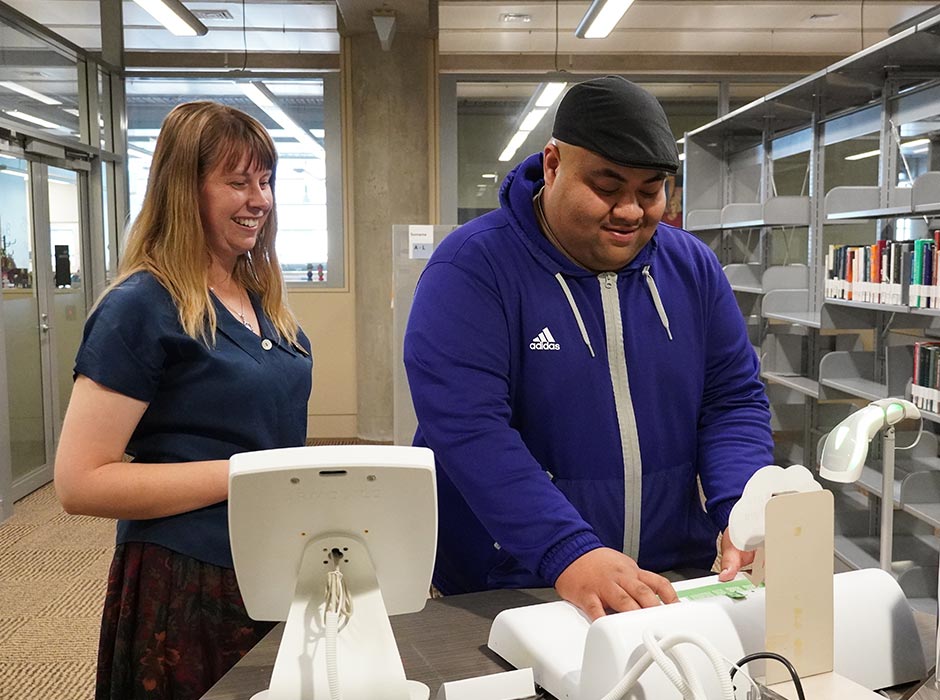
Library Engagement Manager Abbe Hyde and postgraduate student Viliami Lolotakai Ngaluafe demonstrate how to check out a book from the Reserve Collection. Reserve, which houses University textbooks, was one of the last areas still issuing fines, Abbe says.
Without the fear of fines, students would feel more confident engaging with resources, exploring new ideas, and making the most of what the Library offers, he says.
“I feel strongly that fines don’t encourage responsibility. They can create stress, shame, and they distance students from the resources that are supposed to support their learning.” – Viliami Lolotakai Ngaluafe
“It would encourage a stronger sense of community and belonging – especially for students from diverse backgrounds – and signal that the Library is a place where everyone can thrive and succeed.”
This is certainly what Library staff hope to achieve.
“Not assuming the worst of people fosters goodwill – there are stats on it – and we want the Library to be a safe space for our community,” Abbe says.
“We hope to see the same, if not better, behaviour in returning books. The change isn’t about lowering expectations; it’s about removing barriers while maintaining accountability for returning items.”
– Kōrero by Internal Communications Adviser Laura Hewson
University of Otago Library
The Library provides high quality information resources and services, recognising the diversity and needs of all stakeholders.
Library services & resources