
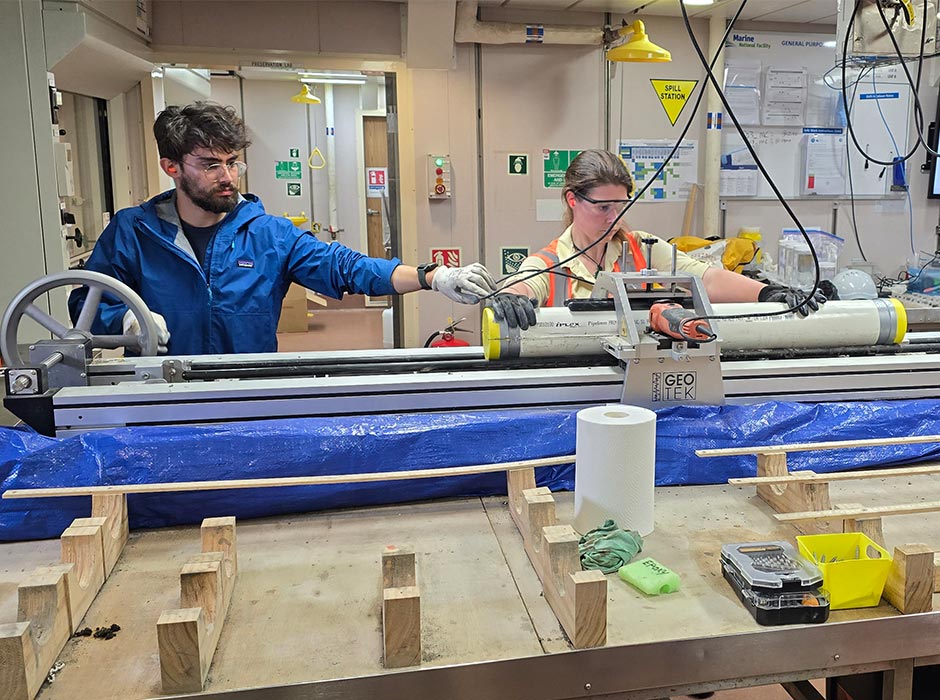
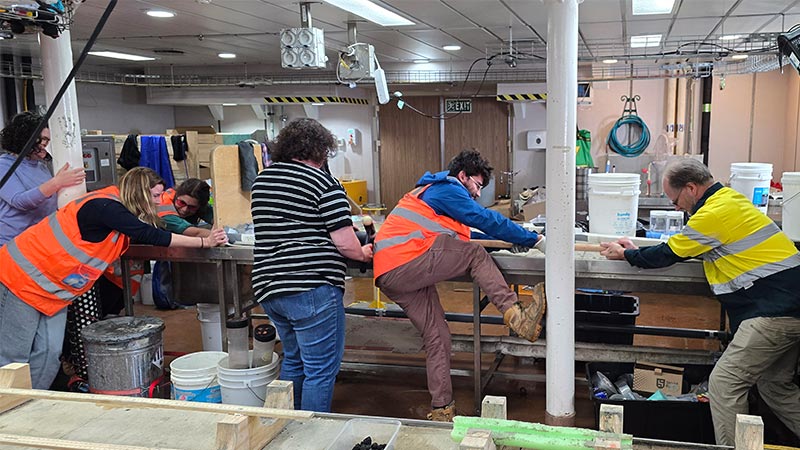
Geology PhD student Rachael Baxter steadies a tube of core extracted using a multi corer on board the research vessel, Investigator.
Two Otago researchers have recently returned to shore after spending weeks at sea exploring the aftermath of a devastating volcanic eruption.
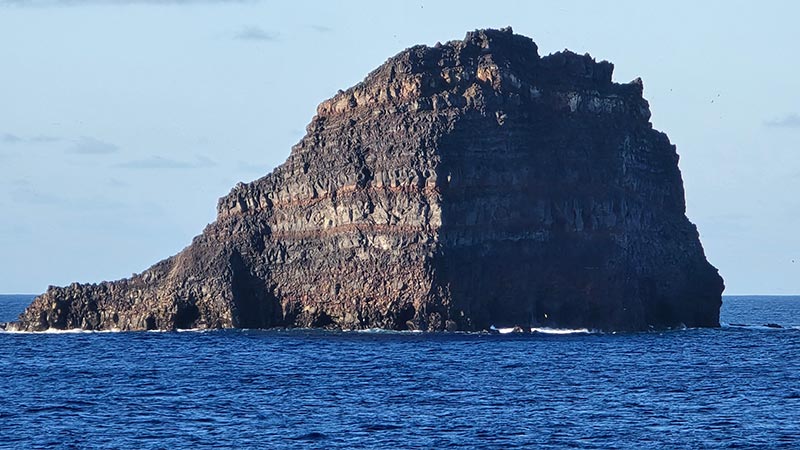
Professor James White and PhD student Rachael Baxter were part of an international team of 40 researchers who studied the areas surrounding the Hunga Volcano, the Tongan underwater volcano that erupted in 2022.
The eruption blast sent an ash column 58km into the sky, triggered a Pacific-wide tsunami and blanketed 100km of seafloor around the volcano, as well as nearby Tongan islands, with fine volcanic ash.
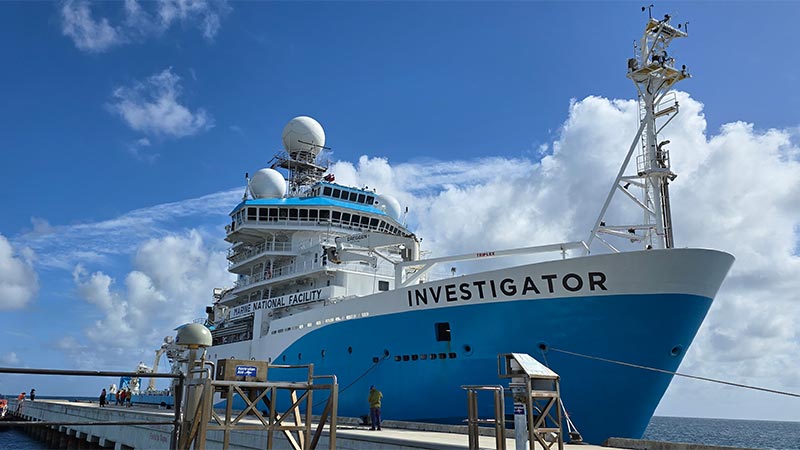
The research team was led by the University of Tasmania on board Australia’s Commonwealth Scientific and Industrial Research Organisation (CSIRO) research vessel (RV) Investigator.
James says there were multiple teams working to answer the same question; how did the eruption take place?
“The height of the eruption plume was unusual, as was the amount of lightning,” he says.
“There was also a relatively low addition to the atmosphere of sulfur, which is one of the things that we look for in ice cores, and is an indicator of big volcanic eruptions.”
James was on board for the final two weeks of the voyage, while Rachael was there the full five weeks.
She assisted with a range of tasks, including working sediment cores, which are collected in a tube at the seafloor and show the layers of earth below the surface.
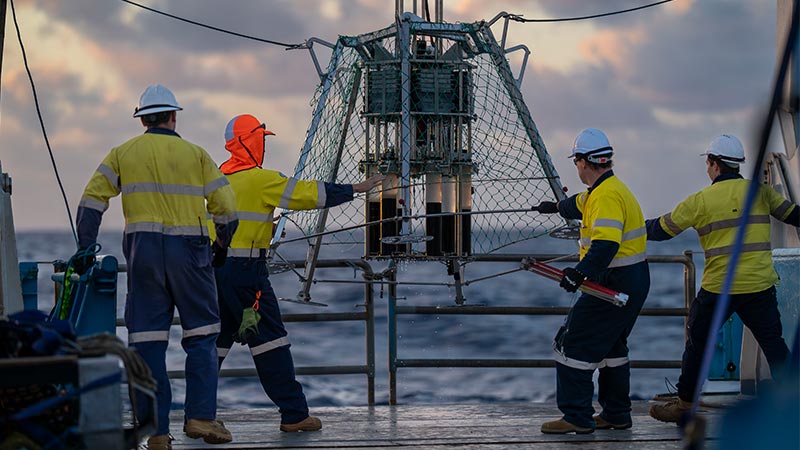
They were collected multiple times a day using a multi corer and piston corer.
A multi corer allows six samples of about 30cm-50cm to be gathered from the same place at once.
It has heavy weights on top and pushes the tubes into the seafloor. The process takes much longer when using a piston corer, which consists of one longer tube of 6m-7m dropped into the seafloor with force from as much as 10m above.
The downside of a piston corer is that the pressure exerted when it hits can splash away the top layer of seafloor sediment, losing information about the most recent seafloor events.
Once the cores were collected, they could be used on board in many ways.
“Different people had different things they were looking for,” Rachael says.
“The biologists were trying to look for any critters in the top part of the sediment, and there were the micropalaeontologists who would look for old dead critters all the way through.
“Seeing so many different areas at work, even in science that I’m not usually involved in, was really interesting.”
About 80 multi corers (each with six cores), were deployed during the voyage, including seven on the final day. Researchers worked around the clock in two shifts – Rachael was part of the 2pm to 2am crew.
Although that made for an unusual sleep schedule, it kept the research running smoothly and consistently, she says.
“Some of the other groups had slightly different hours depending on what they were doing but everything was set up just to keep things rolling nicely.”
Her main role in the research will start now, back on land in the lab.
She is in the process of drying a core so she can look for particles that are 60 to 90 microns in size.
“I’ll look at both the shape of the particles and the fractures on the surface. We can use fractography, which is like what forensic scientists use, to understand what processes might have been involved in breaking them apart, and how intensely.
“Hopefully that will tell us a bit more about what was going on during the eruption.”
This research was supported by a grant of sea time on RV Investigator from Australia’s Marine National Facility, national collaborative research infrastructure operated by CSIRO, Australia’s national science agency.
Department of Geology
As one of New Zealand's leading geoscience departments, Otago offers an active postgraduate programme and practical undergraduate foundation. Graduates are in high demand as society shifts to a low-carbon future.
Find out more