
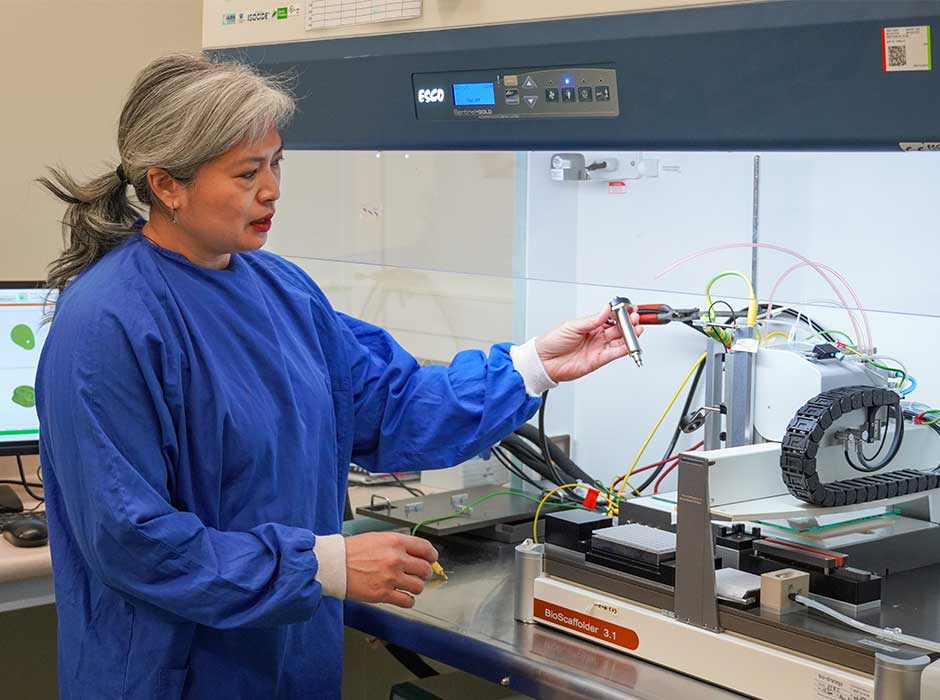
Associate Professor Jaydee Cabral uses a University of Otago 3D printer to test the feasibility of bioprinting human tissue for wound healing.
Associate Professor Jaydee Cabral likens 3D bioprinting to baking a cake, but her research is anything but simple. From wound dressings and scar-preventing gels to bio-printed nipples and patient avatars, the University of Otago biomedical scientist is helping push science fiction into medical reality. Until recently based in the Faculty of Biomedical Sciences, Jaydee is now part of the Faculty of Dentistry.
Ask Associate Professor Jaydee Cabral how she creates something as complex as human tissue and she’ll offer a disarmingly simple analogy.
“It’s like baking a cake,” says the University of Otago biomedical scientist, whose rapidly advancing field of 3D bioprinting bridges biology, chemistry and engineering.
The process comes down to three key ingredients.
There’s bioink: a biocompatible gel that, much like flour and sugar, acts as a scaffold and provides structure for the tissue you’re trying to create.
The cake’s “yeast and eggs” are the cells of interest: the living components needed for the specific tissue.
“And lastly, instead of baking soda, we have bioactives, which are molecules like growth factors that help guide the cells to do what you want them to do.”
Today, 3D bioprinting has progressed to creating thin tissues such as skin grafts, cartilage and bone.
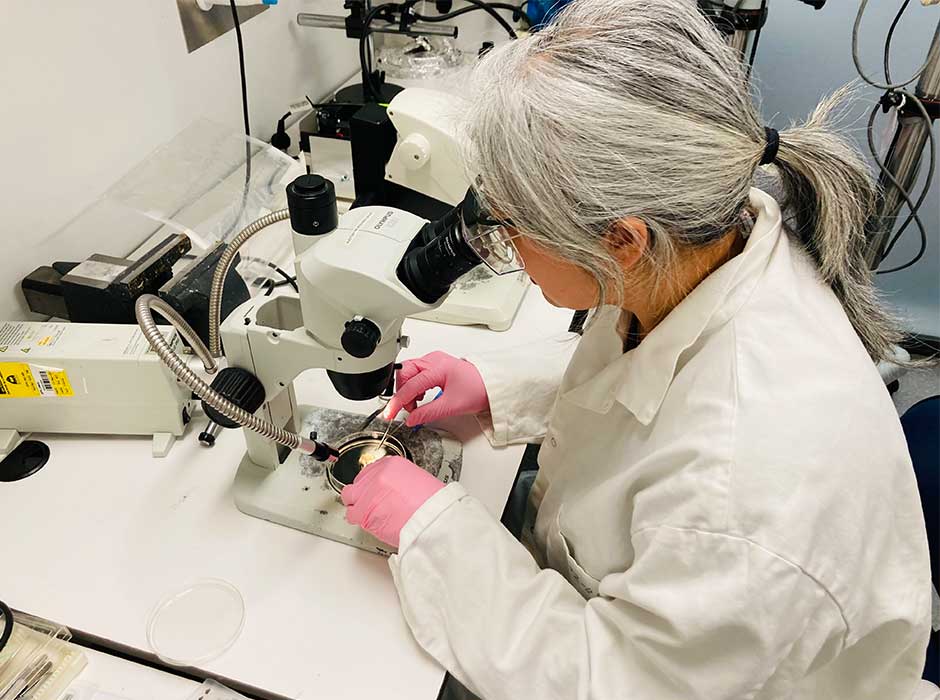
Associate Professor Jaydee Cabral studies cochlea tissue for a medical device development project to treat hearing loss.
Eventually, Jaydee says, it may be possible to print complex organs that mimic human functions, sparing patients long waits on organ donor lists.
When she explains this to people outside her field, they often turn their imaginations to machines from science fiction, such as the replicators of Star Trek.
While a future where body parts can be simply bio-printed is still distant, Jaydee points out how far the field has come within just two decades.
Early efforts involved laying down cells in flat layers. With leaps in 3D printing technology, scientists can now arrange different cell types, and the materials that support them, into life-like three-dimensional tissue.
Jaydee’s lab uses a state-of-the-art GeSiM 3.1 Bioscaffolder: a robotic workhorse that swaps print heads to build intricate three-dimensional structures, layer by layer.
The biggest technical hurdle, she says, remains vascularisation: integrating tiny blood vessels into printed tissue.
“Essentially, you need the plumbing to feed the cells in these thicker constructs and take the waste away.”
That challenge is the reason current successes in tissue engineering are still limited to ‘thin’ tissues, like bladders and skin and tracheal tissue – and it’s one her lab has been trying to tackle with several projects.
From wound dressings to printed nipples
One programme, funded by a Health Research Council Explorer Grant and a Lottery Health Research Grant, produced a “living dressing” for chronic, non-healing wounds.
That involved printing two bioinks at once: one containing endothelial cells, which form blood vessels, and another made of mesenchymal stem cells for structural support.
The result was a vessel lumen: a hollow centre that can quickly integrate with the body’s blood supply.
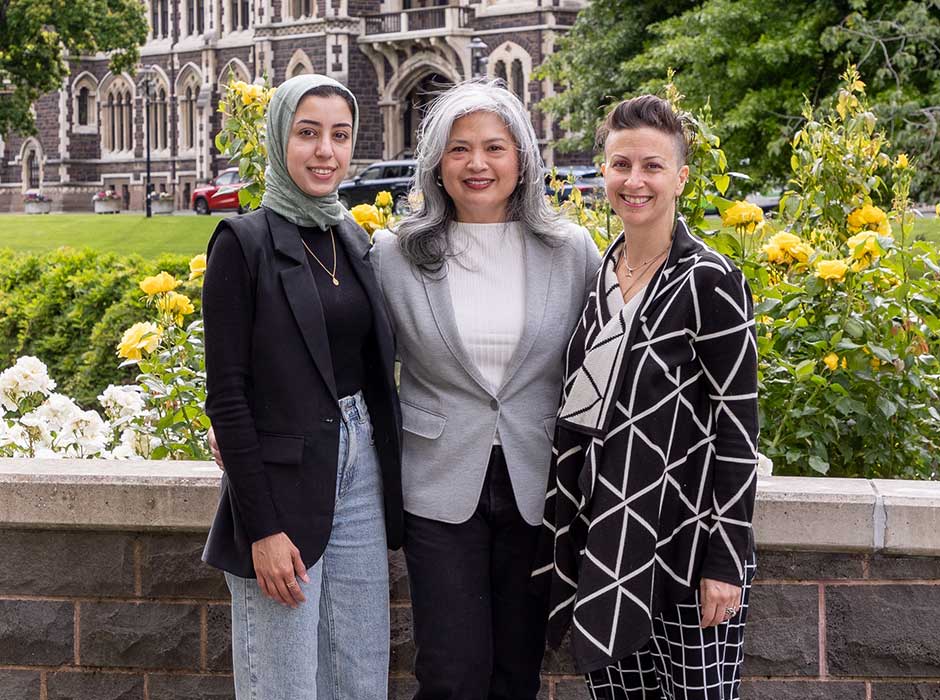
Associate Professor Jaydee Cabral alongside post-doctoral fellow Dr Mina Rajabi and PhD student Alex Leonard. The team is using the bioprinter to build new living tissue for tissue repair and disease modelling.
Jaydee was also a key researcher in a Ministry of Business, Innovation and Employment-funded project that developed Chitogel, a hydrogel system now used as a surgical aid to help prevent post-operative scarring.
That platform has enabled her lab to move into more ambitious terrain, including the bioprinting of nipples for breast reconstruction surgery.
“Currently on the market, there’s nothing available for women. There’s just tattooing, or a flap suture procedure, in which the nipple loses its mechanical integrity,” she says.
“Ideally, we would be able to scan a woman, recreate what she had, and 3D print it if she were to do breast reconstruction.”
With collaborators including Professor John Fisher, director of the Centre for Engineering Complex Tissues at the University of Maryland in the United States, Jaydee is developing special bioreactors to help mature these thicket-printed nipple constructs.
Jaydee acknowledges it’s a surprisingly neglected area of research.
“For whatever reason, it’s not been on anybody’s radar. That’s bizarre when you consider how long women have been having mastectomies,” she says.
“It’s almost like, ‘oh, this is just the way it is’. But now it doesn’t have to be.”
Elsewhere, Jaydee is working with the University of Auckland’s Professor Peter Thorne on a potential device for targeted drug delivery to the inner ear, designed to overcome the limitations of current treatments for hearing loss.
A Translation Research Grant is supporting another project to print a medical device to treatprecancerous cervical lesions.
Her students, meanwhile, have experimented with intervertebral disc replacements and methods for growing branched blood vessels, using combinations of 3D printing and moulding techniques.
As for how far science is from creating fully bio-printed organs, Jaydee thinks this possible: although not yet at adult scale.
“I think the first prototypes will be a miniature version. It won’t be an adult-size version. And the scale-up will be the challenge.”
She is equally focused on another potential use: patient avatars.
“I’m fascinated by disease processes and drug discovery – and the idea of creating a patient avatar so that we could test standard drugs and be able to tell a patient, ‘okay, you can use drugs A and B, but not C’, and they don’t have to go through deleterious side effects with a drug that doesn’t kill their cancer.”
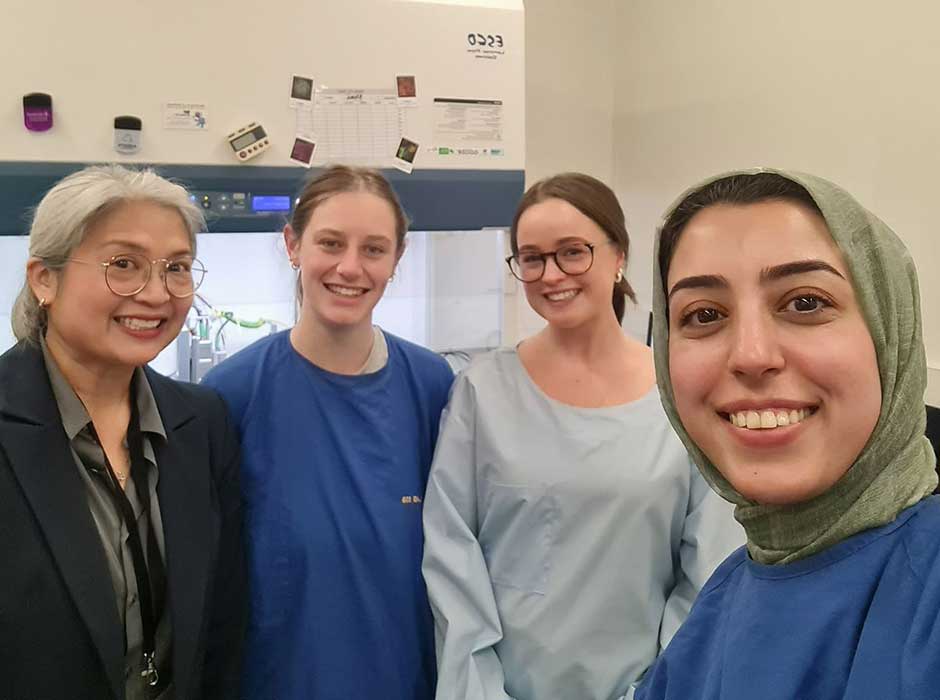
Associate Professor Jaydee Cabral and her Master's students Emma Managh and Caitlin O’Donnell, with post-doctoral fellow Dr Mina Rajabi. The team is in front of the bioprinter, which is being used to build new living tissue for tissue repair and disease modelling.
Jaydee’s broad research portfolio reflects her problem-solving instinct. Clinicians often approach her with unmet needs, she says, and she thrives on pulling together collaborators across disciplines to tackle them.
“I’m not the expert in everything, and I’ll be the first to say that. But I am happy to tap the shoulder of the person that is, and have them join our team, and then we can work together to make something great.”
That openness has helped her overcome the silos she first encountered when arriving in Dunedin from the United States.
“I cold called so many people saying, hey, I want to do this, you’re the expert in this, or you have the cells, or you have the material, and everybody said yes to me. So that part was great, but it was really pulling people out of their silos.”
Now, she says, “Oceania is here to play.” Jaydee was recently guest editor for a special issue of the scientific journal Tissue Engineering on research from Australia and New Zealand, reflecting growing international recognition.
If Jaydee’s research seems all-consuming, her other passion might seem even more surprising: ice hockey.
“I didn’t actually start playing ice hockey until I moved here,” she says with a laugh.
She first played inline hockey in California, but it was her husband, Bret, who grew up on the ice in Colorado and Minnesota, who introduced her fully to the sport.
After settling in Dunedin with their young children, hockey quickly became a family affair, with Bret coaching their boys at regional, national, and international levels.
She later joined as an assistant coach, a role that eventually paved the way for her selection as assistant coach of the New Zealand U18 women’s team, who went on to win a gold medal in 2024.
She is now assistant coach of the Dunedin Thunder men’s team and of the New Zealand under-18 women’s side, which will compete in January next year in Istanbul.
For her, there are parallels between the rink and the lab. Both demand teamwork, persistence and strategy. Both also thrive on the buzz of progress.
“I love lighting that fire. I love what I do, and then that’s contagious, and I pass it on to my students. It is exciting. It’s complex, interesting.
“If you love problem-solving, if you love working in a team dynamic with lots of different experts, and bringing people together towards a common goal, then it’s great.”
Keen to learn more about Jaydee's work?
The Cabral lab has a particular interest in the development of biomaterials, medical hydrogels, tissue engineering, regenerative medicine, and medical devices.
Find out more